





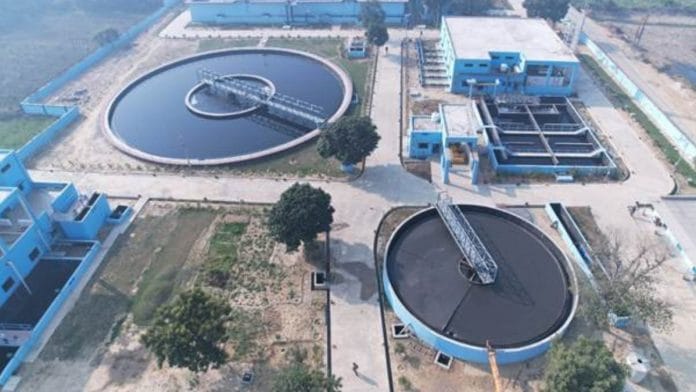



New Delhi: More than 25 per cent of the total capacity of Delhi’s sewage treatment plants and 67 per cent of the Common Effluent Treatment Plants remain unused in the city, states the Delhi Economic Survey released on Monday. The development means that despite having built capacity, a significant amount of untreated waste still enters the Yamuna.
“The river Yamuna, the reason for Delhi’s existence, has suffered heavily from pollution, which is due to the flow of untreated / partially treated sewage and Industrial effluents,” states the survey.
Released ahead of the Budget Session that began on 23 March, the Economic Survey provided an overview of the government’s existing projects in several sectors, including environment, forests, air and water pollution.
The 22-km stretch of the Yamuna in Delhi, from Wazirabad to the Okhla barrage, accounts for the majority of its pollution load. The Economic Survey, in its ‘Water Pollution’ section, addressed how the water quality in the Yamuna, as well as the drains that fall into it, does not meet the safe standards of biochemical oxygen demand (BOD) and chemical oxygen demand (COD) for either aquatic life or organic matter.
As the Yamuna was covered in thick, pink froth last week and activists flagged untreated wastewater from dyeing industries entering the river, the survey states that the existing sewage and effluent treatment facilities in Delhi are still being underutilised. It also highlights other measures, such as banning idol immersions and solid waste dumping in the river, and protecting the Yamuna floodplains from encroachment.
However, the survey did not mention the Rs 9000-crore Yamuna Rejuvenation Plan approved by CM Rekha Gupta in 2025.
The biggest source of Yamuna pollution is the entry of untreated wastewater from 22 drains that pour into the Yamuna in Delhi, with the Najafgarh and Shahdara drains being the major ones. There are two main aspects of the Delhi government’s plan to tackle this pollution: increasing sewage treatment capacity and intercepting these drains through sewage treatment plants (STPs) before they reach the Yamuna.
However, according to the Economic Survey, the government is lacking in implementing both measures.
Also read: After pink Yamuna froth, blue ‘chemical cocktail’ in a Noida gali. Residents are used to it
10 drains yet to be trapped
Delhi currently has the capacity to treat 794 million gallons of sewage per day (MGD). But only 584 MGD of sewage is actually being treated, leaving 26.4 per cent of our sewage treatment capacity idle.
At the same time, the government is constructing three new STPs and upgrading 18 STPs to increase their total capacity from 343 MGD to 456 MGD. The proposed timeline for this upgradation is December 2026, when the Economic Survey states that Delhi’s sewage treatment capacity will be sufficient to tackle the polluted sewage.
However, the Economic Survey did not address the current lag of 26 per cent in the use of the existing STPs.
A constant source of pollution, the Najafgarh drain, is constantly fed by 102 sub-drains across the city. In 2011, a plan was approved for the Delhi Jal Board to lay ‘interceptor sewers’ to divert or intercept the sewage from these drains directly to STPs. It was only in September 2025 that this process of laying the sewers was complete. However, these sewers—capable of diverting 242 million gallons of sewage per day—are still not functional, and none of the wastewater is being treated.
“The treatment of 242 MGD of sewage as planned will take place after construction/rehabilitation of Coronation Pillar & Rithala and Kondli sewage treatment plants,” states the Economic Survey.
Even for the other 20 drains that fall directly into the Yamuna, only 10 have been intercepted and their wastewater directed to an STP. The remaining 10 drains, including the Tughlakabad, Barapullah, Delhi Gate and Mori Gate, are yet to be diverted and trapped.
For some of these projects, the land identification for laying the drains is still in progress, while some others are scheduled to be completed by 2027.
(Edited by Saptak Datta)