



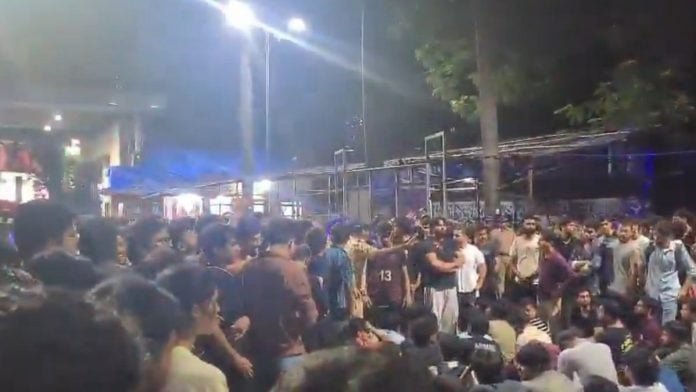
New Delhi: The suicide of 20-year-old IIT Bombay student Sahil Wakode has spiralled into a controversy over alleged caste discrimination, with protests on campus, his parents filing an FIR under the SC/ST Act against a professor and others, and the probe now transferred to the Mumbai Crime Branch. But student suicides are hardly a new issue at the IITs.
At least eight have been reported across the institutes between January and September this year, with two other student deaths also investigated as possible suicides.
Wakode’s was the third student suicide at IIT Bombay this year. He died on 18 September, hours after he was allegedly caught uploading the question paper to ChatGPT on his phone for answers. After his parents alleged caste discrimination, IIT Bombay apologised for sharing details about the circumstances preceding his death and suspended Prof Suryanarayana Doolla from his post as dean pending the investigation.
In recent years, student suicides at the IITs have intermittently triggered protests and inquiries. Many have been linked to academic pressure. Last December, an RTI query filed by IIT Kanpur alumnus Dheeraj Singh showed that 65 students had died by suicide across the IITs between 2021 and 2025. About 40 of those deaths reportedly came after the Union government issued guidelines to higher-education institutions on students’ emotional and mental well-being and suicide prevention.
In June this year, a government release said a national task force constituted by the Supreme Court to examine the “rising incidence” of student suicides in higher-education institutions had visited 30 institutions in 10 states to hold consultations on issues such as caste discrimination, disability and mental health.
ThePrint looks at the circumstances and fallout of the other IIT student suicides reported so far this year.
Also Read: Student suicide: IIT Bombay apologises for earlier statement, suspends deanship of professor
Ramswaroop Ishram, IIT Kanpur
On 20 January, 25-year-old PhD scholar Ramswaroop Ishram died by suicide after jumping from the sixth floor of a campus building. Police said no suicide note was found and that he had been undergoing counselling for anxiety.
“With profound sorrow, IIT-Kanpur mourns the tragic and untimely demise of Ramswaroop Ishram, a PhD scholar in the department of earth sciences. He was a promising researcher who joined the institute in July 2023,” IIT Kanpur said in the statement.
According to reports, around 300 students held a candlelight vigil and accused IIT Kanpur of inadequate mental health support. IIT Kanpur said Ishram had been diagnosed with bipolar disorder and was undergoing treatment. It also set up an internal committee to examine the circumstances of his death. Ishram’s suicide was the second one at IIT Kanpur in a month.
Naman Agarwal, IIT Bombay
On 4 February, 21-year-old second-year BTech student Naman Agarwal died after falling from the terrace of Hostel 4 at IIT Bombay. A handwritten note was recovered from his room and police said he was undergoing treatment for depression.
IIT Bombay director Shireesh Kedare said he was academically on track, with a CGPA above 7, and there was no indication that academic performance was a problem.
Harshit Swami, IIT Delhi
On 12 March, 19-year-old first-year BTech Civil Engineering student Harshit Swami was found dead in a campus apartment where he lived with his mother. No suicide note was found. Police registered an abetment case against unknown persons, in line with a 2025 Supreme Court order requiring detailed investigation of campus suicides.
Police said Swami had been struggling academically, and his mother had been allowed to stay with him on campus for support but had left before the incident. His father told police he did not suspect any kind of foul play.
Jayveersinh Dodiya, IIT Kharagpur
Twenty-one-year-old Jayveersinh Dodiya, a third-year BTech student in Ocean Engineering and Naval Architecture, died on 18 April after falling from the terrace of the Atal Bihari Vajpayee Hall of Residence.
A fact-finding committee later said he had been facing academic difficulties while also preparing for the CFA examination. It also recommended that the institute install grilles on balconies. His family, however, disputed mere academic stress as the cause, claiming that “situational pressure” from the institute or “outside forces” may have been responsible.
Soham Haldar, IIT Kharagpur
On 28 April, 22-year-old Soham Haldar, a fourth-year dual-degree student in Electronics and Electrical Communication Engineering, was found dead in his hostel room. It was 10 days after Jayveersinh Dodiya’s death.
The two deaths in quick succession led to IIT Kharagpur holding an open house with students and announcing a grievance system requiring academic and non-academic complaints to be flagged within 48 hours. Students reportedly raised concerns about faculty harassment, academic stress and insensitive handling of personal or medical crises.
Mohit Kumar, IIT Roorkee
On 10 May, Mohit Kumar, a PhD scholar in Electronics and Communication Engineering, was found dead in the Ganga canal near Asafnagar after being reported missing. Police suspected suicide but said all angles were being investigated. No note was found and the death has not been confirmed as a suicide.
Ritesh Raj Singh, IIT Guwahati
Ritesh Raj Singh, a third-year BTech student in Computer Science and Engineering, died on 26 July after falling from the fifth floor of a campus building. Police said suicide was one possibility but were examining other angles too. Singh had an excellent academic record and had reportedly been “cheerful” after recently bagging an internship with Goldman Sachs.
Sohil Rajkumar Sangwan, IIT Bombay
A 20-year-old second-year BTech student in Materials Science and Engineering, Sohil Rajkumar Sangwan was found dead in his hostel room on 28 July.
No suicide note was found, but police recovered handwritten romantic poems and writings on depression. Police said they suspected a “failed relationship” may have been behind the “extreme step”.
Rishikesh Kumar, IIT Delhi
Thirty-one-year-old MSc Physics student Rishikesh Kumar died on 22 August after falling from the sixth floor of IIT Delhi’s Lecture Hall Complex. No suicide note was found. Police registered an abetment case against unknown persons.
Protests on campus ensued, with students demanding an independent inquiry and the resignation of four IIT officials for not helping him with mental health issues. It was reported that students had scrawled on a wall: “We are students, not cogs in your machine.” IIT Delhi later reconstituted its inquiry panel under retired Delhi High Court judge Justice Mukta Gupta.
Kumar’s brother Abhishek said that his brother had become increasingly withdrawn in the week before his death and had started “feeling like a complete failure in life”. Kumar had also repeatedly told his mother that he was a “big loser” and had been having suicidal thoughts.
In the case of Sahil Wakode, his family said that he had been doing well academically. The IIT Bombay statement claimed that Wakode had been counselled after the exam incident and had been assured that “the incident would not adversely affect his academic career.”
(Edited by Asavari Singh)