





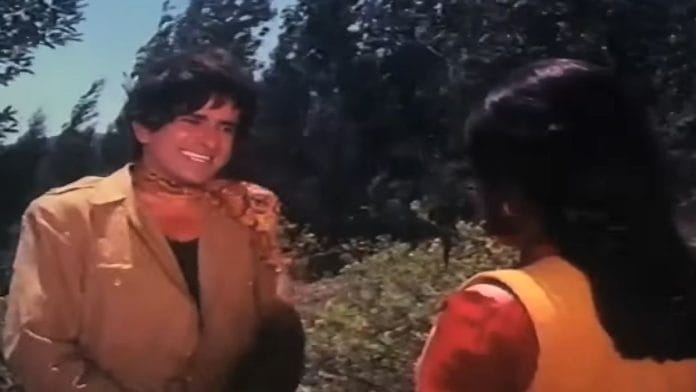



The human-animal trope was quite popular in the 70s, with films such as Haathi Mere Saathi and Banphool tasting commercial success. Shashi Kapoor’s Jaanwar Aur Insaan (1972) also made its way to the big screen.
But, unlike the popular films of that era, which focused on the heartwarming bond between humans and animals, Jaanwar Aur Insaan took a different route. Directed by Tapi Chanakya, it placed man and the wild in direct confrontation.
Jaanwar Aur Insaan was an over-ambitious project; it was a cocktail gone wrong due to too many ingredients.
There are tiger attacks, romance, social drama, family rivalry, and more. Unfortunately, the script fails to fully articulate or do justice to these plotlines. They just linger in the background.
Jaanwar Aur Insaan feels torn between being a socially aware thriller and a mainstream entertainer, which is why the execution falters multiple times throughout its 2.5-hour runtime.
Jaanwar Aur Insaan follows the life of Shekhar (played by Shashi Kapoor), an English-speaking landlord whose character is the typical archetype of 1970s hero. He is a fun and morally upright man, who is burdened with a sense of duty toward his land and people.
His village is terrorised by a man-eating tiger, which poses risk to cattle and humans alike. Shekhar is bound to defend his people, even if doing so puts his own life, or that of his family, at risk.
Rakhee and the music
With films like Abhinetri (1970) and Sharmeelee (1971), Kapoor had established a romantic appeal. But, here, he takes on a far less conventional and less glamorised role.
The screenplay positions him as a protector and a vulnerable target as well, pulling the audience into a tense and unpredictable clash, pitting human strategy against the tiger’s animal instinct.
A particular scene from the film captures the human-animal interaction with gripping intensity, keeping the audience engaged. Shekhar, washing his face by the river, suddenly spots the tiger’s reflection.
Rakhee Gulzar, who was just two years old in the industry following her Hindi debut with Jeevan Mrityu in 1970, plays Meena, Shekhar’s love interest. Her role doesn’t have the same arc as Kapoor, but their chemistry is appealing. The duo also worked in Sharmeelee, Kabhi Kabhie (1976), Doosara Aadmi (1977), Baseraa (1981), and Pighalta Aasman (1985).
The music, composed by Kalyanji-Anandji, is melodious and fits the rhythm of the storyline. But the album is not a memorable one. Songs like Mujhe Aisi Mili Hasina and Jane Mujhe Kya Hua Re fail to evoke nostalgia today.
Also read: Shyam Benegal’s Bhumika is a raw portrait of a female film star’s turbulent life
Riding on the tiger
The primary selling point of Jaanwar Aur Insaan for the audience of 1972 was its tiger sequences. It was the pre-CGI era, hence, Janwar Aur Insaan depended on real animals and practical effects. This makes the scenes of the tiger lurking in the village and the encounters extremely raw.
Close-up shots of the tiger’s eyes and the charged pauses before each attack are captivating. At the same time, the film occasionally slips into sensationalism, using the tiger almost as a gimmick just to keep the audience on the edge of their seats.
The film’s pacing is uneven. The first half builds suspense effectively, combining village politics, romance, and the looming tiger threat.
But the second half loses momentum. There is a new generation introduced, Shekhar and Meena’s son. And, the next couple of minutes are entirely dedicated to establishing his equation with the wildlife. Sujit Kumar, who plays the villain Mohan, returns to the storyline for the third time and has no significant contribution to the pace or the thrill.
Some supporting characters like Raju and Champakali, the servants who live in Shekhar’s house and bring laughter moments in the film, are underwritten.
Janwar Aur Insaan is not perfect. It’s a by-product of its time. It is ambitious, uneven, and occasionally melodramatic, but the central idea of man versus wild is compelling.
Views are personal.
(Edited by Aamaan Alam Khan)