





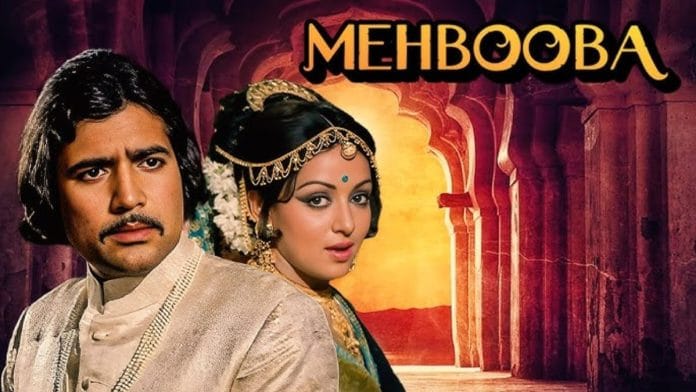



Reincarnation has remained a favourite Bollywood trope, from Madhumati in 1958 to Karz in 1981, and Om Shanti Om in 2007. The 1976 film Mehbooba, directed by Shakti Samanta, too used the theme to depict timeless love and justice. Samanta was known for creating memorable romances on screen such as Kashmir Ki Kali (1964), Aradhana (1969) and Amar Prem (1971). Ironically, his film on reincarnation does not match his otherwise illustrious career.
Mehbooba is also the beginning of the end of a superstar’s career. It was among a string of flops in Rajesh Khanna’s filmography. According to Yasser Usman’s Rajesh Khanna: The Untold Story of India’s First Superstar, Mehbooba is considered the tragedy point of Khanna’s career. By 1976, Amitabh Bachchan’s angry young man image had fully captured the audience’s imagination and there was little space left for stories like Mehbooba that felt heavy with their period drama treatment.
Mehbooba is the story of Suraj (Rajesh Khanna), a singer who is gifted a tanpura by his fiancée’s father. Soon, he starts hearing a haunting song at night. One day, while going for a stage show, he is stuck in heavy rain,and spends the night in a small hotel, where he meets a mysterious woman, Ratna (Hema Malini).
He sees Ratna singing the same song he often hears at night, and walking toward a dilapidated palace. Suraj follows her into the haveli and calls out her name. But to his shock, an old keeper of the palace tells Suraj that Ratna died more than 1,000 years ago.
As he wanders around the palace, a picture of Ratna brings back a flood of memories about his past life when he was a court singer. He had been in love with Ratna, a court dancer, and despite fierce opposition from those around them, the two tried to elope. They were eventually chased down and killed.
How Suraj meets Ratna’s reincarnated self, Jhumri, and their love story is finally completed, forms the rest of the melodrama.
High expectations, low reward
Mehbooba was Khanna’s fourth film with Shakti Samanta after Aradhana (1969), Kati Patang (1970), and Amar Prem (1971). Over the years, Samanta had developed a reputation for bringing out the best of Khanna, creating masterpieces. But Mehbooba does not feature in that list. A big-budget film with a hit music track failed to draw audiences despite Khanna giving all he had to make it a blockbuster.
According to Usman’s book, it was reported in the film magazines that Khanna used all his remaining goodwill and influence in the industry to garner good reviews from trade pundits and critics. “The bar was raised and this hugely anticipated film had immense expectations to meet. Rajesh Khanna’s stature was at stake.”
The film is not just long but also takes too much time to reach its conclusion.
Khanna plays the tortured singer role with remarkable ease, with an unkempt appearance and distraught eyes. He is also seamless in the change from an urban performer to a court singer, singing classical songs.
Malini gets to play two very different personalities–as Ratna, she is sacrificial, soft spoken but Jhumri is fiery, and assertive. She also resists Appa’s advances (Prem Chopra) when he tries to assert his dominance as her suitor.
Despite the Khanna-Malini chemistry, the repetition of ‘Mere Naina Swaan Bhadon’ to indicate the long-lost love begins to get distracting.
Samanta excels in showing that no matter the age, faultlines of class, caste, social strata and communities keep lovers apart. Eras may change, but society’s preoccupation with ‘honour’ causes young lovers to meet tragic ends.
But in other areas, he completely misses the mark, like stereotyping gypsies, and their manner of living and behaving. To show Appa as a villain and also a gypsy, his face is darkened.
This is also reflected in the dialogues. In one scene, after Appa offers his son Bantu a bead necklace, Suraj’s brother-in-law Dr Vinod (Sujit Kumar) says, “ They are called jungli (wild), but they have pure hearts”. While it sounds like a compliment, the use of the word ‘jungli’ is problematic.
But in the very next sentence, he also talks about how the bead necklace is not mere jewelry, but a mark of the gypsies’ respect.
Also read: Manchali is Bollywood’s masala take on Shakespeare—a husband for hire and his bratty bride
Song and dance
The film’s songs were written by Anand Bakshi while RD Burman was the music composer. He created popular numbers like ‘Mere Naina Sawan Bhadon’, ‘Mehbooba’and ‘Parbat Ke Peechhe’ in the film. The male version of ‘Mere Naina Sawan Bhadon’ is sung by Kishore Kumar, while the female version is sung by Lata Mangeshkar.
In ‘Gori Tori Paijaniya’, Malini got a chance to show her classical dance skills. In a TV reality show appearance, Malini had spoken of how dances had changed in Bollywood by the time she started acting.
“Unfortunately, when I came in movies that era was not the same as the time of Vyjayanthimala and Padmini, so I couldn’t get many chances to do classical dance in movies,” said the veteran actor.
Bhanu Athaiya’s costumes, especially from the section of the film set in the past, deserve special mention. Bright colours, fitted blouses and her signature, Amrapali drape, bring a certain glamour to the proceedings of the film. Jhumri’s costumes as a gypsy woman are also meticulously created, featuring bandhani prints, mirrorwork and corset-attached cholis.
These were a few bright spots in an otherwise forgettable film, which is surprising given it came from Samanta.