





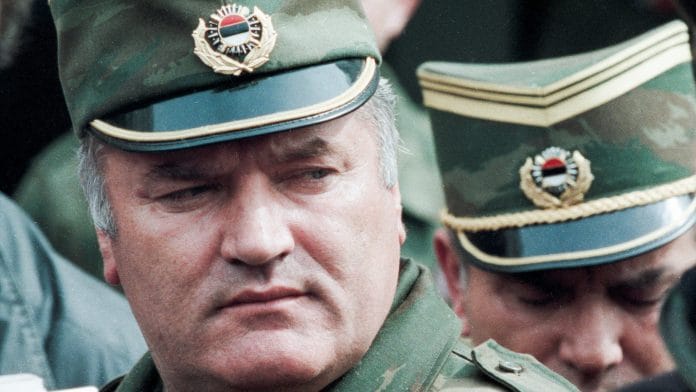

New Delhi: Ratko Mladić, the Bosnian Serb military commander who came to be known as the “Butcher of Bosnia,” has died at 84 in The Hague, where he was serving a life sentence for genocide. His death marks the final chapter of a violent era that witnssed the worst atrocities committed on European soil since the Second World War.
Mladić was the military commander whose campaigns of terror and mass murder tore Yugoslavia apart in the 1990s. He led the forces responsible for the four-year siege of Sarajevo and the 1995 massacre at Srebrenica. The International Criminal Tribunal for the former Yugoslavia (ICTY) convicted him in 2017 of genocide, crimes against humanity, and war crimes. Mladić appealed, but the conviction and life sentence were upheld in 2021.
Born in 1942 in what is now Bosnia and Herzegovina, Mladić’s father was killed during World War II while fighting as a Yugoslav partisan. Around 1965, Mladić joined the Yugoslav People’s Army, the armed forces of communist Yugoslavia, and rose through its ranks.
In 1991, Slovenia and Croatia declared independence. In 1992, Bosnia and Herzegovina followed suit after a referendum supported by Bosniaks (Muslim Slavs) and Croats (Catholics) but opposed by many Bosnian Serbs (Orthodox Christians). Bosnian Serb leaders then carved out their own territory within Bosnia, with Mladić getting appointed commander of the newly formed Army of Republika Srpska.
Under him, the forces launched a systematic campaign to expel non-Serbs from areas claimed by Bosnian Serbs. This drove countless Bosnian Muslims and Croats from their homes, which the ICTY later defined as a deliberate campaign of permanent removal.
The siege of Sarajevo and the Srebrenica genocide
For Sarajevo, the capital of Bosnia and Herzegovina, the nightmare began in April 1992. Surrounded by Bosnian Serb forces, the city faced a siege that lasted nearly four years.
It was a campaign of deliberate terror. Bosnian Serb artillery, mortars, and snipers targeted civilians as they went about carrying out everyday activities like travelling through the city, shopping and collecting water. According to the UN prosecution, more than 10,000 people were killed. The international tribunal found Mladić directly responsible, ruling that the bombardment and sniping were intended to spread terror among Sarajevo’s civilian population.
But the most severe crime of Mladić’s career occurred in July 1995 in Srebrenica.
Once declared a UN “safe area” for civilians, Srebrenica had become a refuge for a large Bosnian Muslim population displaced by the fighting. But when Bosnian Serb forces captured the enclave, they ignored its protected status. They separated thousands of Bosniak men and boys from the women, children, and elderly. They systematically massacred more than 8,000 men and boys.
To hide the killings, Mladić’s forces concealed the bodies in mass graves. They later dug up and moved some of the remains to secondary graves. The UN tribunal legally established the Srebrenica massacre as genocide.
Ratko Mladić, 16 years on the run
When the war ended in 1995, Mladić went from military commander to one of Europe’s most wanted fugitives. He remained in Serbia, protected by sections of both the Serbian nationalist establishment and the country’s military and security structures.
The international tribunal had indicted him in 1995, but his arrest came 16 years later, when he was captured in Serbia on 26 May 2011 and transferred to The Hague.
In November 2017, the ICTY delivered its verdict. Mladić was found guilty of genocide, persecution, extermination, murder, deportation, forcible transfer, terror, unlawful attacks on civilians, and hostage-taking.
Ultimately, though widely known as the “Butcher of Bosnia”, Mladić’s genocide conviction rested specifically on the 1995 atrocities at Srebrenica, rather than the 1992 campaign.