



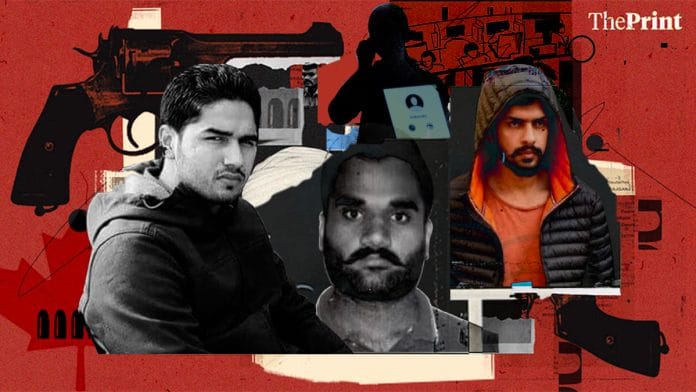
New Delhi: Organised crime in Punjab has reinvented itself as a “gig economy” of fear and extortion, a detailed analysis by retired IAS officer Karan Bir Singh Sidhu noted.
In an essay titled ‘Gangsterism and the Sleaze of Doing Business: Aggregating the Business of Extortion’, the former Special Chief Secretary and Additional Chief Secretary (Home) of Punjab argued that criminal syndicates do not operate as traditional hierarchical organisations anymore. Instead, Sidhu pointed out, they function as brand-driven platforms that outsource discrete tasks, such as reconnaissance, weapons, transport, or the shooting itself, to freelancers. They usually are not connected to one another nor to the principal.
“The syndicate no longer maintains a membership. It maintains a brand, and buys discrete tasks… from freelancers who need not know one another or the principal, and often perform one job and never another,” Sidhu wrote in his paper.
“This is not a metaphor borrowed from the platform economy but the same architecture: an aggregator owning no assets, employing nobody, disclaiming liability, taking the margin.”
The product being sold is fear, he noted, with recurring extortion being the revenue. Killings serve as the marketing.
Also read: New York mayor Zohran Mamdani hands out water, high-fives runners at city marathon
‘Demand is institutional’
Sidhu cited the 13 June 2026 daylight shooting of cashier Janki Das inside Shri Kumar Medical Hall in Chandigarh’s Sector 11. Two young men from Jammu and Kashmir, allegedly hired for the job, fired 13 rounds at point-blank range. Goldy Dhillon, a Canada-based gangster, claimed responsibility for the attack on Facebook. However, he named a different shop in the same market, Kumar Brothers, whose proprietor had faced a Rs 3 crore demand years earlier.
An audio message that followed, according to reports referenced by Sidhu, stated that the gang was “not bothered” whether the victim was a worker or anyone else.
“He was not the message’s subject. He was its medium,” Sidhu wrote.
The intent was to terrorise traders across the market to ensure that future demands are paid readily, he stated.
Economics favour this model over older forms of robbery or dacoity.
“Extortion beats robbery on every measure: nothing to fence, no scene, recurring revenue rather than a single yield, and a victim who guards the secret himself,” he added.
The paper noted that there is a huge difference in costs, with roughly Rs 20,000 for a country-made pistol, and Rs 4 lakh for a shooter, and opening demands that can reach crores on cash-intensive businesses.
Targets are selected based on cash intensity and not the size. The victim’s own unaccounted receipts become the extortionist’s security, as a man who cannot declare his income cannot easily itemise losses either.
Sidhu linked the supply of young, clean-record operatives to local unemployment and migration from eastern Uttar Pradesh and Bihar. It is further amplified by social-media displays of wealth.
Demand, Sidhu argued, is partly institutional. As civil suits average 4.91 years and execution of decrees adds roughly another four years, and 8.82 lakh execution petitions are pending, private recovery through gangsters seems rational for aggrieved parties.
“A market for private enforcement exists because the public monopoly on enforcement has, in the sphere of civil obligation, largely ceased to function within a human lifetime,” he wrote.
The essay also highlighted the operational advantages of freelance gangsters. Cellular structures that break evidentiary chains; the ease with which counterfeit callers invoke famous gang names and collect payments without any real capacity to deliver; direction of networks from inside jails; and the difficulty of proving under Section 111 of the Bharatiya Nyaya Sanhita that a freelancer acted “on behalf of” a syndicate when he may know almost nothing about it.
Sidhu warned against the extra-judicial shortcuts.
“A gig economy of violence cannot in any case be dismantled by an encounter, for the elementary reason that the man who would be killed in the encounter is the most replaceable person in the entire structure… Killing him removes the cheapest input and leaves the platform, the brand, the money and the command entirely intact.”
(Edited by Ratan Priya)