



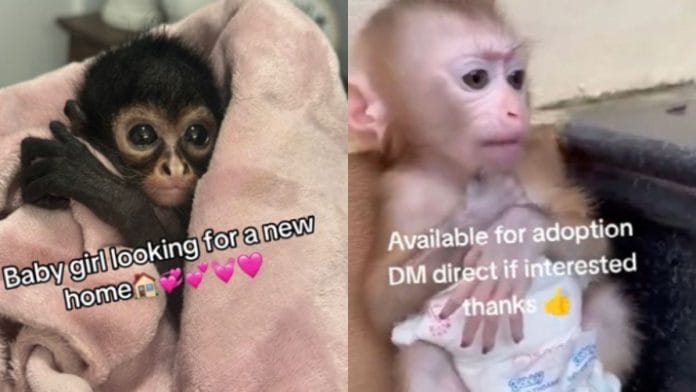
New Delhi: Primate trade is booming in plain sight across US social media platforms, a new study has found. Using emojis, hashtags and covert codes, Americans are buying and selling primates online for premium prices with ‘minimal effort’, according to researchers.
The 19 May report, published by the Association of Zoos and Aquariums (AZA) and the International Fund for Animal Welfare and World Wildlife Fund, has found 1,614 primates listed for sale through 1,131 online posts shared by 122 social media users across Facebook, Instagram, TikTok and YouTube over a six-week period in mid-2025.
“All you need is a phone and a social media account to buy a primate in the US,” said Danielle Kessler, US Country Director of IFAW in a press release.“With just the click of a button, well-meaning animal lovers can end up in a criminal pipeline where animals pay the ultimate price. This is an industry that thrives on clicks, cash and cruelty.”
Low-risk, high-reward criminal enterprise
Researchers identified 12 primates in the listings, with macaques emerging as the most commonly advertised species with 839 posts, followed by marmosets (293) and capuchins (275). Sale prices ranged from $250 (around Rs 25,000) and went as high as $6,500 (around Rs 6,30,000) depending on species, rarity and age. Most were infants often taken from their mothers in the wild, the study said.
Unlike protected wildlife products such as elephant ivory, which are often traded covertly, researchers found little effort to conceal the sale of live primates. Moreover, sellers seeking to evade automated moderation systems relied on tactics such as overlaying sales visuals on videos while limiting text descriptions, requesting private communication and using terms such as “rehoming,” “rescue” and “adoption” with charges called fees for “permits,” “delivery,” or “supplies.”
Among the species identified, chimpanzees are classified as endangered on the International Union for Conservation of Nature Red List, while cotton-headed tamarins are listed as critically endangered. Nearly 75 per cent of the world’s primate species are threatened with extinction.
“The ease with which primates are being bought and sold online should be a wake-up call,” said Sara Walker, senior advisor on wildlife trafficking at AZA in the press release. “These are complex, long-lived wild animals—not pets—and this growing digital marketplace is fueling demand, causing animals to suffer.”
Though the study is based in the US, the researchers warn that unless a specific website is blocked in-country, the content may be accessed around the world. Nearly 41 per cent of sellers also claimed to have documentation proving the legality of the animals, though this was not included in listings.
The researchers also observed that although the platforms occasionally, though not consistently, flagged or suspended users who used direct commercial terms such as “monkey for sale”, posts using alternative language such as “available,” “adoption” and “rehoming” remained unaffected.
They cited one such instance where a TikTok seller who was briefly suspended for using “for sale” later returned offering a baby golden lion tamarin, a species classified as endangered under the Endangered Species Act (ESA), for sale.
“People are falsely led to believe that infant primates will bond more readily with humans. Sadly, many of these primates suffer lifelong trauma or die before they ever reach the buyer due to the harsh and dangerous smuggling conditions, ” the researchers noted in the report.
Wildlife trafficking is part of the global $23 billion illicit wildlife trade, putting it among the largest five black markets alongside drugs, firearms, and human trafficking. Inconsistent legislation turns it into a “low-risk, high-reward” criminal enterprise.
(Edited by Theres Sudeep)