



New Delhi: This month, artificial intelligence took its biggest leap yet in mathematics by solving one of the world’s seven millennium problems—the Navier-Stokes equations.
On 8 September, OpenAI announced that its internal models produced a proof for the Navier-Stokes Existence and Smoothness problem. This fluid dynamics problem has remained unsolved for the better part of a century. OpenAI offering a possible solution has raised questions about the impact of AI in math research.
Professor Anish Ghosh, Dean of the TIFR School of Mathematics, and Aaryan Dangi, CEO of Terrastack, discussed the issue in a closed-door online conversation on 24 September. Hosted by FTW, a private community for India’s founders, entrepreneurs, and thinkers, the hour-long event featured free-flowing discussions on AI, the complexity of the Navier-Stokes equation, the controversy around who solved it first, and the fundamental shift in AI and math brought on by this solution.
“This has to be by far the most impressive thing artificial intelligence has done,” said Dangi, an IIT Bombay CS graduate and an Olympiad mathematician, during the discussion.
The Navier-Stokes equations are one of seven Millennium Prize Problems, curated by the US-based Clay Mathematics Institute (CMI) in 2000 to “celebrate mathematics in the new millennium”. Each complex mathematical problem has a $1 million prize attached, and until recently, only one—the Poincaré conjecture—had been solved.
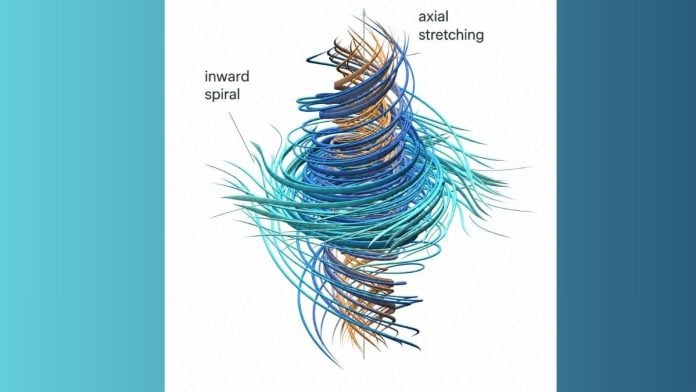
Straddling the world of mathematics and physics, the Navier-Stokes equations deal with how fluids, such as water or air, move, and ask whether their three-dimensional motion can always be described by smooth, mathematically well-behaved solutions. They are partial differential equations and are named after French mathematician Claude Louis Navier and British mathematician George Gabriel Stokes.
Even without mathematical proofs, the equations have routinely been used in various fields dealing with fluid motions, from climate science to aircraft engineering.
“One of the reasons the proof is complex is because math requires precise formulations and solutions, while physical formations—like fluids—are anything but precise,” explained Ghosh.
The Navier-Stokes problem has a few variations, including a forced version of the equation, which accounts for an external force such as gravity acting on the fluid. This was the version attempted and solved by OpenAI. While neither version of the equation is particularly easy or difficult, it does affect the kind of impact the solution would eventually have.
According to an article in Scientific American, though, most mathematicians around the world have been working on the unforced version of the equation, trying to find a more ‘fundamental’ way to prove the equation by using intrinsic forces within the fluid.
“Currently, OpenAI’s solution is not going to lead to breakthroughs in fluid flows. But it is still a major achievement mathematically,” said Ghosh.
What was the controversy?
OpenAI’s solution to the Navier-Stokes equation was not without controversy. A few hours before OpenAI published its Navier-Stokes proof, NYU mathematician Tristan Buckmaster uploaded a public statement on Mastodon, saying that he and his collaborator Levent Alpöge had worked on three proofs related to the Euler equations, which are a version of the Navier-Stokes equations.
“On Thursday, September 3rd … Levent received tips that information about our progress had been passed to OpenAI,” said Buckmaster in his statement, implying that his work could have been used to design the prompts that led to OpenAI’s solution.
In his statement, Buckmaster said he too had been working with Anthropic’s Claude and OpenAI’s Codex to help with his results. The broader issue, as discussed by Ghosh and Dangi, centred around how frontier AI agents are now indispensable in mathematics.
“A year and a half ago, AI was struggling to solve Olympiad-level mathematics problems, but now both Anthropic and OpenAI have proved they can compete at the highest mathematical level,” said Ghosh.
Moreover, while AI agents have been used for complex data cleaning, coding, and applied mathematics, the Navier-Stokes equations are from a branch of mathematics that AI was not known to be particularly good at. As Dangi explained, there are still certain problems AI struggles with.
“It isn’t so good with spatial reasoning for example. If you ask it to understand or help with 2D or 3D spatial data, you need to add a lot of context to get reasonable responses from AI,” said Dangi.
Also read: Past emissions will impact the climate for hundreds of years, finds study
Where is AI taking us?
One thing that could have helped OpenAI engage in the kind of advanced mathematical thinking required for Navier-Stokes is the existing work done by human mathematicians. Spanish mathematicians Diego Córdoba and Luis Martínez-Zoroa have spent the last few years working on the equation, specifically developing the strategy that OpenAI eventually used to find a solution for the forced version of Navier-Stokes.
“If there is substantial literature on a particular mathematical problem, and we let frontier agents at it, chances are that AI will be able to solve it,” said Ghosh, acknowledging the recent advances in the technology.
This new relationship is not without its own set of problems. For example, OpenAI’s solution has no real author or mathematician, even though it used the work of mathematicians to build the frontier agents that eventually solved the problem. Similarly, for new mathematicians entering the field, the influx of AI agents and their use in the discipline will be a challenge, according to Ghosh, but he expects it to stabilise soon.
“Going forward, attribution will be a massive problem if OpenAI or any other LLM solves a major math question,” he said. “But I think that is a problem that all disciplines need to tackle, not just math, in the age of AI.”
On the question of whether AI and its discoveries could eventually outpace human understanding and verification, Ghosh expressed caution. Dangi, though, was much more hopeful about how it would play out in the future.
“The hardest challenge in using AI is bridging the messy physical world with formal data. Once that happens, we hit a historic tipping point—where problems will become about resource maximisation, and most humans won’t need to contribute economically to keep things functioning,” said Dangi. “People who do work will keep up with AI and guide its development, and we might even reach universal basic income.”
(Edited by Prasanna Bachchhav)