


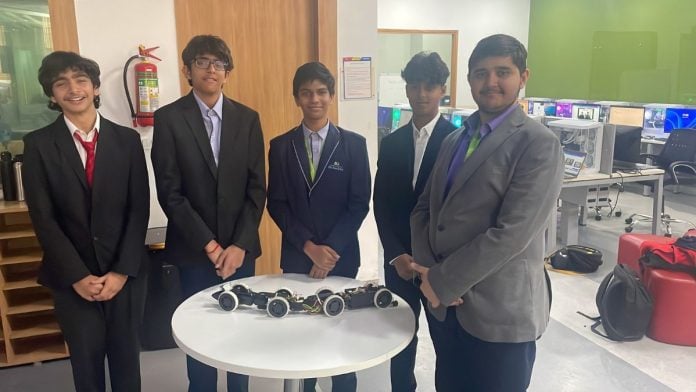
New Delhi: A snake-inspired robot built by five Class XI students of the Shiv Nadar School in Noida could one day help rescue teams find survivors trapped in the narrow, unstable spaces beneath collapsed buildings. Named Vasuki after the mythical serpent, the prototype uses thermal imaging, cameras and gas sensors to navigate rubble and locate possible victims.
“We discovered how many lives are lost each year due to earthquakes and structural collapses, largely because rescue teams struggle to quickly locate people trapped under rubble,” the students, aged 17 to 19, said of the origin of the idea.
Vasuki draws its core idea from the flexible, slender movement of real snakes and is designed to navigate the chaotic, debris-filled environments created by structural failures and natural disasters like earthquakes.
“A snake robot’s flexible, segmented body allows it to slither through small openings, climb over uneven rubble, and maneuver around obstacles while minimizing the risk of causing further collapse,” the team of students said in an email response to ThePrint. “This enables it to reach areas that are inaccessible to conventional rescue robots and detect trapped victims more efficiently.”
The team comprised students Armaan Sen Dave, the project’s outreach manager; Daksh Malik, who handled project funding; Devansh Bajpai, the research lead; Mahish Bhalla, who oversaw documentation; and Vedang Darbari, the technical operations manager and team lead. Their teacher, Komal, helped further develop the project.
The technology combines thermal imaging to detect possible heat signatures of people trapped below, a live camera feed with lighting for visual inspection in dark or low-visibility conditions, and gas sensors to flag potentially hazardous atmospheres.
“By providing the location of trapped victims and real-time information about the environment, Vasuki helps rescue teams plan safer and faster rescue operations, improving the chances of saving lives,” the team added.
Inspired by Gaza
The idea took shape after a news report on thousands still missing under the rubble of Gaza, which particularly affected the team.
“At first, we thought it was an exaggeration, but after researching further, we realised the scale of the problem, which ultimately inspired us to pursue this idea for our capstone project,” the team said.
While wheeled and tracked robots are useful in relatively open spaces, navigating through narrow gaps, unstable debris and collapsed structures is considerably more difficult for the larger machines.
“Project Vasuki can assist in disasters such as earthquakes, landslides, floods, and building collapses by entering areas that are too dangerous or inaccessible for human rescuers,” the team said of their capstone school project.
Uninterrupted data flow
Vasuki was not the team’s first idea for a disaster-response project.
The students initially explored using drones to scan affected areas. However, they soon realised that aerial surveillance alone would be insufficient, since it could not help locate people trapped beneath collapsed structures.
The students then shifted to a ground-based solution. As the design evolved, they added wheels to improve movement across certain terrains, while retaining the robot’s flexibility. They also upgraded its camera system with thermal imaging and added gas sensors to detect hazardous gases.
“Over time, these iterations shaped Vasuki into a more complete rescue system focused on both navigation and real-time environmental awareness,” the team said.
Beyond the individual robot, the students envision a swarm-based system in which multiple Vasukis could explore different sections of a disaster site simultaneously and share information with a central control unit.
“If one robot detects a possible survivor, the location is instantly shared across the system, allowing others and rescue teams to respond quickly,” the team said.
To address the breakdown of communication networks during disasters, the students are working toward small, egg-like modules that can be deployed at intervals, functioning as temporary Wi-Fi extenders.
These would create a local mesh network, maintaining communication between the robots and the base station when connectivity is weak or unavailable. The modules are in the development stage.
“Even in deep rubble or underground environments, this ensures uninterrupted data flow and coordination during critical operations,” they said.
The system also incorporates drones for aerial mapping, while the Vasuki robots are intended to explore ground-level and underground spaces.
Also read: Two Popes, two Mahindras—Anand Mahindra highlights rare link with Catholic leaders
Improving rescue operations
One of the team’s biggest challenges was ensuring that the robot could navigate uneven terrain while transmitting sensor data reliably. The students developed a custom graphical user interface (GUI) to display the robot’s movement, sensor readings and live video feed on a single screen.
“We developed a custom GUI that made it easier to monitor the robot’s movements, sensor readings, and live feed,” the team said.
The students also demonstrated the prototype to the National Disaster Response Force (NDRF), and incorporated the expert feedback to improve the robot for practical rescue operations.
The suggestions included adding a thermal camera, improving lighting for low-visibility conditions, introducing manual controls for greater precision, integrating gas sensors to detect LPG, CNG, chlorine and methane, and improving the robot’s stability on uneven terrain.
Following the feedback, the students conducted simulation-based tests, which they said indicated that Vasuki could improve the effectiveness of rescue operations by approximately 76 per cent.
The students plan to further improve the robot’s mobility across unstable terrain, extend its battery life and enhance sensor accuracy. They also want to strengthen the communication system to allow multiple units to coordinate across larger disaster zones.
The team estimates that a basic deployment prototype would cost between Rs 4 lakh and Rs 5 lakh per unit, depending on the quality of sensors, communication modules and manufacturing scale, but they want to bring down costs in the future.
“With mass production and optimisation, the cost could reduce significantly, making it more feasible for large-scale deployment by disaster response agencies,” they said.
(Edited by Ratan Priya)