





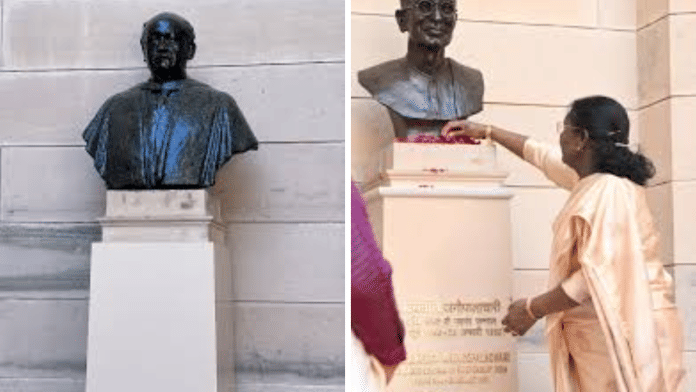



New Delhi: Following Prime Minister Narendra Modi’s announcement that a bronze statue of British architect Edwin Lutyens, which has been inside the Rashtrapati Bhavan premises for decades, has been replaced, Lutyens’ great-grandson said that while he understood the government’s wish to remove colonial statues, his ancestor was never a viceroy.
Lutyens’ bust has been replaced by a black-coloured bust of C Rajagopalachari, inaugurated by President Droupadi Murmu on Monday.
Matt Ridley posted a year-old picture from the inner courtyard of the president’s estate, which was built by his great-grandfather and where his statue stood for decades on X.
“Sad to read that the bust of Lutyens (my great-grandfather) is to be removed from the presidential palace he designed in Delhi. Here I am with it last year. I wondered at the time why his name had been removed from the plinth,” he wrote.
Answering a question about taking Lutyens’ statue to his home, Ridley shared that he already has a replica sculpted by Sir William Reid Dick in his house. He also said that Lutyens should be treated as an architect and remembered for his contribution to the development and planning of Delhi city.
For those suggesting I offer a home for Lutyens’s bust from Delhi, I already have a copy of it. It looks down on my desk as I write this. It was sculpted by Sir William Reid-Dick.
I understand India’s wish to remove colonial statues but he was an architect, not a viceroy. https://t.co/t6jScd6njW pic.twitter.com/H9tX8CWc8S
— Matt Ridley (@mattwridley) February 23, 2026
During his monthly radio address on Mann Ki Baat on Sunday, Modi noted that after independence, statues of British administrators remained in Rashtrapati Bhavan, while those of India’s great leaders were not honoured.
“Today, the country is leaving behind the symbols of slavery and has begun to value symbols related to Indian culture,” said Modi in his address.
The Rashtrapati Bhavan was originally built for the Viceroy and was completed in 1929. Its architecture blends Western classical style with Indian elements such as chhatris, jaalis, and a dome inspired by the Sanchi Stupa.
The President of India currently resides in the guest wing of the estate. The palace has 340 rooms and is larger than the residence of any other head of state in the world.
Also Read: Shahjahanabad or Lutyens’ Delhi? Panel asks who the real Dilliwallas are
Who was Lutyens?
Sir Edwin Lutyens was the principal architect and town planner responsible for designing New Delhi, transforming it into the imperial capital of the British Raj in the 1920s and 30s, which is now the diplomatic enclave of the capital. The area is often referred to as “Lutyens Delhi”.
Lutyens played a leading role in the planning and construction of the central administrative area of New Delhi, with several key structures directly designed by him or under his guidance.
His work contains a blend of Indian and European styles, characterised by large, green lawns and tree-lined avenues. It was under his guidance that Delhi became a garden city with areas such as the Lodhi Gardens and the Mughal Gardens at the President’s estate.
Lutyens specially developed a hybrid Indo-European style, fusing Western neoclassicism with Mughal, Buddhist, and Hindu motifs. He worked on these projects with fellow British architect Herbert Baker as well.
Some of his major works and contributions include Rashtrapati Bhavan, India Gate (All- India War Memorial), Hyderabad House — the residence of the Nizam of Hyderabad, designed in a distinct “butterfly plan” with a central dome; Baroda House — the former palace of the Maharaja of Baroda, now the headquarters of Northern Railways; Patiala House — the former city residence of the Maharaja of Patiala, which retains its original grandeur in its façade and dome; and the many Lutyens bungalows scattered throughout his Delhi, reserved for diplomats and officials.
Amid the debate over the replacement, historian Swapna Liddle underlined Lutyens’ architectural contribution to Delhi.
“Lutyens design for Delhi was significantly inspired by Indian history and architecture, as reflected in the Indian forms he used — for example, the Sanchi Stupa dome, or the chhajjas and chhatris on the Rashtrapati Bhavan,” Liddle said.
Liddle added that the design for Delhi was a “political move”, and not something sudden or accidental, but a planned political step.
“This was no accident. The politics of the time — the rising national movement and the growing demand for greater freedoms by the Indian people — forced the colonial state to take a more ‘Indianised’ path in the architecture of New Delhi. Lutyens and his architecture were thus very much shaped by the politics of India,” she said.
Also Read: ‘Keep foreign-made products away from festivals’: PM Modi makes ‘Vocal for Local’ appeal
Who is Rajagopalachari?
A new statue of C Rajagopalachari, also known as “Rajaji,” was unveiled in place of Lutyens, as part of the newly coined “Rajaji Utsav,” with an accompanying exhibition from 24 February till 1 March.
Rajagopalachari was an Indian statesman, lawyer, writer, and freedom fighter. He served as the last Governor-General of India from 1948 to 1950 and was the only Indian to hold the post.
Rajaji was also a close associate of MK Gandhi and later served as Chief Minister of Madras State. He was awarded the Bharat Ratna, India’s highest civilian honour, in 1954.
“Rajagopalachari was among those who saw power not as a position but as a service. His conduct, self-restraint, and independent thinking in public life inspire us even today,” said Modi.
After Independence, he served as the Governor of West Bengal from 1947 to 1948 before becoming Governor-General of India.
Rajaji was the founder of the Swatantra Party in 1959, which primarily advocated for free-market economic policies and opposed the socialist policies of Jawaharlal Nehru’s Congress government.
(Edited by Insha Jalil Waziri)
Good riddance ! Why keep busts of plunderers ? Western nations cannot secure statue of beacon of non violence Mahatma Gandhi which is frequently vandalised and here we are debating on busts of looters