





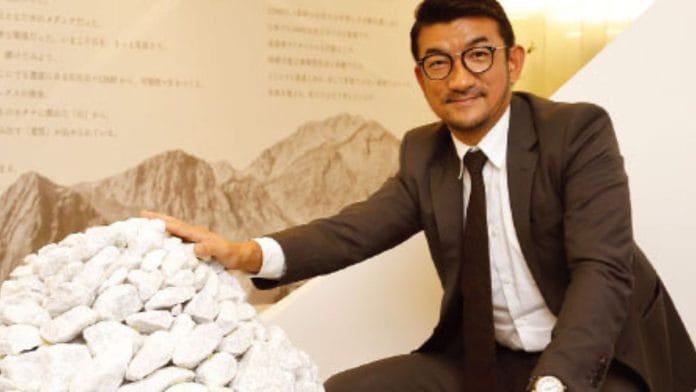



New Delhi: Japanese start-up TBM set out to make paper with limestone a decade ago: from business cards to shopping bags, their sustainable LIMEX material is everywhere now. Now, they’re getting into recycled plastic with their new CirculeX technology, which makes products even stronger than virgin plastic.
Launched in February 2026, CirculeX promises to fix two of the biggest challenges with recycled plastic – durability and odour. The new product promises to be 126 per cent stronger than conventional post-consumer recycled plastic, and has 60 per cent less odour than it too.
“Leveraging over a decade of expertise in new material development, we have transformed PCR (Post-Consumer Recycled) plastic—which traditionally suffered from quality degradation and low value—into a superior resource,” said Nobuyoshi Yamasaki, CEO, TBM, to ThePrint.
In the last 15 years, from LIMEX to CirculeX, TBM has charted a path for itself in recycled and new sustainable materials development, with presence in over 10,000 companies and municipalities and more than 10 countries, and 250 patents filed. However, TBM’s real strength lies in its precise science and engineering that underscores their product development, be it carbon capture, recycled plastics, or their original LIMEX design.
“Following the Industrial, IT, and AI revolutions, we are taking on a global challenge to realise the Sustainability Revolution,” said Yamasaki.
Also read: Cancer therapy may soon skip the lab step — and cut costs
The science behind LIMEX
In 2008, Yamasaki was visiting Taiwan when he came across ‘stone paper’, a product made using recycled construction materials. Struck by the idea, Yamasaki wanted to market these products in Japan too, but he noticed that the sales were low because it was heavy, expensive, and poor in quality.
So, Yamasaki decided to develop a new kind of stone paper in-house, by using an abundant resource—limestone. According to TBM’s website, limestone is a resource that “Japan can be 100 per cent self-sufficient in”, and by using it to make plastic or paper, TBM can reduce the use of other, limited resources like petrol, wood, and water too.
“The amount of limestone used in LIMEX produced at our own factory is only 0.01 per cent of the amount used in Japan,” said TBM’s website. “The world’s population will continue to grow, and the demand for plastics and paper will continue to increase … limestone is abundant, so it has excellent supply stability and low price as an alternative raw material to plastics and paper.”
The process of making LIMEX is anything but simple— calcium carbonate derived from limestone is ground to a fine powder and mixed with thermoplastic resin to make pellets, which are then molded into either sheets like paper or shapes like plastic bags or containers. According to TBM, the production of LIMEX uses 94 per cent less water than the process of making normal paper, making LIMEX a sustainable material in comparison.
After the first factory was established in 2015, the first successful product they made using LIMEX was business cards. Yamasaki still uses his own product during business outings, events and international forums, even as LIMEX has grown to produce notebooks, menus, backlit film signage, and other printed material.
In 2023-24, however, TBM achieved another breakthrough by making LIMEX from captured carbon dioxide. Introduced at the World Economic Forum in Davos in 2024, ‘Next Generation LIMEX’ marks a shift from using direct limestone to using captured CO2 emissions and converting them to calcium carbonate, and using that to create LIMEX.
“First, we directly capture CO₂ from emissions generated by factories, power plants, and waste incineration facilities,” said TBM to ThePrint. “Next, we dissolve waste streams from sources such as steel mills and concrete plants in water and extract only the calcium. We then chemically react that calcium with CO₂ to synthesise and produce CCU calcium carbonate,” they added.
This product has gained TBM entry into the carbon capture and utilisation (CCU) market, with plans to open a CCU plant in Vietnam too currently ongoing. CCU production is also a goal the Japanese government is pursuing through its Ministry of Economy, Trade and Industry. But TBM is already ahead of the curve.
“The Japanese government’s roadmap had assumed that CCU products such as chemicals and concrete would become commercialised from around 2040, yet TBM achieved commercialisation roughly 15 years earlier,” said TBM to ThePrint.
(Edited by Ratan Priya)