





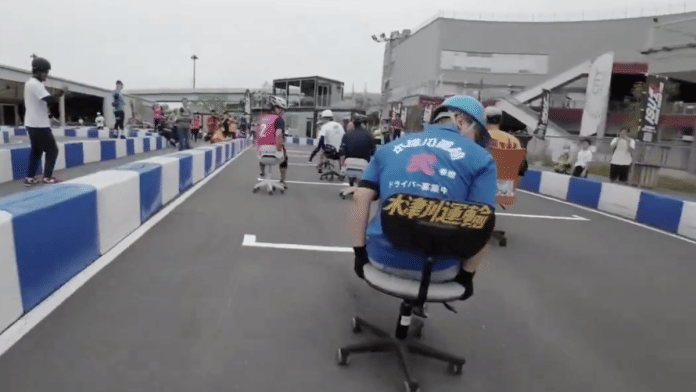



New Delhi: Amid Japan’s gruelling work culture, office-goers in the country have a new favourite racing sport. Every year since 2010, hundreds of office workers put on safety gear and roll out onto streets on their office chairs, ready for a two-hour race, to win a grand prize of 90kg of rice.
At the ISU-1 Grand Prix, teams of three compete to finish as many laps as possible around a circuit covering over 20 km during the race duration. The first-ever race of its kind was held in 2010 in Kyoto by Tsuyoshi Tahara, inspired by a teacher who once scolded him for playing with an office chair.
Since then, the sport has grown in popularity, and the annual race is now held in ten cities, including Tokyo, with the world’s largest automobile manufacturer, Toyota, also sending their employees to the race.
Tahara told CNN that people in Japan are addicted to this because of its long work hours.
“People in Japan may work too much, but they can still become fully dedicated to something silly like this and enjoy it even as they grow older,” he said.
A very serious game
On the day of the race, office-goers get to the starting line geared up in safety equipment — helmet, elbow pads, knee pads and gloves. They cannot use customised chairs and must use only commercially available chairs.
The game is open to everyone, irrespective of gender and age.
Yasunori Miura, a Japanese office-goer, told the American news outlet that there are hurdles in the race. Sometimes, a few chairs break, and some tracks are so bumpy that the wheels stick to the ground.
The winning team usually ends up covering 20-25 kilometres, with each member taking a lap for eight kilometres. Race demands coordination, even if one has trained really hard.
“All three members have to be strong, so we make sure we train together as a team,” he said.
Apart from rice, there are some regional variations – in Tokyo, the coveted prize is five kilograms of tuna.
Also Read: 59% Indian employees show burnout symptoms, says new mental health report
Balm in Japan’s gruelling work culture
Tahara says that the office chair race allows participants to return to their childhood. They were doing something that they were never allowed to do.
“A balm for Japan’s gruelling work culture,” said Tahara.
Tahara told CNN that the game is quite similar to Formula One because of its chequered flags, tyre changes, and lapses of trails. He hopes that one day office chair racing will become so big that it reaches the Circuit de Monaco, one of the most iconic and prestigious locales in motorsports.
Japanese work culture
The island-nation prides itself on its high dedication, strict hierarchy, and well-organised offices.
Organisations in Japan demand longer working hours, mandatory overtime, and a reduced work-life balance. The system also includes extreme attention to detail, lifelong employment and team harmony.
As a result of the rigidity, lack of transparency and slow decision-making process, Japanese people are seeking rewarding careers as well as after-work drinks and entertainment.
(Edited by Insha Jalil Waziri)