



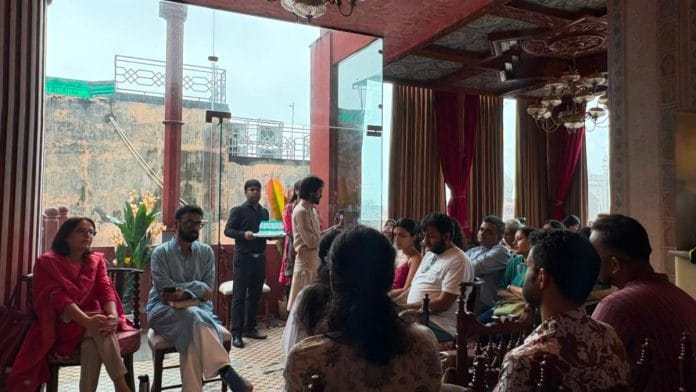

New Delhi: A discussion on the Progressive Writers’ Movement in Old Delhi on Sunday focused on a question that is still relevant: what makes writing progressive? Is it enough for literature to point out injustices, or should it also show a way out?
At the first Urdu Bazar Baithak at Mushk Rooftop Café in Daryaganj, Dr Rakhshanda Jalil said the answer lay in author Ismat Chughtai’s simple example of a person picking up a stone in response to injustice.
“Ismat said that as long as a big fish eats a small fish in the pond, if there is exploitation, there will be progressivism,” she said.
Jalil was speaking about her 2014 book Liking Progress, Loving Change: A Literary History of the Progressive Writers’ Movement in Urdu.
Rather than beginning with the first All-India Progressive Writers’ Conference, Jalil’s book traces the emergence of social and political consciousness in Urdu literature from the nineteenth century onwards.
Using Shehr-e-Ashob and Premchand’s Thakur Ka Kuan as examples, she argued that progressive writing does more than point out what is wrong.
“I think the one identifying feature of progressive literature, to my mind, is not self-pity. You identify the problem-this is wrong, that is wrong—but you then also hold out another way of seeing it, way out of that situation,” Jalil said. “The progressives believe that literature is yoked to social change.”
Delhi’s old troubles
The Shehr-e-Ashob poems recorded Delhi’s troubles as its political and economic fortunes declined centuries ago. Jalil described a city surrounded by instability: the weakening of Mughal authority, counterattacks by the Marathas and Jats, insecurity on the roads and the effects of famine in the countryside.
But there is a difference between recognising a problem and imagining a way out of it.
Premchand’s Thakur Ka Kuan offered a useful comparison. Its protagonist knows that the only uncontaminated water available to her sick husband is in the Thakur’s well. She goes there, but fear prevents her from drawing the water.
For Jalil, the story identifies the injustice clearly. What progressive writing would increasingly seek was a stronger sense of agency.
That transition became more visible with Angare.
Published in December 1932, the collection brought together nine stories and a play by Ahmed Ali, Sajjad Zaheer, Rashid Jahan and Mahmud-uz-Zafar. The book challenged social and religious conventions and was banned by the colonial government in March 1933.
Despite its short life, it became one of the important landmarks in the history of the Progressive Writers’ Movement.
In response to the ban, Mahmud-uz-Zafar wrote in defence of the book, questioning the attempt to silence its authors.
“This letter to the editor by Mehmood Zafar is a manifesto of sorts. Because it says, why should we remain silent? If you don’t like our literature, don’t read it. Continue writing your own kind of literature,” he wrote.
By 1935, a group of Indian writers and intellectuals in London had begun working towards a formal organisation. The following year, the Progressive Writers’ Association held its first All-India conference in Lucknow, with Premchand presiding.
Premchand, in his address, argued that literature should hold a mirror to society, showing its good and bad sides, its flaws and its inequalities. He called on writers to rethink what they considered beautiful.
“These ideas resonated with the writers who gathered at Rifa-e-Aam Hall in Lucknow in April 1936 for the first All-India Progressive Writers’ Association meeting. Most of those present were among the leading Urdu writers of the time,” said Jalil.
Also Read: ‘Urdu will survive hate, needs jobs to thrive’ — lessons from Rakhshanda Jalil’s book launch
Transition, translations, tensions
The ideas of the Progressive Writers’ Movement travelled through different Indian languages and translation played an important role.
Russian literature and socialist ideas also reached young Indian writers through translated texts, teachers and mentors.
One example was Saadat Hasan Manto, who began his literary career partly through translation.
“Abdul Bari Alig gave Manto these texts. There were communist texts, there were stories by Russian masters which had come to them via English. And because Manto had studied English and knew enough English to translate these texts. So Manto cut his teeth as a writer, as a translator,” said Jalil.
The movement also grew beyond literature.
By the 1940s, writers, theatre practitioners, filmmakers and artists were increasingly working in overlapping circles. The formation of the Indian People’s Theatre Association in 1943 was part of this movement, while Bombay became an important meeting point for the PWA, IPTA and the film industry.
She pointed to Shaukat Azmi’s memoir Shaukat and I, as well as memoirs by artists such as Krishen Khanna, to show how these circles overlapped. As new art galleries, bookshops and cultural spaces emerged, ideas travelled across disciplines.
“It’s not possible to talk about literature in a silo. It’s not existing in a vacuum. All of these people, there’s a lot of cross-fertilisation of ideas. So the Bombay progressives are drawing from the progressive writers and vice versa,” she said.
Jalil recalled Gulzar’s account of attending meetings and poetry gatherings, sometimes in Sahir Ludhianvi’s outhouse in Juhu. When the group could not find a room for a meeting, they would even take it to a Bombay tram.
“Most of us had passes, so we would travel from one point to another and hold our meetings at the back of the tram,” she recalled Gulzar as saying.
The discussion also brought out the tensions within the Progressive Writers’ Movement, particularly over questions of obscenity and creative freedom.
Jalil recalled a 1943 meeting in Hyderabad where a proposal to ban obscenity in literature was challenged by Maulana Ashraf Mohani, who asked: “Before you ban it, define obscenity.”
The debate demonstrated the difficulties of different writers following the same literary line. This became particularly clear in the cases of Manto and Chughtai, who kept writing about the body, sexuality and social conventions.
“I’m going to do my own kind of writing,” Manto had said as he distanced himself and cut himself off from the professors.
Chughtai refused the suggestion that she should write about women working in factories when that was not the world she knew.
“I know nothing about women who work in factories. I’m going to write exactly the kind of stories I write,” Jalil recalled Chughtai as saying.
(Edited by Stela Dey)