





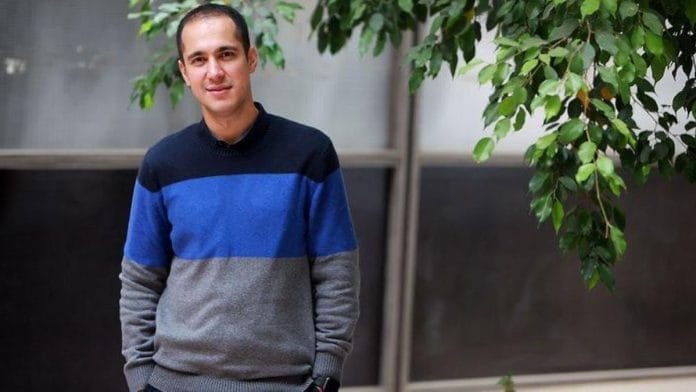



New Delhi: Exiled environmental scientist and former Iranian politician Kaveh Madani made history on Wednesday by winning the Stockholm Water Prize for 2026. At 44, Madani is the youngest recipient of this prize, awarded by the Stockholm Water Foundation and the Royal Swedish Academy of Sciences.
Madani, who is currently the Director of the United Nations University Institute for Water, Environment and Health in Ontario, was awarded the prize for his “groundbreaking research on water resources management with policy, diplomacy and global outreach, often under personal risk and political complexity.”
“It is a profound coincidence that this news arrives as my country and the region whose sustainability I have fought for have been burning in the fires of conflicts and a war being conducted in defiance of international law,” said Madani in his statement after the prize. “I hope that in the midst of this fragmented world, this Prize and World Water Day serve as a reminder that water does not wait for politics.”
This is the first time that a UN official and a former politician has been awarded the Stockholm Prize, which has earlier honoured people like Rajendra Singh of the Tarun Bharat Sangh in 2015, and institutes like the Centre for Science and Environment (CSE) in 2005. It will be presented by H.M. King Carl XVI Gustaf of Sweden in August to Madani.
“I share this award with the millions of compatriots who stood by me, with my friends in the conservation community, who were imprisoned and killed for their love of nature, and with the brave and innocent Iranian lives taken from us in January 2026, and those lost before and since,” said Madani in a press statement after the award was announced.
From serving as the Deputy Vice President of Iran to being called a ‘water terrorist’ and arrested by the Iranian authorities, sent into exile, Madani has had a tumultuous career as an environmental scientist and policymaker. In terms of his contribution to the field of water management, he is credited with introducing game theory concepts to managing water resources, especially in Iran.
Madani also coined the concept of ‘water bankruptcy’, to describe a stage of chronic water shortage that moves a region well beyond ‘crisis’. He was one of the authors of the 2026 UN Report that declared that the world has entered a ‘Global Water Bankruptcy’ era, meaning that several river systems in the world can no longer recharge their water levels.
Water research
Born in Tehran to parents who both worked in the water sector, Madani left Iran at 22 to get an MSc in Water Resources at Lund University, Sweden. After a PhD from the University of California, Davis, Madani was working as a professor at Imperial College in London in 2017 when he was invited back to Iran by the Department of Environment under the Hassan Rouhani government.
Madani’s work stands at the intersection of environmental resource management and game theory — he frames the problem of water crisis as one of strategic allocation of resources.
While addressing the media after launching the Global Water Bankruptcy report, Madani said that water should be treated as a financial asset, and that bankruptcy does not indicate the end of all hope.
“It is the start of a structured recovery plan: you stop the bleeding, protect essential services, restructure unsustainable claims, and invest in rebuilding,” he said in his statement.
His theories and research on water resource management have urged policymakers to rephrase water issues globally, and in Iran.
However, even as he returned to Tehran in 2017 and served as the Deputy Vice President, Deputy Head of the Department of Environment and the Chief of Iran’s Department of Environment’s International Affairs and Conventions Center, not all political factions in the country were happy with Madani’s presence.
Also read: Kerala’s Vela carli crab specimens have both male and female reproductive organs
Political persecution
A report in Reuters explained how Madani was detained and questioned by the Islamic Revolutionary Guard Corps for hours multiple times over the year that he served in the Iranian government. His ideas on water conservation in Iran sometimes held the Department of Environment responsible for mismanagement, and he was outspoken about environmental issues — all of which did not bode well with some ‘hardliners’ in the government, said the Reuters report.
Madani finally had to flee the country after his last arrest in February 2018, when the government also arrested eight other environmentalists for trying to save the Iranian cheetah. After a few months in hiding, Madani took up a position as a professor at Yale University, but continued speaking out about Iran and the world’s environmental problems.
(Edited by Ratan Priya)