







New Delhi: India spent Rs 4.5 lakh crore on energy subsidies in 2025. Out of this, Rs 3.12 lakh crore, or 75 per cent, was spent just on providing electricity and LPG subsidies to consumers, found a report by the International Institute for Sustainable Development, published on 29 April.
Titled ‘Mapping India’s Energy Policy 2026’, the report is a timely analysis of India’s energy landscape in the context of the oil and gas crisis caused by the Iran war.
Using data from the Union Budget of 2026-27, the new report points out three things—first is the focus on electricity subsidies for low-income consumers given by state governments, second is that 17 per cent of all energy subsidies are directed toward LPG, and third is that even though clean energy and EVs make up 10 per cent of all energy subsidies, they are still subject to price shocks due to India’s oil dependence.
The report argued that an increased focus on subsidies for LPG, oil and gas, especially due to the current crisis, was reducing the government’s capacity to invest in clean energy.
“When global LPG prices rise, policy-makers face a difficult decision. They can pass through higher costs to households … or they can cap the retail prices, which cushions consumers in the short term,” read the report.
With the closure of the Strait of Hormuz in March 2026, LPG benchmark prices have increased by 44 per cent in just one month. If the government continues to provide increased subsidies to keep consumer prices the same, this would increase the losses or ‘under-recoveries’ of India’s oil marketing companies (OMCs), leading to the government bailing them out.
“The recent tensions in the Gulf highlight India’s exposure to global LPG price volatility,” said Sunil Mani, policy advisor at IISD and one of the authors of the report, in a press release. “If prices remain elevated at current levels, under-recoveries of OMCs could exceed Rs 60,000 crore this year,” he added.
To reduce India’s import dependence on oil and gas and also the burden of energy subsidies, the IISD report proposes a ‘clean energy mix.’
“A durable response requires diversifying the clean cooking energy mix, maintaining LPG and PNG where needed, while systematically scaling up viable non-fossil alternatives,” read the report.
Also read: A perfect storm? High energy prices, the West Asia war, and India’s narrowing fiscal space
LPG and electricity subsidies
India’s affair with electricity and LPG subsidies is around three decades old. It’s seen as an essential welfare scheme for developmental outcomes by the government. A 2012 report from IISD and The Energy and Resources Institute (TERI) explained how India has historically subsidised energy, so that consumers are protected from international shocks.
While 68 per cent of India’s energy subsidies come in the form of direct budgetary transfers, meaning the government accounts for them in its Union Budget, the rest is in the form of compensation to OMCs and power distribution companies (DISCOMs) for the losses they incur.
ThePrint reported in 2024 how India’s state-run DISCOMs incurred an 81 per cent rise in losses from 2015-16 to 2023-24. A large part of this was attributed to increasing electricity subsidies and the lack of inflationary adjustment in power purchase agreements with states.
“Electricity subsidies have played an important role in expanding access to energy and protecting consumers, but their current scale and recurring nature have increased fiscal and operational stress for state governments,” said Godwin Paul Chandra Sekar, policy advisor at IISD and co-author of the report.
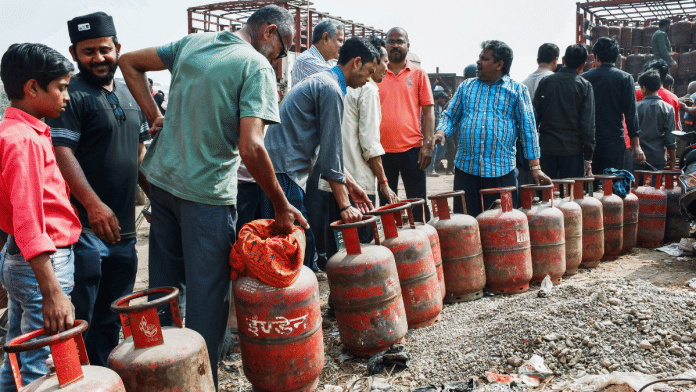
The same can be said of LPG subsidies, the second largest subsidy after electricity. The Union government’s schemes, such as Pradhan Mantri Ujjwala Yojana, and other Direct Benefit Transfers have made LPG the centre of India’s ‘clean cooking’ revolution.
However, since 60 per cent of India’s LPG is imported, it is regularly exposed to price shocks and international vulnerabilities.
IISD’s report thus proposes an overhaul of the current LPG subsidies system in India, with a renewed focus on electric cooking infrastructure. This would decrease households’ expenditure on energy for cooking, and also reduce the government’s import dependence, since electricity is produced in the country.
“Our analysis suggests that large-scale uptake in electric cooking could reduce LPG demand by half, and save up to Rs 2.4 trillion by 2050 in subsidies,” said the report.
Instead of treating the current geopolitical situation as a crisis, the IISD report said that it should be treated as an ‘opportunity’ to divert India’s energy subsidies towards internally produced clean energy. In every sector—power, transport, cooking—the government could slowly reduce subsidies in fossil-fuel, import-dependent energy sources and move toward renewable energy sources and electric vehicles.
“Shifting public financial support—like subsidies—from fossil fuels to clean energy can accelerate the energy transition, with benefits for energy access, government budgets, and energy security,” said the report.
(Edited by Theres Sudeep)