








New Delhi: The monthly budget for Indian households has changed vastly in the past ten years. Across rural and urban areas, the monthly per capita expenditures have increased, but the share of food expenses has declined, signalling an economic diversification.
This quiet shift in India’s food consumption patterns tells a larger story of transition.
“India’s dietary transition shows progress but still has persistent gaps,” reads the paper titled Food consumption patterns and their micronutrient content in India: Evidence from the household consumption expenditure surveys, 2011–12 and 2023–24 published in Nature and co-authored by Professor Shamika Ravi, member of the Economic Advisory Council to the Prime Minister.
The study finds that India’s food consumption landscape has transformed over the past decade, with significant implications for nutrition security. It highlights the changes in household expenditure, consumption patterns across major food groups and dietary sources of selected micronutrients based on the data from Household Consumption Expenditure Surveys (HCES) 2011-12 and 2023-24.
Rising incomes and shifting consumption patterns are driving this change in India’s food consumption, coupled with targeted welfare initiatives. The focus, however, isn’t just about spending less on food, but also on eating differently.
Since 2010, India’s food plate has been slowly transforming. Cereals, once the unquestioned staple dominating household budgets, now occupy a much smaller share.
“Within food budgets, the share of cereals has fallen sharply, particularly in the poorest quintiles, consistent with expansion of food security programmes providing subsidised cereals,” the paper read.
This decline has been sharp which reflects both demand-side shifts and the impact of large-scale food safety programs such as the Pradhan Mantri Garib Kalyan Anna Yojana (PMGKAY) and the National Food Security Act (NFSA).
The study finds a noticeable rise in the consumption of more nutrient-dense foods such as milk, fruits, and even meat in some regions. This suggests a gradual shift toward more diverse diets.
Yet, beneath this progress lies a more complex reality. Even as diets diversify, they are not necessarily becoming fully nutritious.
“Seasonal and regional disparities in perishable food consumption persist but have narrowed,” the study found.
The paper also studied how India’s food consumption patterns are evolving, where progress has occurred, and which gaps remain critical for food and nutrition policy action.
“The decline in food expenditure as a proportion of total household spending — falling below 50 per cent in rural areas for the first time in post-independence India — signals improved living standards and economic maturation,” reads the paper.
Also Read: A quiet renaissance of Sindhi food is underway—social media, supper clubs and cookbooks
Shift in household expenditure
The recent study paints a complex picture of a country that is eating differently, spending differently, and yet, not necessarily becoming healthier.
Despite improvements in food availability and economic growth, micronutrient deficiencies persist, particularly among vulnerable groups across the country. The paper added that efforts to improve nutritional outcomes must go beyond meeting basic nutrient requirements.
According to the paper, understanding the country’s food consumption patterns in (is) essential for reducing micronutrient deficiencies and for designing effective nutrition strategies.
Between 2011–12 and 2023–24, the average monthly household expenditure nearly tripled in rural areas, from Rs 7,531 to Rs 20,789.
In urban India, it rose from Rs 11,950 to Rs 29,510.
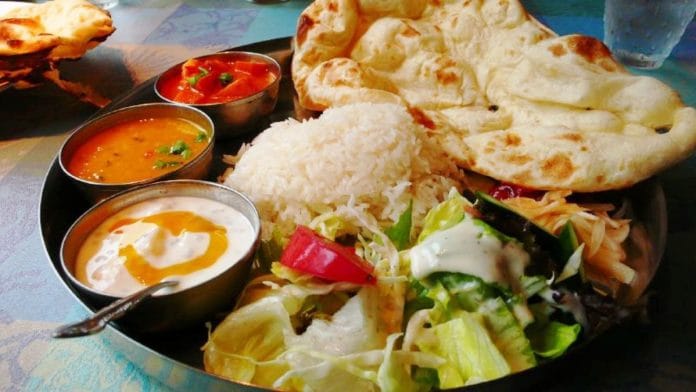
With rising incomes, the Indian thali also evolved. Families are no longer spending as much of their budget on food. The share of food in total household expenditure has fallen — from 53.4 per cent to 47.8 per cent in rural areas, and from 43.9 per cent to 40.8 per cent in urban areas.
“Spending on non-food items such as consumables and durable goods increased. Notably, the share of expenditure on cereals halved over the decade, dropping from 11.24 per cent to 5.13 per cent in rural areas and from 7.37 per cent to 4.04 per cent in urban areas,” the study found.
Also Read: Prisoners eat healthier than one-third of Indian households. Eating defines the new poor
Seasonal and geographic disparities
Indian food consumption, the paper found, isn’t just determined by expenditure but also by seasonality and geography.
The paper noted that the seasonal variation remains a determinant of perishable food intake. It highlights that urban fresh fruit consumption peaked in May and declined in December, while rural consumption peaked in June with troughs in December.
“Consumption of vegetables exhibited seasonality as well, with the lowest intake in July and the highest in January. Compared to 2011–12, seasonal fluctuations have narrowed, suggesting improved supply chain efficiency and year-round availability,” according to the paper.
But seasonality is only one part of the picture. Geography draws even sharper lines on India’s food map. Fresh fruit intake was noted to be highest in southern states such as Kerala while the dairy consumption showed a wider geographic divide, with higher intake in northern and western regions and the lowest in the eastern and southern areas.
Whereas, meat product consumption has been concentrated in the northeast, eastern coastal areas as well as Kerala. “While vegetable intake was elevated in eastern states, cereals dominated in the east and north, and pulses were more prominent in central and southern regions,” the paper noted.
(Edited by Insha Jalil Waziri)