






New Delhi: India installed more than 20 gigawatts of solar energy capacity this year, yet it still does not produce an ounce of polysilicon — the base raw material used for solar panels.
Despite registering the second-largest growth in solar capacity in 2025, second only to China, India’s upstream solar production remains in the ‘intended’ category, with manufacturing giants such as Adani Solar yet to begin operations.
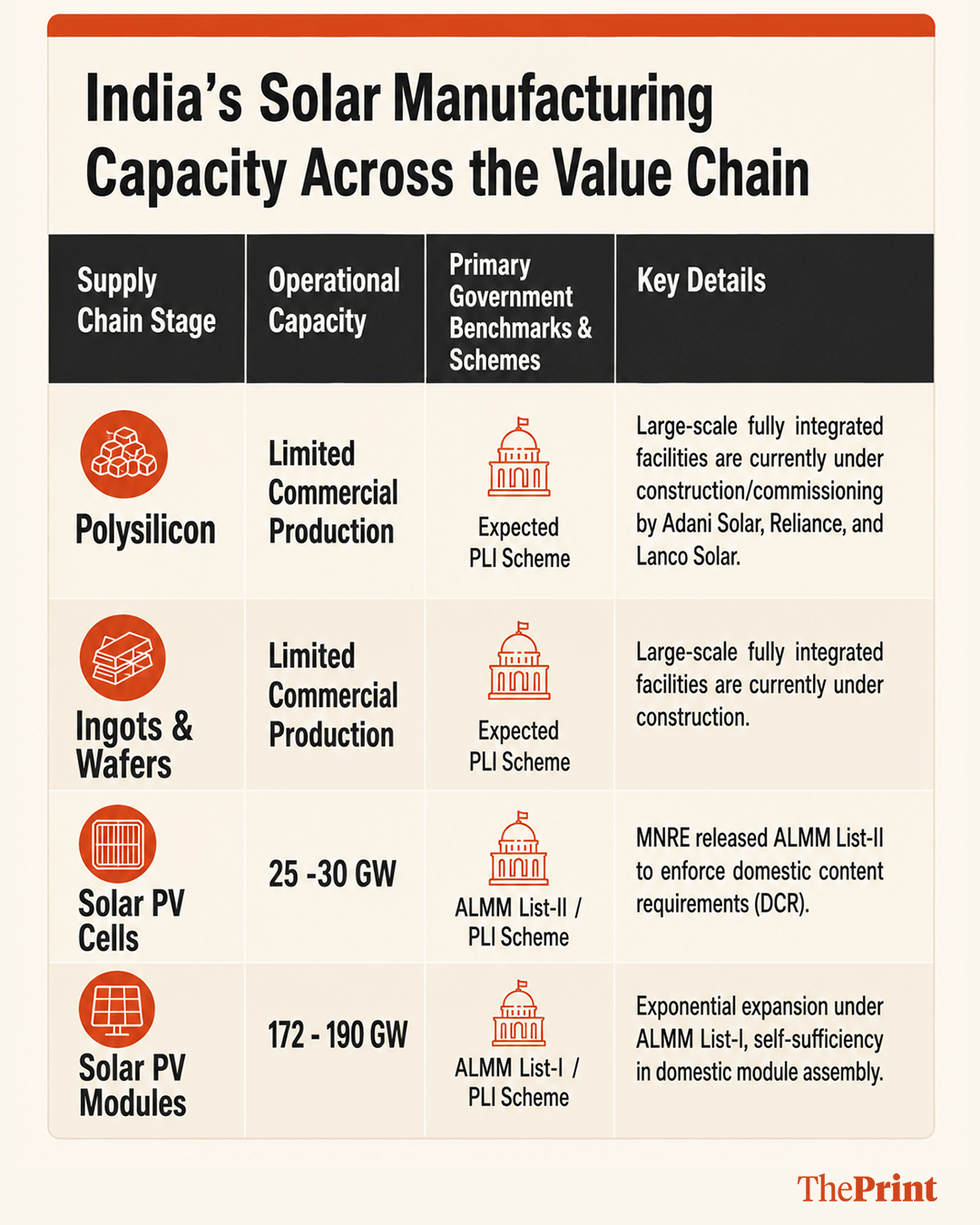
Currently, India has installed 163 GW of solar energy capacity, making it the country’s largest source of renewable energy. It has also achieved significant advancements in manufacturing solar panels and cells. However, these remain ‘downstream’ capabilities, and most manufacturers still rely on imported solar wafers, ingots and polysilicon — critical materials in the solar manufacturing supply chain.
On 7 August, the Union Ministry of New and Renewable Energy said it was planning a new production-linked incentive scheme for polysilicon manufacturing. The scheme would provide manufacturers with financial incentives to produce solar-grade polysilicon, an extremely pure form of silicon used to make solar cells.
Now, however, a handful of companies — Adani Solar, Reliance and Lanco Solar — have said they are in the process of producing polysilicon. Adani plans to start commercial production in 2028, while the other companies are yet to set timelines.
The PLI scheme would enable around 10 GW of polysilicon production capacity in India, but the MNRE has not yet revealed details of the scheme. Still, experts say it could bring about significant changes in the sector.
In 2021, the ministry announced a similar scheme for the production of solar photovoltaic cells and modules, which are the later stages of solar panel manufacturing. India now has around 173 GW of solar panel manufacturing capacity and 25-30 GW of cell manufacturing capacity, both of which continue to grow.
“India is moving towards building a completely Swadeshi solar value chain, with the target of achieving indigenous solar cell manufacturing by 2028,” said Prahlad Joshi, Union Minister of New and Renewable Energy, at an event in September 2025.
However, unlike solar cells and solar panels, polysilicon requires greater precision in production. It is not an assembly-line manufacturing process. To produce polysilicon from silica, manufacturers use highly reactive gases and extreme heat. Yet, China controls most of the world’s polysilicon production.
What is the polysilicon production bottleneck?
On 13 August, NITI Aayog released a report titled Key Sectors to Position India as a Manufacturing Hub, which has an entire section on solar photovoltaic manufacturing and how India can increase its footprint in the sector.
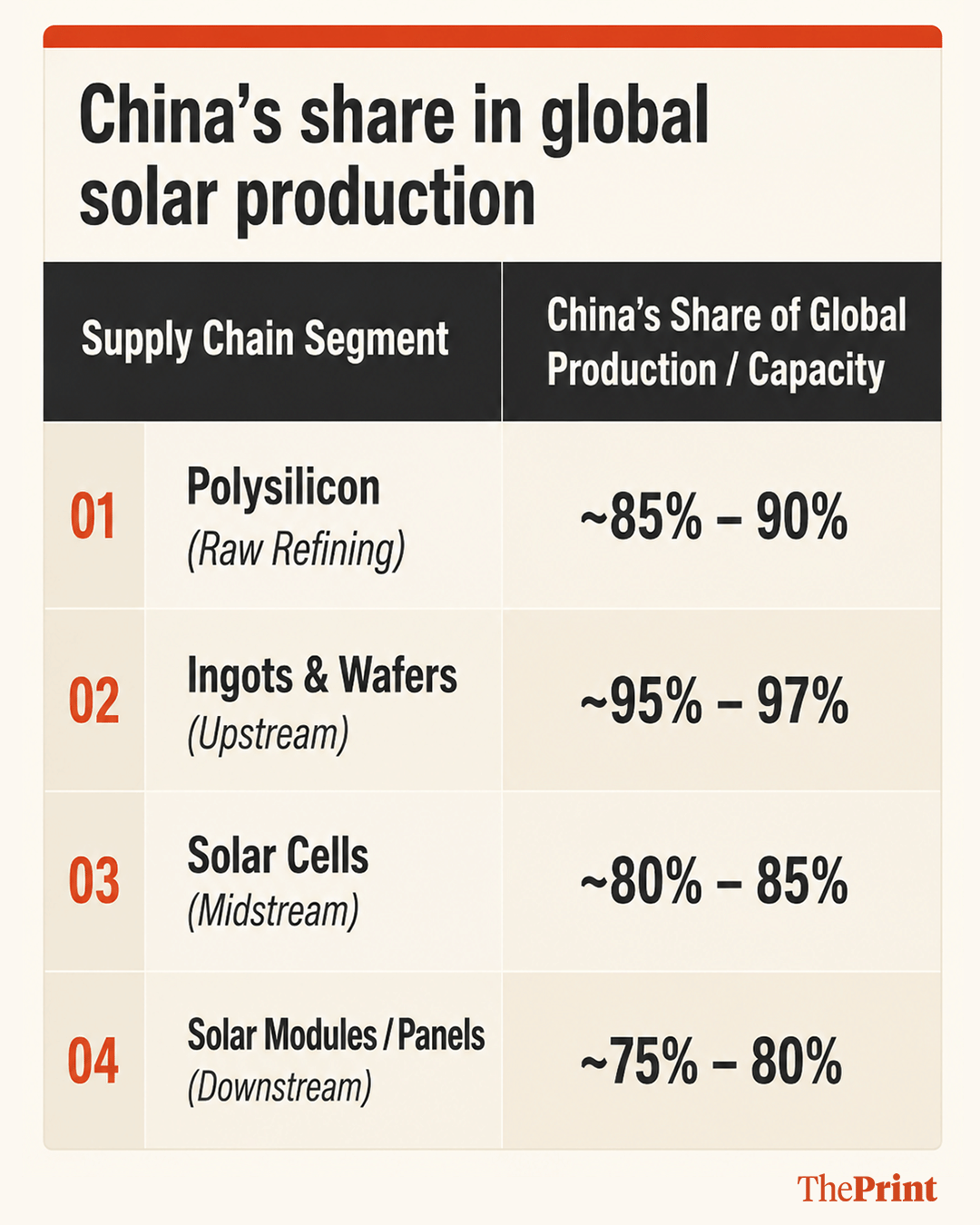
“China continues to dominate global PV manufacturing, with over 85% of global supply capacity and a highly integrated presence across polysilicon, wafers, cells and modules,” said the report.
A major reason India has focused on increasing indigenous production of solar panels, cells and polysilicon is China’s dominance of the global market, which increases strategic risks in the solar supply chain. However, the NITI Aayog also acknowledged that this dominance makes it difficult to establish commercially viable solar manufacturing capacity, given China’s cost advantage.
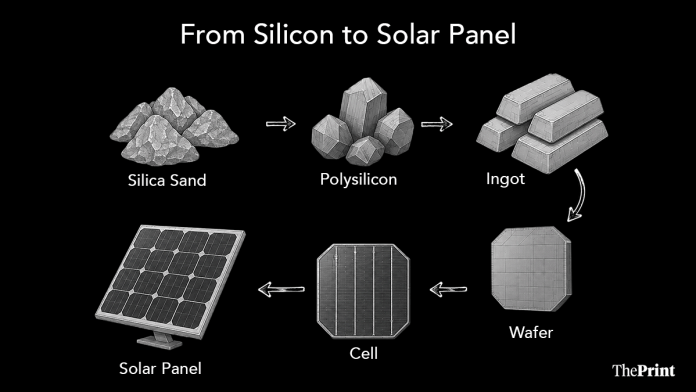
For any solar panel, coarse silica sand or quartz is converted into high-grade polysilicon, which is then made into ingots. These are sliced into wafers, which are processed into solar cells and finally assembled into solar panels.
India has managed to gain a foothold in the bottom two layers of this process — solar cells and solar panels. However, most producers of these cells and panels still import wafers and ingots from China, maintaining India’s dependence on imports.
While India’s demand for solar remains strong, and renewable energy capacity is expected to grow to 500 GW by 2030, the NITI Aayog report and a report by the Centre for Energy Environment and Water (CEEW) argue that India needs to adopt elements of China’s playbook to advance polysilicon production.
Why polysilicon will be helpful
Polysilicon is important not just for India’s burgeoning solar energy market; it is also a key material for critical technologies such as semiconductors. This is why India has tried to build indigenous polysilicon capacity since the 2008 Semiconductor Policy, which invited proposals for manufacturing polysilicon, single- and multi-crystalline ingots, wafers, solar cells and solar photovoltaic modules.
A 2022 paper by IIT Bombay scientist Narendra Shiradkar explored how, in the 1990s and 2000s, India was one of the few countries, alongside China and Taiwan, with a global solar manufacturing sector. From Tata BP Solar and BHEL to Moser Baer, Indian companies were producing solar modules and cells, and even exporting them to Europe, West Asia and the US.
However, this model collapsed around the 2010s, as China and other Southeast Asian countries began to dominate the sector. By starting early in the 2000s, deploying production at massive scale, and providing tax incentives and R&D support, China managed to build “cost leadership” in the solar sector, said the NITI Aayog report.
NITI Aayog now believes India should adopt a similar approach to polysilicon manufacturing. This would mean going beyond PLI schemes and linking tax and other fiscal incentives directly to research and development (R&D) in solar manufacturing. NITI Aayog also said India’s next step must be to focus on securing export-market access for its manufacturers.
“India should treat PV manufacturing as a long-term industrial policy priority, not only as a renewable-energy deployment objective,” said the report.
(Edited by Prashant Dixit)