






India finally has its electric flying taxi, but don’t expect to see city commuters climbing aboard just yet. The reality? Its first riders might be patients heading to a hospital, not office goers skipping traffic.
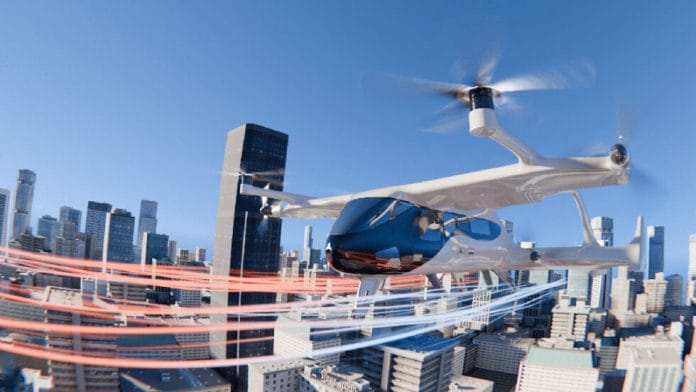
The ePlane Company, a Chennai-based deep-tech startup founded by IIT Madras professor Satya Chakravarthy, last week pulled the covers off PT-01, a prototype for India’s first full-scale electric vertical take-off and landing (eVTOL) aircraft.
The company’s 60,000-square feet production facility is located at the IIT Madras Discovery Campus in Chennai. It is trying to build India’s first new category aircraft PT-01, which itself is modelled on another prototype, the e200 X.
It looks like a flying car and hints at the future of urban mobility, but the team is starting somewhere more practical: as an air ambulance, not just another air taxi.
Hospitals already have helipads, and in emergencies, speed is everything. It’s a lot simpler and safer to get flying taxis off the ground as ambulances. PT-01 weighs about 2.2 tonnes, and its wings stretch 8 meters across. It can fly up to 110 kilometres on a single charge, carry a pilot and a 200 kg payload, which is enough for a patient, a paramedic and their gear, according to reports from The Times of India and Digit.
Unlike regular planes or helicopters, eVTOLs shoot straight up, thanks to multiple battery-powered propellers. This means that they don’t need much space to land. To ensure safety, there’s a built-in backup if one motor fails.
Prototype is only Step 1
With this prototype, India jumps into a global race already heating up in the US, Europe, and the Middle East, where companies are pouring money into electric aviation to beat traffic jams and shrink commutes in packed cities. But building a prototype is only step one. Turning it into a certified aircraft capable of carrying passengers is an even bigger challenge.
The ePlane Company plans to run ground tests next year and start more rigorous certification tests after that. If all goes well, commercial flights could begin by 2028.
A lot needs to happen first. Battery performance, air traffic control, costs, and let’s be honest, winning people’s trust are all big hurdles that electric aircraft must cross before lift off.
Yet PT-01 is still a big leap. India has usually just flown planes built elsewhere but now it is showing it wants to be a real player in designing the future of flight.
Will flying taxis become everyday transport or just an option for special situations? That’s going to depend on the technology, rules, and how much people actually want it. We won’t have those answers for a while. But right now, PT-01 proves that India’s ambitions for mobility are only growing.
(Edited by Aakriti Handa)