





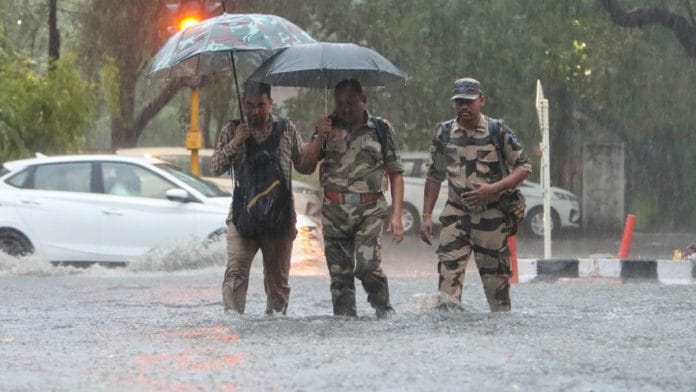


New Delhi: Most parts of the world have seen heavier, more intense storms with longer dry periods over the past four decades, leading to increased land drying, states a new study. Though it is pouring, that doesn’t necessarily mean the parched earth is getting more water.
The study titled ‘More concentrated precipitation decreases terrestrial water storage’ was published in the peer-reviewed scientific journal Nature on 13 May.
“It doesn’t matter where you are, more consolidated rainfall means less water is available for the land. We show that this phenomenon is consistent worldwide, what physically accounts for it, and what we should expect going forward,” Justin Mankin, the study’s senior author and an associate professor of geography, said in a statement by the University of Dartmouth.
The study, led by Corey Lesk, a Neukom Postdoctoral Fellow in Mankin’s Climate Modeling and Impacts Group, highlighted that the soil can absorb only so much water at once. Therefore, if a year’s worth of rain descends in a short period of time, what can’t be soaked up just evaporates instead of seeping into aquifers and ecosystems.
Lesk and Mankin analysed annual rainfall across the globe from 1980 to 2022. They found that regardless of the local climate, most parts of the world were seeing more concentrated rainfall. The study links this consolidation to climate change and states that rainfall is likely to grow even more consolidated with the rise of global temperatures.
An increase of 2 degrees Celsius could lead to abnormally dry land conditions for 27 per cent of the world’s population, offsetting any rise in total rainfall, the study says.
From Nile to Ganges
The duo also used the Gini coefficient, an economic tool usually used to measure wealth inequality, to capture the regularity of rainfall in a particular area.
When measuring inequality, the Gini coefficient represents wealth distribution on a scale of zero to one, where zero means everyone has the same income and 1 represents maximum inequality, where one person holds all the income.
In the case of precipitation, Leak and Mankin tweaked the Gini coefficient so that zero meant a region received the same amount of rain every day of the year, and one meant that all the annual rain fell in a single day.
The results show that the region west of the Mississippi experienced the highest rain consolidation. Major river basins such as the Amazon, the Nile, the Ganges, and the Yangtze also witnessed heavy storms and longer dry phases.
The Arctic, Northern Europe, and Canada saw a more even distribution of rainfall from 1980 to 2022. However, the study says this is likely because the region faces more rain and snow after temperatures have become warmer due to global warming.
Also read: Harrison Ford to graduating students—‘world my generation left you is a real mess’
‘Prolonged dry spells norm now’
Lesk and Mankin also predicted that Southeast Asia is likely to see the highest rain consolidation with each degree of global warming.
So far, the importance has been given to how much rain a place gets. But the study presents a new way of thinking about water resources. While the total amount of rainfall is still important, how and when rain falls is equally important.
“We discovered that it’s not just supply that counts, but also how it’s delivered. Rainfall concentration is essentially asking the land to drink from a firehose,” said Mankin.
In India, recent trends have also shown fewer and weaker westerly disturbances. These are non-monsoonal storms originating in the Mediterranean region that bring sudden winter rains to north-west India.
“Prolonged dry spells are the norm now. The environment is warming up, which means the air’s capacity to hold moisture is also increasing. This results in Cumulonimbus clouds, which are dense thunderclouds. We have massive thunderstorms that can last just 30 minutes sometimes,” Mahesh Palawat, Vice President of meteorology and climate change at Skymet Weather Services, told ThePrint
This consolidation of rainfall may also require new ways to manage public water supplies. Palawat says that canals should be built and rainwater harvesting should be set in place.
“When there is a sudden downpour, we need to be able to tap into the extra water, especially in states like Gujarat, Rajasthan, and Maharashtra, where the dry spells are growing more common,” said Palawat.
(Edited by Saptak Datta)