





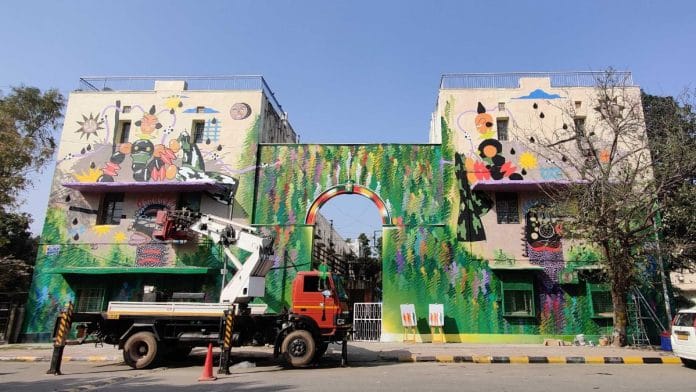



New Delhi: A sprawling, vibrant mural was inaugurated recently at Lodhi Colony’s Art District in Delhi by Spain’s Prime Minister Pedro Sánchez, marking a rare moment when neighbourhood graffiti and international diplomacy meet on the same wall.
The mural—named “Garden of Encounters”—is a three-way collaboration between Spanish street artist Suso33 and Delhi-based artists Ishaan Bharat and Tarini Sethi. Inaugurated on 18 February, the painting marks ten years of Lodhi Art District, India’s first public art neighbourhood. It was an initiative led by St+art India Foundation in collaboration with Asian Paints.
“Garden of Encounters” treats the street as a living meeting ground. Figures move across the wall, at times faceless, and at times, mythical and stylised, hovering between the surreal and the everyday rhythms of India.
Suso’s section dominates the central arch and upper facade—a dense, immersive field of green punctuated by streaks of red, orange and yellow. The strokes are almost vegetal, suggesting foliage, movement and anonymous figures dissolving into colour.
For Suso, the green represents a “zoomed-out” vision of India—vast and energetic. “It is how I imagine India from afar,” he said, through his wife and translator Annabelle.
At the top of the adjacent walls, Bharat introduces stylised, doll-like figures in drag. Sethi’s Picasso-inspired modernist figures complete the artwork.
Each artist contributes a distinct visual language of street movement, speculative identity and playful abstraction in an Indo-Spanish colour palette of green, red, and orange.
Curated this year under the theme “Dilate All Art Spaces”, the 2026 edition of the Lodhi Art Festival features six new murals across the art district. Earlier editions focused primarily on scale and expansion under co-founder Hanif Kureshi, who passed away in 2024. This year’s focus is on exchange across borders and identities. From three murals in 2015 to more than 65 today, Lodhi Art District has grown into a living, open-air collection.
Art beyond class
On Tuesday afternoon, the street was almost barren as the traffic thinned to an occasional car. A masked Suso, armed with spray cans, swayed gently on a crane, finishing the last strokes of green that stitch the two facing residential blocks together through a painted archway. Annabelle smiles from below: “He dances when he paints.”
Passersby inevitably lift their phones.
“We live in the photo generation,” Suso, 52, said matter-of-factly. “People scroll. They see art on social media. That is also a space.”
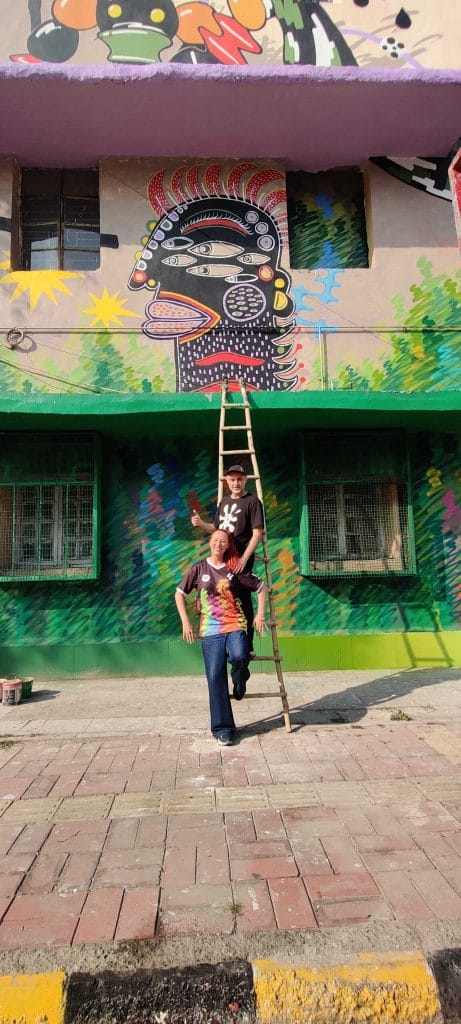
The three artists, however, faced interruptions as Delhi’s pollution, harsh summers, and practical challenges make outdoor work difficult. The artists worked in turns due to time constraints. Yet they say the reception of people, their smiles, conversations and curiosity, makes it worthwhile.
“In the end, it’s about expressing yourself with others,” Suso said. “That is the greatest pleasure.”
For the Madrid-based artist, art is not just for the elite who frequent museums. “Art is for everyone. Those who cannot visit museums can admire art on the street. It is beyond class,” he said.
He doesn’t mind the weather or the lack of audience when nature doesn’t cooperate.
“Everything is now tele-grafitti. Art is accessible through mass media now. Even if you can’t see a mural outdoors, you can see it on your phone. That vast reach gives me immense satisfaction. The effort is worth it,” he said.
Also read: Does The Kerala Story 2 show God’s Own Country as centre of terrorism? Pinarayi Vijayan says so
A wall in three languages
‘Garden of Encounters’ unfolds vertically and across surfaces. At the top, on both sides, sit stylised, doll-like figures inspired by Channapatna wooden toys—Karnataka’s traditional, stackable lacquer dolls that can be dismantled and reassembled. Ishaan reimagines them as drag figures, hair flowing, expressions exaggerated, and posing for cameras.
“It’s about identity,” Ishaan said. A visual and performance artist who works with 3D printing and drag, he sees the dolls as metaphors. They are breakable, rearrangeable and fluid. “They can be taken apart and put back together. That’s also how I think about identity.”
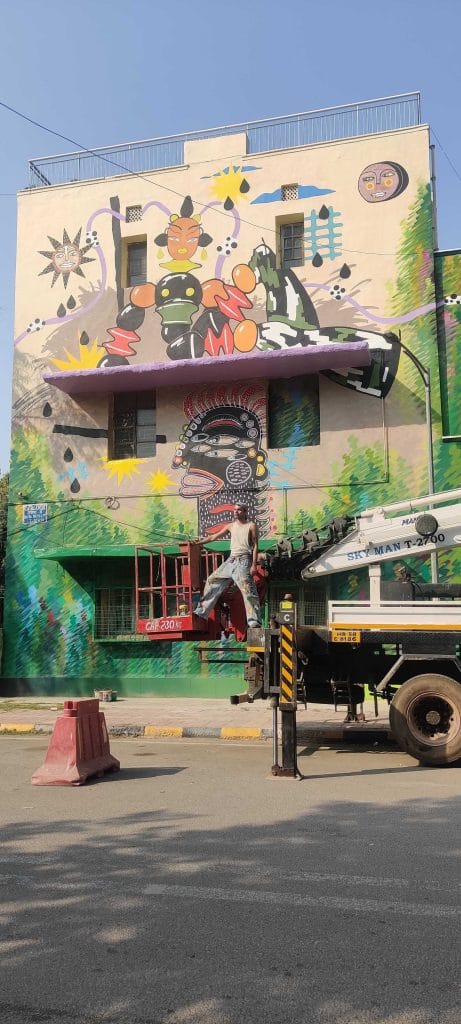
Openly queer and a drag performer, Ishaan’s figures are playful and political and a futuristic representation of India’s crafts. He uses the craft to stage a contemporary assertion of queer presence that is rooted in culture but looks beyond it.
Below, Tarini’s section introduces folk-inflected forms—creatures in masks and graphic contours—drawing from both Indian visual traditions and European modernism, mainly Pablo Picasso.
For Suso, art is a universal language. While collaborating with two Indian artists who do not speak Spanish, Suso held that belief. “I didn’t need many words; I could communicate through art,” he said.
Also read: Who is Kolkata-born Jay Bhattacharya, new acting chief of US medical body?
Branches of the same tree
Suso started painting at 11. He believes public art is not an alternative to institutional art but one branch of a larger ecosystem.
“All forms of art can coexist without competing,” he said. “Street art, murals, performance, human art—they are branches of the same tree.”
Awarded Spain’s Gold Medal for Merit in Fine Arts in 2025—the first graffiti artist in the country to receive the honour—Suso remains committed to painting outdoors.
By Tuesday evening, the work was wrapped up. Suso steps down eventually, hands stained, body still in rhythm.
He has murals lined up across Spain and says he will never retire. “This is my life. I will paint until I cannot move,” he laughed, smoking a hand-rolled cigarette.
(Edited by Saptak Datta)