


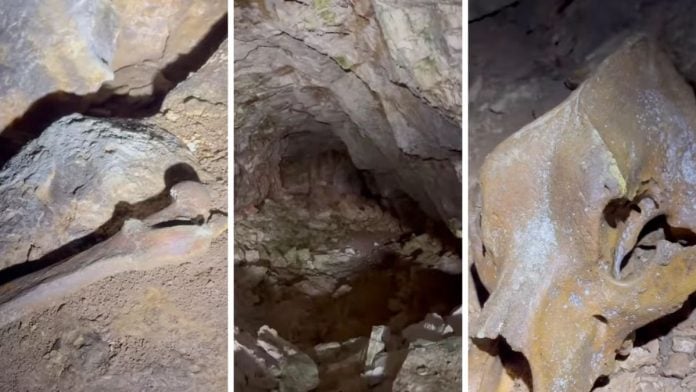
New Delhi: Scientists have discovered hundreds of ancient bones in a hidden cave in Italy’s Dolomites, offering a rare glimpse into the lives of giant bears that roamed the Alps during the Ice Age.
Mountain guide Kurt Walde discovered the cave on 3 July at an altitude of more than 2,850 meters. He first spotted a black mark on the mountainside three and a half years earlier but had to wait until he could safely reach it. Inside, he found an extensive collection of ancient remains, including skulls and what appeared to be almost complete skeletons.
“I was impressed with the number of bones,” Christian Terzer, director of the South Tyrol Archaeology Department, told the BBC. “There are hundreds and hundreds of bones there. I don’t know how many individual bears are inside, but it’s quite a lot.”
The discovery, reported by the BBC on 14 November, has attracted attention because the cave could offer a detailed record of prehistoric wildlife in the Alps. The remains are believed to belong to Ursus ladinicus, an extinct cave bear associated with the Dolomites. However, scientists are yet to complete their investigation of the site.
The cave is located in the Fanes-Senes-Braies Natural Park, in South Tyrol, northern Italy, close to the previously known Conturines Cave. The discovery could help researchers understand how these bears lived in the high mountains, what their environment looked like and how they accessed caves that are now difficult to reach.
‘Landscape and conditions are different now’
The cave bears were among the largest bears to have lived in prehistoric Europe. Despite their size and fearsome appearance, they were largely herbivorous, feeding on vegetation rather than hunting other animals.
The species believed to be represented in the newly discovered cave, Ursus ladinicus, was found in the region’s Conturines Cave in 1987. Its remains helped scientists identify it as a distinct cave bear species. These animals lived in the Dolomites around 50,000 years ago, with estimates suggesting they could weigh up to 1,200 kg and grow to about three metres in length.
However, their habitat looked very different from the landscape visitors see today. During the Ice Age, environmental and climatic conditions in the Alps changed considerably. The tree line was higher in some periods, and vegetation could grow at elevations that are now too cold for it.
Bears’ remains, along with evidence preserved in caves, can help scientists reconstruct the climate and vegetation of the region. The cave’s proximity to Conturines Cave also raises the possibility that the two sites were once connected, although researchers have not established such a link.
Vertebrate palaeontologist Martina Pacher, who took part in excavations at Conturines Cave, told the BBC that the discovery raises questions about how the bears entered the cave in the first place. Its entrance is now extremely difficult to access, suggesting that the landscape and conditions may have been different when the animals lived there.
Also read: Gen X has more health problems at 50 than Baby Boomers, UK study finds
‘Possibility of more complete assemblage of bones’
Beyond the number of bones, it is the condition and arrangement of the remains that make the discovery particularly important. Researchers have found bones lying in unusual positions, including a solitary bone resting on an elevated rock formation resembling a table. Scientists are yet to establish whether these arrangements occurred naturally or whether humans may have entered the cave thousands of years ago.
There is also the possibility that the cave contains remains of other Ice Age animals. Cave lions, hyenas and leopards have been found in other Alpine caves from the same period.
Spyridoula Pappa, a researcher at London’s Natural History Museum, sees the discovery as an opportunity to study the animals in greater detail.
“What excites me about this is the possibility of studying a much more complete assemblage [of bones],” she told the BBC. She hopes the remains will allow scientists to use evidence from teeth, skeletons, genetic material and geological records to build a fuller picture of these animals.
“We also need to see if they are all cave bear remains,” Pappa said.
The immediate priority is to protect the site. After the discovery was reported to authorities, South Tyrol’s archaeological department installed a metal gate and a monitoring system at the cave entrance to prevent unauthorised access and possible damage to the remains.
(Edited by Saptak Datta)