





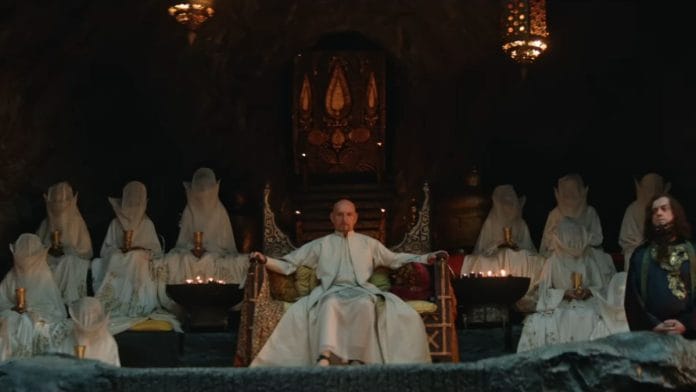


New Delhi: More than four years after it finished shooting, Desert Warrior, the first major movie filmed in and produced by Saudi Arabia, finally released in American theatres Friday. Inspired by pre-Islamic Arabian lore, the movie is set amid the warring desert tribes of seventh-century Saudi Arabia. It tells the story of a tribal princess seeking the aid of an infamous bandit to topple a powerful ruler.
The movie boasts a star-studded cast and crew. Desert Warrior is helmed by British director Rupert Wyatt, best known for the 2011 blockbuster Rise of the Planet of the Apes. It stars MCU’s Anthony Mackie, veteran South African leading man Sharlto Copley, and Ben Kingsley, who won an Oscar for his portrayal of MK Gandhi in the celebrated 1982 biopic.
Yet, even the film’s $150 million budget could not ease its path to audiences. A difficult three-month filming schedule in the sweltering Arabian desert was made even trickier by the Covid-19 pandemic, which Business Insider reported had doubled its budget.
Midway through post-production, Wyatt was taken off the editing process. He told Variety he had been “sidelined” for disagreeing with changes the studio insisted on. In July 2023, a screen test of a cut produced without Wyatt’s involvement failed to interest three-quarters of test viewers. After the director was brought back to re-edit, the movie screened for the first time at the Zurich Film Festival last September. The producers finally found a distributor in February, following months of negotiations.
Also read: Bollywood rom-com line-up this summer—from family chaos to love triangle
A showcase for Neom’s Media Village
The film’s release is significant for a nation in which cinema was banned until 2018. According to a production executive, one of the main characters is a “fierce, female hero”, falling neatly in line with the country’s attempts to present a more modern image abroad. Produced by MBC Studios, a company controlled by the Saudi sovereign wealth fund, the film has been viewed as part of the kingdom’s expanded cultural diplomacy efforts, as it seeks to diversify its oil-centric economy and revamp its international image.
Large parts of Desert Warrior were shot around the planned site of Neom, the mega-project whose flagship, The Line, is conceived as a 170 km linear desert city. The production hopes to showcase Neom’s Media Village film production infrastructure. The producers have been open about their ambitions for the movie to supercharge the nascent Saudi film industry, with its production acting as a “living training ground” for Saudi Arabian production crew, Variety reported.
Early reviews have been lukewarm at best, with praise for the movie’s production value and little else. Deadline termed the movie ‘stodgy’, while The Hollywood Reporter criticised its ‘paper-thin characterisations’. Desert Warrior now faces a tough opening weekend, debuting alongside the eagerly awaited Michael Jackson biopic. Next weekend, it will face off against the sequel to the 2006 hit The Devil Wears Prada.
As a rule of thumb, large productions must gross twice their budget just to break even; for Desert Warrior, that would require $300 million. Saudi Arabia’s movie dreams were already dented by the dismal performance of Kandahar, the 2023 action thriller co-starring Bollywood actor Ali Fazal, which was shot in the country and partially funded by MBC Studios. If Desert Warrior flops at the box office, it will be a serious blow to a national film industry struggling to find its footing.
Sahaj Sankaran is an alumnus of The Print School of Journalism and an intern at ThePrint.
(Edited by Prasanna Bachchhav)