





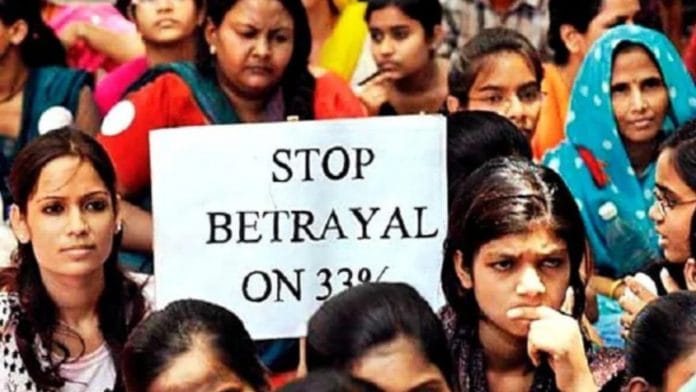



New Delhi: With the Centre pushing to reserve 33 per cent seats for women in Parliament and state Assemblies, a group of former civil servants, professors, activists, and advocates have flagged the “opaque” and “non-consultative” manner in which related legislations are being brought in the upcoming special session of Parliament.
In a statement, issued on Monday and endorsed by 262 people, the group of academics and former civil servants expressed deep concern over the “complete lack of transparency regarding the draft legislations proposed to be taken up during the 3-day special extension of the Budget Session”. They also demanded that the draft bills be made public and put through public consultation.
Parliament is expected to discuss three bills during a special sitting from 16 April to 18 April, with the aim to implement women’s reservation in Lok Sabha and Assemblies by 2029.
The Nari Shakti Vandan Adhiniyam (Women’s Empowerment Act) Amendment Bill was passed in Parliament in 2023 to reserve one-third of seats for women in the Lok Sabha and state Assemblies. But, as per the Act, the reservation cannot be implemented unless the delimitation exercise is completed after the 2027 Census, which would push the implementation to 2034. In order to expedite the process, the Centre is set to make amendments to the Act in the special session this week. If the amendments are passed before the 2027 Census, then the implementation will be based on the 2011 Census.
Also read: Low wages, no overtime pay—why workers in Noida are protesting
The demands
The amendments will also pave the way for an increase in the total number of Lok Sabha seats from 543 to 816, out of which 273 will be reserved for women.
But the signatories argue that the proposed legislation will have “tremendous impact” on democracy. Hence, they demand that the text of the draft bills be shared with the public in multiple languages and through different media. They also want the bills to be put through “robust public consultation, in line with the Pre-legislative Consultation Policy”.
“While we wholeheartedly support reservation for women in legislature, and many of us have been part of campaigns demanding the same, we strongly oppose the secretive, nondemocratic manner in which the proposed legislations are being brought,” the statement read.
The signatories also highlighted the “irony” that while the legislation is being brought for women empowerment, it fails to include women in the conversation.
“A reform of such historic magnitude deserves transparent debate, public scrutiny and the inclusion of diverse voices to ensure it truly empowers people, rather than being rushed through in the midst of ongoing state elections as a political tool,” the statement said.
The signatories include transparency activist Anjali Bhardwaj, political scientist Nivedita Menon, AITUC leader Annie Raja, former ambassador Meera Shankar, former IAS officer and author Harsh Mander, and RTI advocate Amrita Johri, among others.