





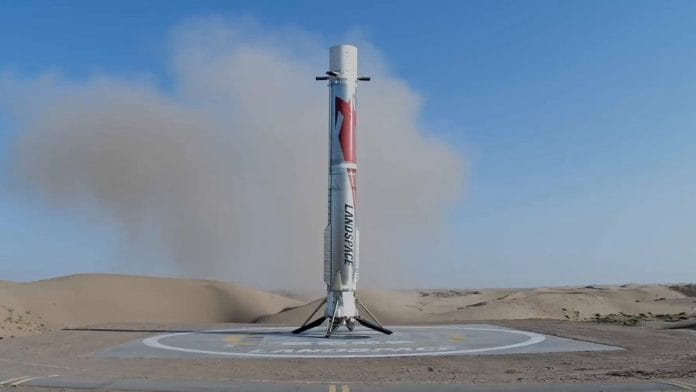

New Delhi: China’s space programme has hit a new milestone. The first stage of LandSpace’s Zhuque-3 Y2 rocket made a controlled soft landing on solid ground on 19 August. It is the second time the country has recovered a rocket stage, though the first time was on a sea platform back in July.
The booster touched down at a dedicated recovery site in Minqin County, Gansu Province, roughly 390 kilometers downrange from its launch pad at the Dongfeng Commercial Space Innovation Pilot Zone in northwest China. This marked the country’s first successful land-based recovery of a rocket stage using deployable landing legs.
The Zhuque-3, developed by Beijing-based commercial firm LandSpace, is a two-stage, liquid oxygen-methane (methalox) vehicle standing 66.1 meters tall with a 4.5-meter diameter, according to Xinhua, the official state news agency of China.
Its stainless-steel first stage is powered by nine Tianque-12A engines and equipped with grid fins, attitude-control systems, and landing legs. After separating from the second stage about 137 seconds after liftoff, the booster executed a sequence of high-altitude adjustments, re-entry deceleration burns, aerodynamic glide control, and a final propulsive landing burn before deploying its legs for a soft touchdown. The second stage successfully delivered the Honghu-03 satellite into its planned orbit.
Also read: After ‘Operation Safed Sagar’, makers return with documentary on MiG-21’s 62 years with IAF
First in the race
This came just over a month after China Aerospace Science and Technology Corporation (CASC) recovered the first stage of its Long March 10B rocket at sea on 20 July. The mission used a novel net-capture system on an offshore vessel in the South China Sea—the world’s first such recovery of an orbital booster. The two successes establish China as the first nation to demonstrate controlled recovery of orbital-class boosters via two distinct technical paths.
The company aims to reuse Zhuque-3 boosters up to 20 times, supporting high-frequency, lower-cost launches for satellite constellations and other commercial missions.
Reusable rocket technology is regarded as essential for reducing launch costs and increasing flight rates, following the model pioneered by SpaceX’s Falcon 9.
Experts note that China is now the second nation after the United States to achieve orbital-class booster recovery, reflecting coordinated advances across both government and commercial developers.
(Edited by Ratan Priya)