





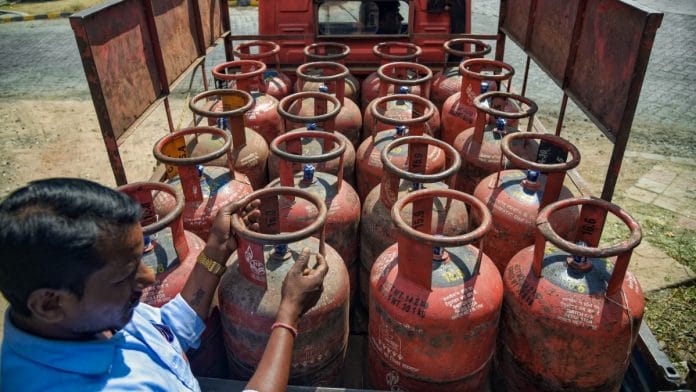



New Delhi: As the LPG shortage squeezes restaurants and food vendors across several cities in India, some eateries are beginning to pass the burden directly to customers by charging them the cost of cooking gas on restaurant bills.
Bills showing separate “gas charges” from restaurants in Chennai and Bengaluru have gone viral on social media, triggering a debate over whether eateries should add such surcharges as the conflict in the Middle East intensifies, straining global energy supply chains.
A bill from Geeras Restaurant in Chennai is currently circulating on social media. The receipt shows a separate Rs 9.52 charge for gas in addition to food costs. ThePrint tried to reach out to the restaurant but didn’t receive a response.
Similar bills have surfaced from Bengaluru as well. In a bill shared on X, a restaurant called Mr Andhra Meals was seen charging an additional Rs 30 under the label “gas supply issue”. “Already in Bangalore PG announced food shortages and won’t be varieties. Went to hotel they are charging for gas shortage. Such a scam, they looting us every possible way,” the user wrote.
The restaurant, however, had a clarification. “We are being transparent. We ask customers if they want to pay the extra amount and only then add it. We have not increased our menu prices, which is why we are showing the cost separately,” the manager of Mr Andhra Meals told ThePrint.
According to him, the restaurant has not received cylinder supplies for four days. “We are rationing the gas we have so that it lasts for two more days, but we are not sure how long it will last. If we are getting cylinders that are costing Rs 4,000. We either have to shut down or recoup that cost somehow,” the manager added.
He said that there are 15 employees in the outlet, and their salaries, along with electricity bills and rent, will have to be paid. “Our costliest item is Rs 200, and we are only adding Rs 5 to 15 extra, depending on the order. There has already been a 30 per cent loss, and I am worried about what will happen next,” he said.
The original cost of a commercial LPG cylinder in Delhi is around Rs 1,900. The initial hike was around Rs 300 per cylinder. But rising crude prices have led to the cost of cylinders across Delhi and other metro cities to almost double, according to vendors.
The controversy has exposed a recent strain across food businesses: as cylinder supplies dry up and costs skyrocket, restaurants and street food vendors say they are cutting menus, increasing prices or scrambling for alternatives just to keep their kitchens running. Some have even shut shop temporarily.
‘Consumer anxiety’
Petroleum Minister Hardeep Puri said that while this is an “unprecedented” crisis, the LPG panic is being driven by “consumer anxiety”. Prime Minister Narendra Modi also warned that action would be taken against those spreading panic.
ThePrint also contacted several restaurants across Chennai, Bengaluru and Delhi to understand how eateries are responding to the shortage. In Chennai, restaurants such as Salt Indian Restaurant, Spice and Dum, and Zeeshan Restaurant said they have neither added a separate gas charge nor increased menu prices so far.
In Bengaluru, responses were mixed. Desi Masala, a buffet restaurant, said it has not introduced a separate gas charge but has increased the price of meals by Rs 30 to offset rising costs. However, others like Eden Park Restaurant said it has not raised prices yet.
In Delhi, restaurants, including Hauz Khas Social and Karim’s, said they have not increased their prices so far despite supply concerns. At Udupi cafe in ITO, the management said that, as of now, there is no shortage as they are using a different supplier, and therefore have not had to increase the costs.
“We have reduced the items on our menu that use more gas, such as fried items like vadas and elaborate thalis, but we have kept the same cost,” they said.
However, the restaurant industry body says it has not seen members adding separate gas charges yet. National Restaurant Association of India (NRAI) Noida chapter head Varun Khera said the authenticity of such bills circulating online would need to be verified.
“As far as our members are concerned, we have not seen restaurants adding a separate charge for gas,” Khera told ThePrint. “Restaurants are instead trying to reduce their dependence on LPG by shifting some operations to induction cooktops, electric fryers, microwaves, coal and tandoors so that the burden on gas is less,” Khera added that restaurants are reluctant to increase prices, as higher costs could drive the customers away.
He noted, however, that the impact of shortages is often felt more sharply in the unorganised sector. “Nearly 50 per cent of the industry is unorganised, street vendors and small eateries, who are not under our association. They are more vulnerable to fluctuations such as increases in vegetable prices or fuel shortages,” he said.
Also read: 2 healthy bustard chicks hatch at Jaisalmer centre. ‘Important milestone’
Uncertain future
The shortage is already worrying small street vendors who rely entirely on LPG cylinders. At Connaught Place’s Dhaba Food, known for its rajma chawal and chole bhature, owner Anil Mehta says he has already drastically cut down the menu.
“With this situation, we have stopped selling everything else and are only serving two items–rajma chawal and kadhi chawal. This is the only way we can avoid increasing prices,” Mehta said. The once-busy shop has grown quieter this week, with business dropping by nearly 50 per cent.
“We only have cylinders left for the next one or two days. My son and manager have been going to different gas agencies for two days to find cylinders. We are not sure what will happen after that,” he said. Although he has not heard of restaurants adding separate gas charges in the area yet, he says prices of items from chai to tawa parathas have already nearly doubled.
Baljeet Singh, who sells parathas near central Delhi’s ITO, says he is fearful of what tomorrow may bring. “The shortage of gas is extremely worrying for me. We have not received a cylinder in two days. Now we only have enough gas left for today,” he said. Singh usually gets cylinders daily from local gas agencies, as do most vendors in the lane.
“For now, we have reduced the number of items we are selling. But it would be wrong for customers if we increase the price. Most of our customers are regular middle-class people. If someone has to bear the burden, it should be me,” he said.
Pointing to the usually bustling row of stalls, Singh fears the situation could worsen soon. “It doesn’t look like we will open the shops tomorrow. Nobody in this lane will,” he said.
(Edited by Saptak Datta)