



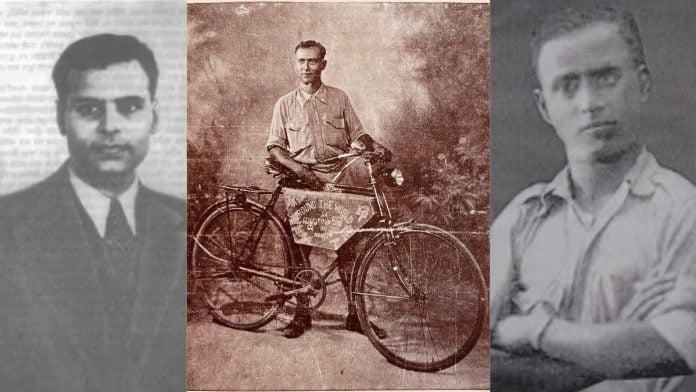
New Delhi: In the winter of 1926, four young Bengali men set out from Calcutta on bicycles, beginning a journey that would take them across continents. They had limited funds but they were determined to travel the world at a time when the British Empire continued to portray Indians, particularly Bengalis, as physically weak and incapable of governing themselves.
Their journeys challenged colonial ideas about Indian ability and independence.
In the Bohemian Alps, Bimal Mukherjee and others cycled through freezing winter conditions with little protection against the cold. Mukherjee later joked that they survived the freezing conditions because they carried India’s sunshine with them.
“One of the most interesting things about these cyclists is that their bodies themselves became part of their argument against colonialism,” said Souvik Naha, a historian at the University of Glasgow, whose research examines Indian globe cyclists and they way they challenged imperial rule.
Mukherjee and Ramnath Biswas, another Bengali traveller who undertook three international journeys, returned from their final tour in 1940. Through their travelogues and newspaper articles, they questioned British rule and explored India’s place in a world shaped by colonialism, capitalism and different political ideas.
Naha’s research, published in the South Asia: Journal of South Asian Studies in June 2026 under the title Revolutions in Motion: Indian Globe Cycling and the Challenge to Empire, 1920s-30s, examined how their travels acquired a political meaning. The study draws on their writings to show how cycling allowed the men to challenge colonial stereotypes while developing their own understanding of societies beyond India.
“The more interesting point is that these men turned their physical experiences into political meaning when they wrote about them. Their journeys effectively claimed that the colonial stereotype of the weak Indian does not correspond to what Indian men are actually capable of doing,” Naha said.
Four travellers
For Mukherjee, the journey began on 12 December 1926, when he and three others left Calcutta’s Town Hall on bicycles. Mukherjee’s world tour ran from 1926 to 1937. They travelled through parts of Europe, Asia and the Americas. Mukherjee later documented his experiences in Du Chakay Duniya, which translated into The World on Two Wheels.
In the Thar Desert, Mukherjee and his companions sometimes had to carry their bicycles because the sand made cycling impossible. In the Bohemian Alps, the winters tested their endurance. Such episodes made their journeys a practical challenge to colonial ideas that associated physical strength and adventurousness with European superiority.
The bicycle too had a political significance. It was an inexpensive way to travel independently, without relying entirely on the established transport and hospitality networks used by wealthier travellers.
Biswas, born in 1894 in Baniachong, present-day Bangladesh, had little financial resources. He began his first world tour from Singapore on 7 July 1931. Over the following years, he travelled through parts of Asia, Europe and Africa, undertaking three international journeys before returning for his final expedition in 1940.
He relied on odd jobs, help from strangers and whatever money he could find to continue travelling. Mukherjee also took up work and gave paid talks to fund his journey. Both had to find ways to pay for food, shelter and bicycle repairs along the way.
“Their lack of money fundamentally shaped the kind of world they encountered,” Naha said. “Wealthier travellers normally moved through steamships, trains, hotels and colonial networks, which meant that they tended to meet officials, businessmen and other members of the social elite. Mukherjee and Biswas had a completely different experience.”
The bicycle gave them the freedom to stop in smaller towns and villages, meet people along the road and travel beyond the usual routes of elite tourism. These encounters also shaped their political understanding.
Biswas, in particular, became interested in socialist ideas and anti-colonial movements. His travels encouraged him to connect British rule in India with wider questions about capitalism, class and imperial domination.
“They were not simply travelling around the world; they were discovering a different social geography of the world,” said Naha.
Also read: Delhi Ramlila’s fourth effigy is a pink, moustached man with a cockroach crawling up his chest
A new social geography
Mukherjee’s recollections included a meeting with former Irish President Éamon de Valera, observations of public life in Soviet Russia and even an encounter with Adolf Hitler. These experiences offered different perspectives on nationalism, freedom and political power. Ireland provided a point of comparison with India’s struggle against British domination.
“Soviet Russia offered something different. Mukherjee was fascinated by what he saw as a society attempting to reduce class inequality and provide greater access to education, healthcare and public institutions. It gave him an example of a possible social order beyond colonial capitalism, although his account of Soviet Russia was also idealised and should not be treated as an objective description of the Soviet system,” said Naha.
Mukherjee’s meeting with Hitler showed him that opposing Britain did not necessarily mean supporting freedom and equality. Nationalism could also fuel ambitions to dominate other countries.
“Biswas began to view British rule in India as part of a wider system of imperialism and capitalism. Although neither man developed a detailed comparison of the struggles in Ireland, Russia and India, their travels helped them understand India’s fight for independence in the context of wider movements against colonial rule and social inequality,” said Naha.
Also read: In countries with written constitution, people are the final authority in everything: Morarji Desai
Travelogues and novels
Their travelogues allowed readers who had never travelled abroad to encounter other societies through the cyclists’ experiences. Biswas was particularly prolific, producing 39 travelogues and novels in Bengali and English, according to research published in the Journal of Global History. He also wrote for publications including Anandabazar Patrika, Prabartak and Desh.
His writings addressed readers beyond the privileged English-speaking elite. By describing foreign societies, political movements and ordinary people, he helped make international experiences accessible to a common Bengali reader.
Mukherjee’s Du Chakay Duniya similarly recorded the challenges and encounters during his world tour. The books became ways of discussing race, empire, social inequality and India’s position in the world.
However, their popularity does not tell us how many people read their books or whether the writings inspired others to join the freedom movement.
“There is good evidence that their journeys attracted considerable public attention, Ramnath Biswas even has a road named after him in Kolkata, but I would be cautious about claiming that their writings directly produced political activism on a large scale,” Naha said.
Their journeys have received far less attention than the political leaders, mass movements and campaigns that dominate popular accounts of India’s freedom struggle. But their travels were achievements. They returned with accounts that challenged the limits colonial rule sought to place on Indian identity and ambition.
(Edited by Janaki Pande)