





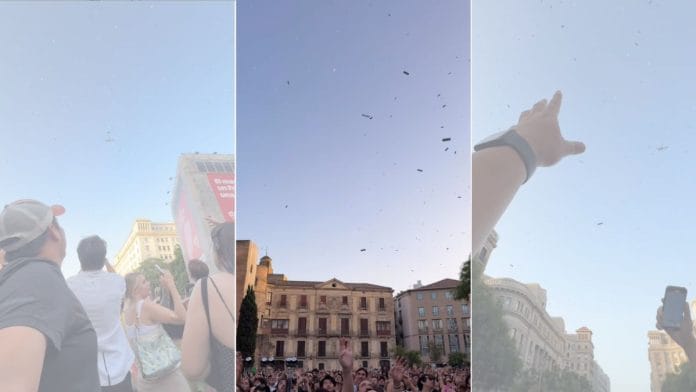


New Delhi: Barcelona was bombed with over 1,00,000 aerial ammunition—of the literary kind. A helicopter dropped bookmarks with Catalan and Spanish poems on the theme of freedom over the city’s Gothic Quarter, to commemorate 50 years of Spanish democracy.
The poems, written by 50 Catalan poets and 50 Chilean ones, were dropped as part of an artistic performance by the Chilean collective Casagrande. The collective has organised similar poetry bombings in nine other cities, including London, Berlin, and Gernika.
The project focuses on cities that were bombed from the air, figuratively returning their skies to the residents through poems. Barcelona endured 1,903 bomb attacks from 1937 to 1939 during the Spanish Civil War. The attacks claimed over 2,700 lives and injured around 7,000 people.
As the videos of the event on 20 June were posted on Instagram, people worldwide showered praise on the initiative. “Humans can be so cute sometimes,” read a comment. Others expressed the hope that a similar event would someday happen in Palestine too.
“Raining poems gotta be my favourite weather,” said a comment.
The event stood as a testament to the unifying and healing power of art and beauty. Poet and writer Lena Tuffaha, however, didn’t like the name of the event.
“Could we have gone with ‘raining poems’? Unfortunate naming for this event,” she wrote.
The first poetry bombing
The event took place in Rotterdam, Netherlands, in May 2025, marking 85 years since the city was bombed during the Second World War. Poems by 50 Dutch and 50 Chilean poets rained down on the city, printed in both the original language and in Dutch or Spanish translations.
The first poetry bombing took place in Santiago, Chile, in 2001. The city was heavily bombed during the 1973 military coup. The Casagrande collective later expanded the project into a wider project, taking it to Dubrovnik (2002), Warsaw (2009), and Berlin (2010).
Bombinh has recently emerged as an artistic practice, where artists occupy the public space to deliver a message.
“The influence of guerrilla art is important for the interpretation of bombing since they share the same urgency of delivering a message: guerrilla through communicative inversion and bombing through repetition,” read a recent article by Rachele Gusella and Ann Peeters in Audioliterary Poetry between Performance and Mediatization (2024).
Also read: Muharram procession in UK met with online hate. Good luck Britain, says Polish MEP