





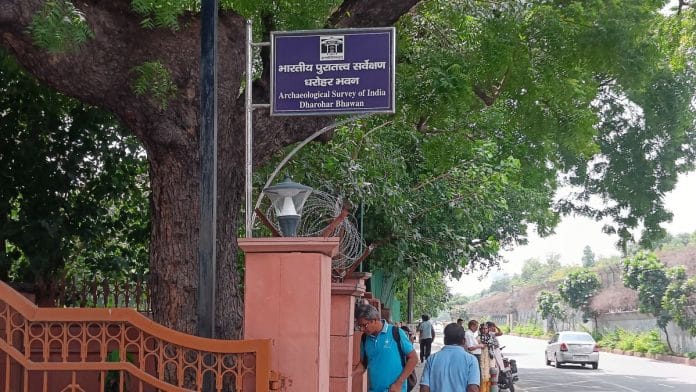



New Delhi: One-third of the sanctioned posts in the Archaeological Survey of India are vacant, according to data presented in the Lok Sabha by the Minister of Culture Gajendra Singh Shekhawat.
Out of the 7,585 sanctioned strength, 2,646 posts are vacant across the 38 circles of ASI.
ThePrint analysed the parliamentary data and found that all ASI circles are grappling with a severe staffing crisis. Shekhawat was replying to a question asked by the All India Trinamool Congress MP Sharmila Sarkar.
Shekhawat revealed that in Bhopal, out of 393 sanctioned strength, 201 posts are vacant. In Delhi, out of 622 posts, 158 are vacant. In Agra, out of 552 posts, 132 are vacant. Cities such as Aurangabad, Amravati, Jabalpur, Mumbai, Puri and Srinagar are also facing a similar staffing crunch in the 165-year-old organisation.
“The staff shortage is one of the biggest challenges facing the ASI. The staff crunch impacts the monitoring of protected monuments on the ground, and also circles are overloaded with work,” a superintending archaeologist of one of the North Indian circles told ThePrint on the condition of anonymity.
The official said that these posts are filled through the Staff Selection Commission (SSC) and the Union Public Service Commission (UPSC).
“For the last 11 years, people have not been hired at the circle level,” he added, noting that technology allows one person to handle the work of multiple people, which is also a reason not to hire staff.
Despite the country-wide staff shortage, the government agency oversees 3,686 protected monuments and sites across India, with entry fees charged at only 143 monuments.
The Comptroller and Auditor General of India has highlighted the staff crunch issue twice in last the 13 years, and a parliamentary committee was also established to look into the matter once in 2022 and again last week. The recent Parliamentary Standing Committee report on Transport, Tourism and Culture raised concerns about ASI-protected sites lacking protectors.
“The Committee further recommends that the Ministry (of Culture) actively explore models of structured community participation in the conservation and upkeep of protected monuments, particularly in areas where ASI staffing levels remain below sanctioned strength,” reads the report.
(Edited by Insha Jalil Waziri)