





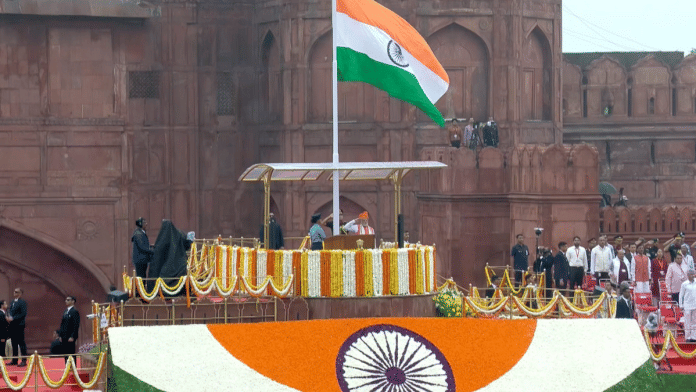


New Delhi: Before Prime Minister Narendra Modi hoists the flag on Independence Day this year, the Archaeological Survey of India is going to spend Rs 12.5 lakh on the cleaning and preservation of the Red Fort wall that serves as the background for PM Modi’s speech, ThePrint has learned.
On 27 June, the Archaeological Survey of India (ASI) issued a tender notice to purchase 5,096 litres of Mineral Turpentine Oil (MTO) and 340 kilograms of silane-siloxane for hydrophobic treatment of monument surfaces.
MTO is a petroleum-derived solvent used in artefact restoration, cleaning, and conservation, while silanes are penetrating, hydrophobic sealers used to waterproof porous masonry such as concrete, brick, and stone.
The estimated cost of material is Rs 12,55,708. This work will be done under the Deputy Superintending Archaeological Chemist, Science Branch, Delhi Zone of ASI.
The conservation effort does not include the entirety of the fort complex. Only the fortification wall facing Chandni Chowk, from where the prime minister hoists the flag, will undergo the treatment.
ASI’s Delhi Science Branch demanded the MTO on the GeM portal.
“This product is to be used for the dilution of Silane siloxane BS 290 for hydrophobic treatment on Sandstone surface,” read the bid document accessed by ThePrint.
The bid will close on 18 July, nearly a month before Independence Day.
ASI has also listed criteria for bidders: they must have an annual turnover of Rs 4 lakh and have experience in the work for at least two years.
According to the bid, the bidder should supply the order within one week from the date of issue.
Also read: What happened inside Aurangzeb’s harem—Real Housewives of the Mughal Empire
Red Fort is turning black
Researchers have noticed over the past few years that the UNESCO World Heritage monument is slowly turning black.
In 2025, a joint India-Italy study found that toxic pollutants are forming a black crust on the monument’s red sandstone walls.
ASI’s Additional Director General (ADG) Sanjay Kumar Manjul was part of the study.
“The formation of a black crust is a progressive phenomenon that usually begins with a thin black layer or deposit, which can be removed without significantly damaging the stone’s integrity, at least in the early stages. In addition, a maintenance cleaning program for the most affected areas and the application of stone protectives could prevent or at least slow down the formation of a black crust,” read the study.
Meanwhile, the parliamentary standing committee wants the Red Fort curation model to be replicated across India.
“The Committee notes with appreciation the curation of the Red Fort complex and recommends that the Ministry document this model and examine the feasibility of replicating it at other major heritage sites,” read the 23 March report of the Parliamentary Standing Committee on Transport, Tourism and Culture.
(Edited by Prasanna Bachchhav)