





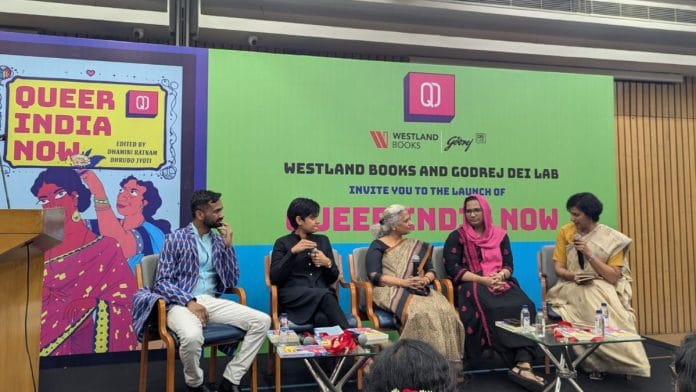

New Delhi: “What is our life?” Dr Aqsa Shaikh asked a packed room at the India International Centre.
The audience listened quietly as Shaikh explained a life through a litany of battles—with family, schools, colleges, hospitals, governments, strangers and systems. “Because we are not human. We are cockroaches,” said the transgender rights activist.
Shaikh was speaking at the launch of Queer India Now, an anthology edited by journalists Dhamini Ratnam and Dhrubo Jyoti.
The event brought together retired Justice Asha Menon, who as member secretary of the National Legal Services Authority assisted the Supreme Court in the landmark NALSA vs Union of India case and currently advises a Supreme Court-appointed committee on equal opportunity policies for transgender persons, Shaikh, one of India’s first transgender medical doctors and a faculty member of community medicine at Hamdard Institute of Medical Sciences and Research, Dhiren Borisa, geographer and assistant professor at Jindal Global Law School, and entrepreneur Susan Dias, who, along with her partner Aditi Anand, was among the petitioners in the marriage equality case.
Opening the evening, co-editor Jyoti reflected on the lives documented in the book.
“An activist who’s living in a 300-year-old brothel thinks of a life of dignity for sex workers. A queer person in Delhi, a teacher, holds a portrait of herself as an old woman,” he said.
The stories, he noted, were often about seemingly ordinary aspirations.
“A dream job, wanting to be a policeman, having a bank account, having documents for dignity, having a degree, passing college. The right to be next to a person in a hospital whose heartbeat you know better than your own,” he said.
Also read: India’s queer politics isn’t about Right vs Left. It’s a matter of privilege
The question of identity
After the formal launch of the book, the evening moved into a panel discussion moderated by Ratnam. She began with a question that has shaped many recent debates around transgender rights: Who gets to determine a person’s identity?
“The question of your identity is fundamentally self-identity,” Menon said. She recalled that during the NALSA case, both the petitioners and the bench had recognised self-identification as a valid basis for legal recognition.
The conversation moved to Shaikh, whose chapter in the book is drawn from conversations on healing and healthcare.
“Queer people should keep doctors and lawyers at arm’s distance. White coat and black coat. Because a lot of damage is done by uninformed doctors and lawyers,” she said.
Responding to recent debates around medical boards and certification requirements, Shaikh challenged the assumption that gender identity could be medically verified.
“Can you all look at me and find out if I have an appendix or not?” she asked.
The audience laughed.
“By looking at someone, one, you can’t know what is between their legs. And even if you look at their genitalia, if you are so interested, you can’t find out their gender identity.”
Gender identity, she argued, is not visible nor is it reducible to anatomy.
Also read: Indian drag scene is a messy place—and yet full of possibilities
Proud of the process
The second half of the discussion turned to rights and the limits of legal victories. Dias reflected on what it meant to take a deeply personal aspect of life to the country’s highest court.
“The process was meaningful to us. For the first time, we put into words the rights that perhaps are taken for granted by heterosexual couples who are married and that same-sex couples just get used to living without,” she said.
The courtroom experience, however, eventually ended in disappointment with them losing the case.
“My partner and I are part of the same society. We do not live outside of it. We don’t live in the margins. We’re not on the fringe. We’re engaged, tax-paying citizens of exactly the same citizenry,” she said.
The consequences of legal exclusion, she noted, continue to surface in everyday life. She spoke about the difficulties she currently faces while trying to travel internationally with her son because her family lacks legal recognition.
The experience also prompted a broader reflection on what comes after legal setbacks.
“If the loss has left me with anything permanently, it’s that I feel and know and I’m happy to say that I have a lot of pride in my identity, in my family and in my child,” she said.
Also read: There is more to queer life than young couple falling in love, facing challenges, then uniting
Queerness and caste
The evening’s most expansive intervention came from Borisa, who urged the audience to think about queerness beyond sexuality and gender alone.
“The very ordinary ways in which we live out queerness, desires is already being structured through caste,” he said.
He argued that discussions around queerness often fail to engage with the caste structures that shape people’s lives long before they begin to articulate their identities.
Recalling his first experiences online, he shared that he created a Facebook account under a different surname.
“I called myself Sanidhya Sharma. I knew that the very structure of caste was the currency through which desire would flow,” he said.
Even self-identification, he argued, required negotiating hierarchies that were already in place. Queerness, he said, could not be separated from larger questions of citizenship, dignity and belonging.
“Queer India cannot happen without engaging with solid questions of who is even considered a citizen in this country, who can have a dignified life, who can keep a moustache and not keep a moustache, who can take the risk of falling in love,” he said.
Organised abandonment
A recurring theme throughout the evening was hope and the limits of it.
Ratnam pointed to the title of Dias’ chapter, The Hardest Part is Letting Go of Hope, as the discussion moved from legal victories to the realities that followed them.
Borisa cautioned against romanticising resilience.
“We often celebrate the joys that queer people have without understanding that half the time the joys are fractured. They are always pivoted to the edge. You will never know what will happen next,” he said.
He urged audiences to examine the structures that repeatedly leave people unsupported. Quoting scholar Ruth Wilson Gilmore, he described this condition as “organised abandonment”.
The phrase lingered in the room, connecting discussions about healthcare, legal recognition, caste discrimination and citizenship.
(Edited by Theres Sudeep)