





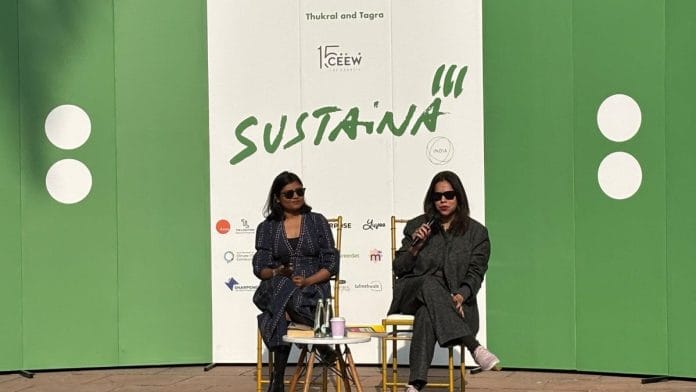



New Delhi: Could Shah Rukh Khan and love have a connection with sustainability and the economy? A fireside chat at Delhi’s Bikaner House tried to address this question.
The talk—‘Love: The Bitter Nectar of the Economy’—was part of the Council on Energy, Environment and Water’s Sustaina 3.0. The guest speaker, Shrayana Bhattacharya, an economist and the award‑winning author of Desperately Seeking Shah Rukh, was in conversation with Neera Majumdar, communications manager at the think tank. The talk, held on 7 February, highlighted the importance of questioning and demanding the place of love in the economy and the budget.
“One of the things I am really fascinated by is this idea of how love is generated in the economy, how consumption and savings and borrowing of so many of our economic behaviours are embedded in the love we wish to express and want to feel,” said Bhattacharya.
‘SRK was a very different kind of masculinity’
The session saw Shah Rukh Khan fans, researchers and economists turn up for the discussion.
Bhattacharya took time to give a framework of the economic survey and research, which resulted in her book. She began by discussing what led her to write a book on the economic patterns of the country through SRK. Bhattacharya, a young researcher conducting surveys, asked the respondents who their favourite actor was, and the near consensus was that the figure was Khan.
“The women I followed loved Mr Khan but also loved their own economic independence, their ability to purchase tickets on their own, and not need anyone’s permission, to be able to just claim their own joy and fun,” said Bhattacharya.
The book follows 10 different women for 15 years across various locations and occupations.
“The one answer that was common across class, caste, faith, region was that he would care and he would show up in emotional labour, care labour consistently, whether through his David Letterman interviews, or the movies he was doing. His was a very different kind of masculinity showing up on the screens,” said Bhattacharya.
An analysis of the actor’s films also showed that compared to a lot of other actors, he would let women speak and have space to voice their concerns.
“We had to inform his team before publishing the book, and they were very supportive, and he has remained a steadfast stakeholder in this book, in some of the lives of the women in the book. People say you should never meet your heron but if it’s Shah Rukh Khan, please meet him,” said Bhattacharya to loud cheers from the audience.
Also read: Indian science was never apolitical, says Hyderabad panel on space and vaccine stories
Self-care in today’s economy
Bhattacharya mentioned how love was the driving force behind women’s participation in the workforce. In the course of her research, many of the women she followed for her book would say to me that they drop out of the workforce because if they don’t, they would be less loved by their family, husband or lover.
Majumdar then narrated her own memory of dancing to songs of Dil Toh Pagal Hai (1997) as a child watching a movie with her mother in a small town in West Bengal, and asked Bhattacharya if obsessive love for an actor is sustainable in today’s economy.
Bhattacharya responded by mentioning how young people now prefer engaging with actors and internet personalities rather than actual people, and how circumstances have shaped it so.
“Are our educational institutions credibly diverse enough to actually allow for strangers to meet each other? Are women in our country safe enough to meet strangers?” asked Bhattacharya.
She also answered a question on self-care in today’s economy, and how it has to be linked to the way economists look at care work.
“There is tremendous time poverty for average Indian women. What I care about is how much the public sector is coming to support men and women to have free time. The question is about public care, and if public institutions actually invest in care work,” said Bhattacharya.
She also urged people to be sentimental about the economy and not see data as just numbers but actual people, and ask about the ‘love elasticity’ of the jobs being created.
“Perhaps we are in the economy to express love and to enjoy love, and I think the centre of that economic conversation. I keep joking that I hope someday Raghuram Rajan will have a conversation with me about how we’re maximising love,” said Bhattacharya.
(Edited by Saptak Datta)