





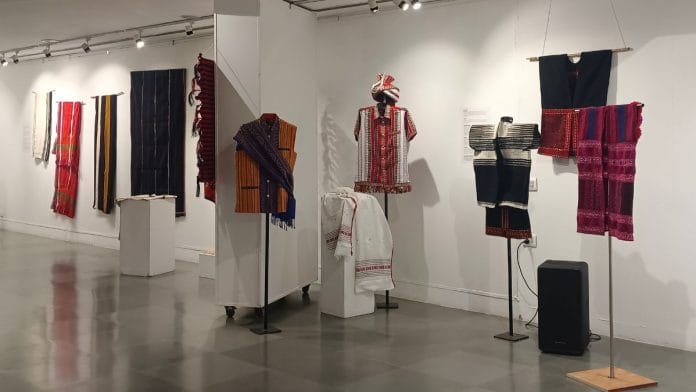



New Delhi: A personal collection of garments from the eight northeastern states of India, carefully preserved by family and friends of social entrepreneur and Naga textile specialist Sentila T Yanger, has taken the form of an exhibition in Delhi.
It explores how textiles act as a visual language, expressing cultural iconography, identity, and a deep sense of belonging.
Titled Threaded Heritage: Symbolism, Ritual and Memory in North East Textiles, the exhibition, curated by Yanger, is being held at Delhi’s India International Centre from 2 April to 12 April.
It celebrates the rich textile traditions of Northeast India, bringing attention to a heritage that has often remained underrepresented. Rather than presenting textiles as mere decorative objects, the exhibition positions them as living archives, which carry identity, tradition, and collective memory.
“Northeast textiles are not just decorative cloth. They embody a rich synthesis of culture, heritage, and innovation,” said Yanger.
The exhibition space features garments and handwoven pieces from Manipur, Nagaland, Sikkim, and other northeastern states, creating a vibrant tapestry of regional diversity. It also features live demonstrations by two weavers from Nagaland, offering visitors a glimpse into the intricate processes behind the craft.
Organised into three thematic sections — symbolism, ritual, and memory — the exhibition guides visitors through the many roles that textiles play in society.
“Through symbolism, textiles communicate identity; through ritual, they shape experience; and through memory, they preserve and transform histories,” Yanger said.
‘Every thread has a story’
In one corner of the hall, a maroon woollen shawl is quietly displayed on the wall, with the loose strands of wool hanging from it, making it different from other items at the exhibition. It draws visitors in, many pause to examine its texture, curious about its origin, its craftsmanship. What surprises them most, however, is the fact that the shawl is not meant to be worn.
It’s a Youhnyi shawl of the Konyak Naga community, reserved for a deeply solemn purpose. It appears only at the time of someone’s death, gifted to individuals of high social standing, and placed beside the deceased as a final tribute.
Across the exhibition, every garment, whether a wrap, shawl, cap, saree, dupatta, or men’s attire such as shirts and coats, is displayed with a note detailing its origin and the story it carries.
“Each thread holds a story and a folktale. These are not just clothes, they tell you which community, tribe, and even gender one belongs to,” said Yanger.
Nearby, Yanger gestures toward a hat placed on a stool. The base is black, the upper portion blends shades of brown and red, and it’s topped with a striking red accent. This is a traditional Lepcha hat, or Sumok Thyaktuk, which derives its name from ‘athyak’ (head) and ‘tuk’ (covering). Often adorned with feathers, porcupine quills, and other natural materials, it reflects a close relationship with the environment.
Also read: Author Hoihnu Hauzel calls for accountability in Manipur—Beyond the valley
Behind the craft
The hall itself is alive with colour — greens, blues, pinks, and blacks — woven into intricate patterns by hand. Amid these vibrant displays, two women sit at handlooms, offering live demonstrations. Their rhythmic movements reveal the patience, precision, and hard work behind each piece.
“We learn this from childhood. In every household, women grow up weaving,” said 32-year-old Nutalu Nyekha from Nagaland.
Seated on the floor, her hands move steadily across white threads as she works on a wrap. She said that completing one piece takes about two weeks and can cost between Rs 5,000 and Rs 6,000. Nyekha sells her work in local markets, travels across India for exhibitions, and also reaches buyers through Instagram.
But the craft comes at a cost. “These beautiful attires demand a lot from us. We often suffer from back and leg pain from sitting for long hours,” she added.
The exhibition’s inauguration also featured KN Shrivastava, Director of the India International Centre, who highlighted its cultural significance.
“This is not just a textile exhibition,” he said. “It presents the art, culture, and history of the Northeast. What you see here are treasures from personal collections.”
(Edited by Aamaan Alam Khan)