





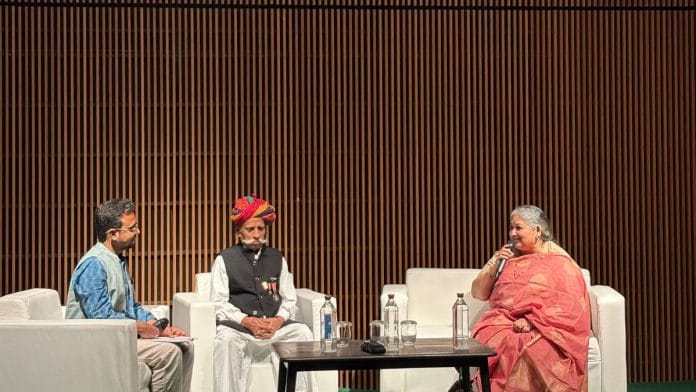


New Delhi: India loves to speak of its musical heritage of ragas, gharanas, folk ballads and ancient traditions, but the artists who carry this tradition recount a different story. They say they are being reduced to cultural symbols in a marketplace driven by celebrity concerts, streaming algorithms, and commercial music.
“If you play tabla, sarangi, people think you are old-fashioned,” said Shubha Mudgal, an Indian singer and composer. “But if you add drums and keyboards to the same composition, suddenly it becomes contemporary.”
She was speaking at a discussion held at the Humayun’s Tomb Museum in Delhi recently as part of The Heritage Dialogues, a series exploring the place of traditional art forms in contemporary India. Titled Flowing Traditions: Indian Folk & Classical Music in a Changing World, the session brought together Mudgal and Sindhi sarangi exponent Lakha Khan, with author and cultural archivist Gopal Singh Chauhan moderating.
The conversation was about the fragile future of India’s musical traditions—from the collapse of patronage systems and the growing invisibility of folk artists, to the ways streaming platforms, copyright frameworks and the commercial music industry continue to exclude traditional forms even while celebrating them as symbols of heritage.
Around 50 music and culture enthusiasts, mostly aged between 30 and 70, attended the event. Some audience members asked what could be done to secure the future of classical music, but there were no simple or direct answers. A few people recorded videos while Lakha Khan performed.
The discussion was followed by a performance by Rajasthani father-son-duo Lakha and Dane Khan, with Lakha on the sarangi and Dane accompanying him on the dholak.
Mudgal raised a major concern about how young artists today face constant distractions and are often made to believe that traditional art will not bring recognition or audiences, while commercially popular performances receive more attention–a mindset she described as harmful for art.
“When society pushes everyone towards a monoculture, that becomes a dangerous situation. A young artist also has to think about survival. If someone is worried about how they will earn a living or support their music, what choice do they have? This has happened for years in classical music. Many respected musicians worked regular 9-to-5 jobs and only became full-time artists after retirement. Until society gives artists dignity, respect and financial security, things will not change,” said Mudgal.
When tradition is reduced to a relic
Throughout the evening, Mudgal repeatedly returned to how Indian music traditions have never been rigid or isolated from one another. Folk and classical music, she said, have constantly borrowed, evolved and absorbed influences across regions and generations.
Using the example of Thumri, she explained how folk forms such as Kajri, Chaiti, Jhoola and Baramasa naturally entered Hindustani semi-classical traditions over time.
“We make so much noise today about fusion,” she said. “But all this was happening earlier, too. How is it possible that artists remain untouched by what they hear around them? Folk traditions have taught us seasons, emotions, rituals, language, even ways of living.”
Mudgal recalled a lesson from her guru, describing how a Chaiti composition carries knowledge tied to time, season and memory. Her guru had asked her to understand the meaning of the lyrics, explaining that when the month of Chaitra arrives, flowers bloom, colours change, and moods shift.
The problem begins when traditional arts are treated as relics. Mudgal strongly rejected the idea that classical or folk music is “archaic” and that other forms are contemporary. She argued that any music being created in the present is, by definition, contemporary, whether it is hers or Lakha Khan’s.
She also criticised how modern music is reduced to only Western instruments, while indigenous instruments are seen as old-fashioned.
At the discussion, Lakha Khan, whose life has been shaped by oral musical traditions passed down through generations, spoke about learning music from his father and uncle.
“I only came to know about classical music later,” he said. “When I went to Jodhpur, teachers there would tell me, ‘This is classical music.’ I listened to great artists like Pandit Bhimsen Joshi, Ravi Shankar ji and others. Then I understood there are many kinds of music.”
At the same time, Khan pointed out that classical music is often associated with the educated and the wealthy, while folk music is carried by people in villages. But according to him, music belongs to everyone.
Also read: Ek Mulaqat revisits Sahir Ludhianvi and Amrita Pritam’s unfinished love story
A symbolic celebration of heritage
India’s traditional music survives because generations of artists continue to carry it despite shrinking patronage systems and a cultural economy obsessed with visibility, celebrity, and commercial returns.
“There was a time when our people had patronage,” moderator Gopal Singh Chauhan said during the discussion. “But after 1947, after the end of the jagirdari tradition, a big question emerged around livelihood and inheritance. Today, governments spend enormous amounts on celebrity nights while folk artists disappear from the conversation entirely.”
Mudgal added that digital platforms have changed how music is shared. This has further pushed traditional forms of music to the margins.
Mudgal recalled her experience of uploading a self-produced classical recording onto an international music distribution platform.
“The form asked me who the supporting artists were,” she said. “There was no option for tabla, sarangi, sitar or sarod. I had to categorise tabla as drums and sarangi as fiddle because the system was not designed for Indian music at all.”
The episode highlighted that although technology lets artists publish their own work, global music platforms still follow Western frameworks, where the vocabulary of Indian music is still missing. While African and Latin music are categorised separately, traditional Indian music is often excluded.
Mudgal said the issue is structural.
“The music business in India is not really concerned with traditional music,” she said. “Everything is geared toward what is considered commercially profitable.”
Mudgal added that even copyright systems meant to protect artists remain poorly designed for Indian classical and folk traditions.
“I composed a dadra composition and wanted to register it,” she said. “But the system only asked if it was for film, OTT, advertisements or documentaries. There was no category for dadra, thumri or kajri. I had to ask them to create a field for classical music, and when they did, they named it ‘classic’.”
(Edited by Janaki Pande)