







New Delhi: In India, civil servants are highly celebrated and widely criticised for their mistakes, but their enduring relevance is hard to ignore. The collector’s position was created by the British in India even when they don’t have any such official position in their governance system.
“There is not and never has been an official like the Collector anywhere else. The very country, which created the post, does not have such a general-purpose functionary,” said CK Mathew, former Rajasthan Chief Secretary and the author of The Historical Evolution of the District Officer: from early times to 1947, on the evening of 10 April.
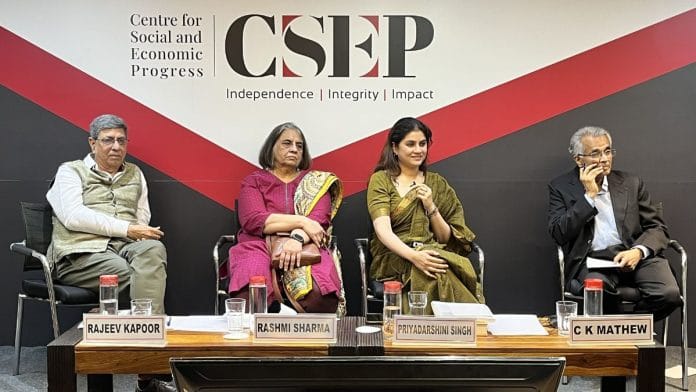
At the auditorium of the Centre for Social and Economic Progress in Delhi, around 60-70 people gathered to attend a discussion on the evolution and legacy of the district collector. The hall was packed with retired bureaucrats, policy researchers, and scholars.
Mathew’s book talks about the origins of the collector’s post, from colonial times to independence, and its journey afterward. The session at the CSEP was opened by Amarjeet Sinha, former adviser to Prime Minister Narendra Modi. He chose not to dwell on the specificity of the book; instead he offered his perspective on the evolution of India’s governance systems, drawing on over four decades of experience in public service.
“A civil servant is like a plumber trying to improve the last mile of the system. There are leaking pipes all over. You fail many times, you succeed a few times,” said Sinha.
He described how the district administration was originally designed and how it played a crucial role in establishing a new independent India.
“It was essentially a regulatory administration meant for maintaining public order, but it provided the stability that allowed a fragile, newly independent nation to hold together,” said Sinha.
“Institutions like the district administration ensured that the boundaries of India remained intact and that the conduct of elections became a credible and enduring democratic exercise,” Sinha added.
Also read: Khada Parsi in Byculla is an act of colonial defiance. And a son’s tribute to his father
The evolving role of the collector
Narrating from his book, CK Mathew traced the origins of the district administration and explained how the collector’s post came into existence after the East India Company’s transition from a trading entity to a government authority.
“When the East India Company received the Diwani in 1765, a commercial enterprise was suddenly compelled to transform itself into an administrative authority, giving birth to the office of the Collector,” said Mathew.
He also described how the collector became more than just a revenue official over time and played the role of a bridge between authority and people.
“The Collector was envisioned as a shield between the ryot and oppression—a refuge and redresser of wrongs, with access to him meant to be easy for every citizen,” said Mathew. “This relationship between land, state, and citizens forms the very foundation of governance in our country”.
The discussion also touched upon how Jawaharlal Nehru and MK Gandhi were against continuing the district collector system, but Sardar Vallabhbhai Patel firmly supported it.
“Patel firmly said that If we take out the Collector and the ICS, the system will
collapse. We have worked with them for over 200 years, and the institution must continue,” said Mathew.
The speakers agreed that even today, the collector plays a very important role in the governance system.
“Today, the District Collector remains the single-point coordinator at the district level—the go-to person for governance, development, and disaster management,” Mathew said, adding that while there are challenges, the office of the district collector cannot be dismissed.
“We are adapting, we are changing ourselves, evolving to meet new challenges. Therefore, we should not dismiss the district Collector; the institution remains relevant even today,” he said.
(Edited by Aamaan Alam Khan)