








New Delhi: When two men walk onto the stage wearing shirts that proclaim, “1947: At the stroke of the midnight hour, when the world sleeps, India will awake to life and freedom,” one braces for a familiar kind of political theatre with the usual mud-slinging, ideological sparring, and predictable cycles of accusation centred around independent India’s first Prime Minister Jawaharlal Nehru.
But Blame it on Nehru, Paperclip’s new experimental stage production, resists that script entirely. Directed and performed by Paperclip’s co-founders, the play was performed for the first time in Delhi on 22 March at the Bangiya Samaj Mancha.
Instead, the show unfolds as a live history lesson, moving fluidly between the past and the present; layering archival fragments, cultural memory, and contemporary anxieties. It is less like watching a play and more like participating in an extended act of collective remembering, nudging the audience to consider not just what India was, but what it might have been — and perhaps still could be — if its histories were engaged with more honestly.
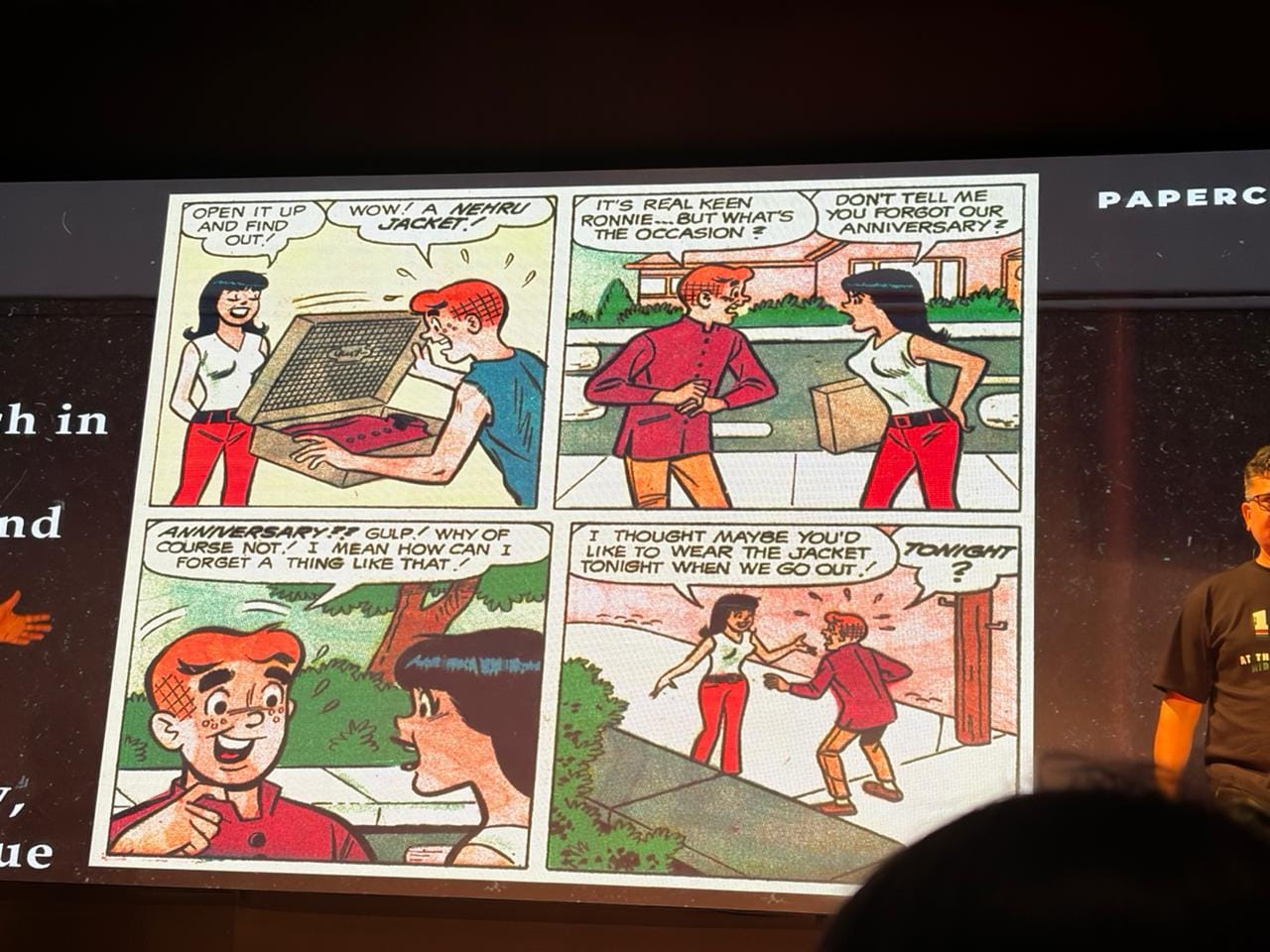
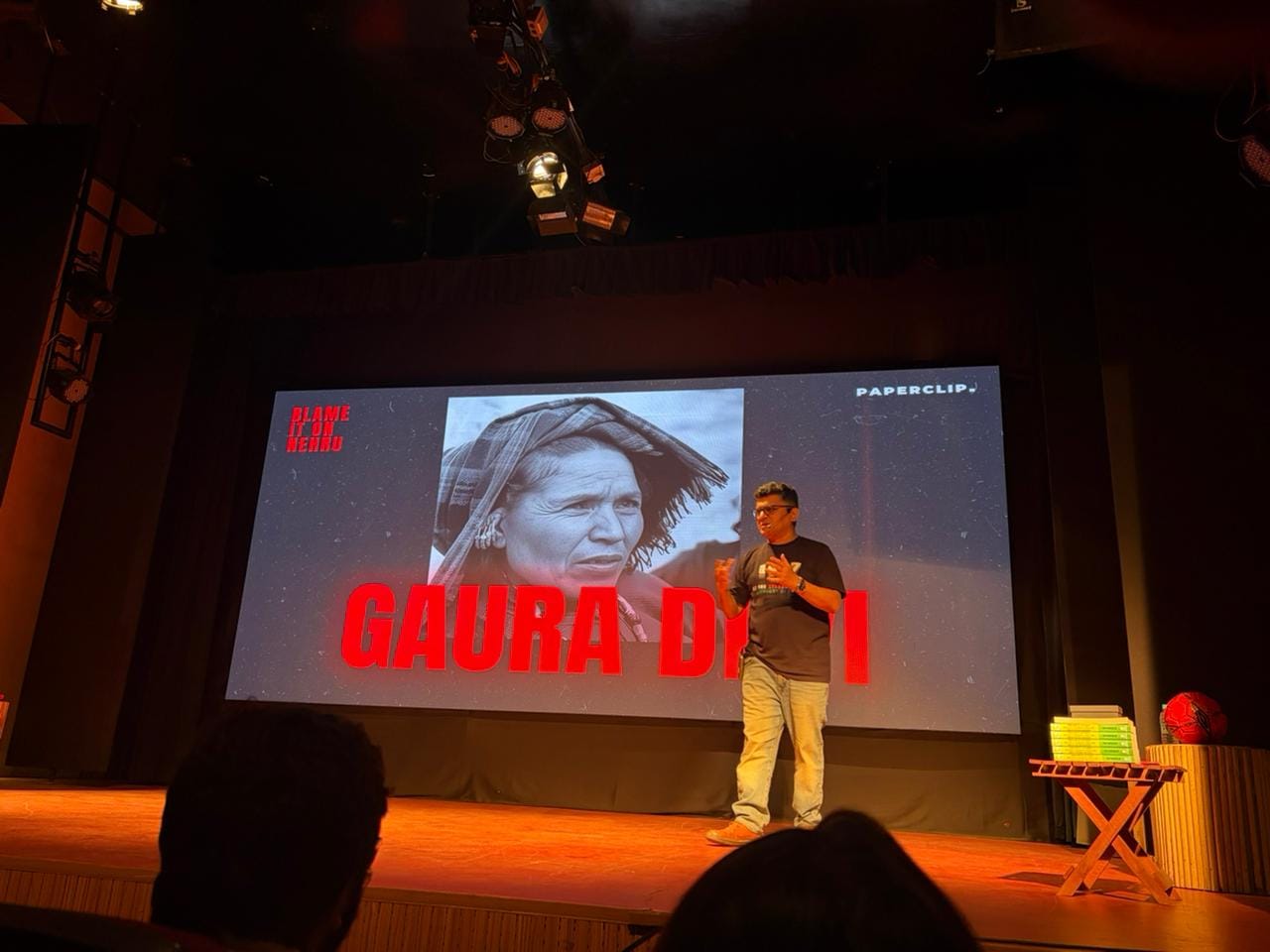
It links local and global histories to make a point — India’s internationalism isn’t a new phenomenon, it was always there, quietly making its way through schools in Hungary, Hollywood movies, Archie’s comic strip, influence on Colombian extremists with a Narcos reference, an Aurangzeb reference in the football club Arsenal’s logo, and vinyl records of a Spanish band named after the key architect of the Chipko movement. The power of India’s freedom struggle and the promise of the newly born nation captured the global imagination in the 50s and it remained in popular culture for decades. Though the word “Vishwaguru” was never uttered during the performance, it hovered conspicuously over the hall throughout the two hours.
Nehru is present, certainly, but so are unexpected cultural and historical touch-points. The production thrives on these contrasts, weaving them together with a storyteller’s instinct for rhythm and surprise.
Also read: MF Husain to Tom & Jerry—Delhi art exhibition brings a fun mix
What the play aimed at
It begins with a simple question by co-founders Indranath Mukherjee and Trinanjan Chakraborty: “With a show of hands, how many times in the past year have you heard the phrase ‘Blame it on Nehru’?” The response is immediate, revealing how the phrase has become a reflexive shorthand in India’s political discourse. But, as the performers make clear, the play is not about ending conversations.
“It is about beginning the conversation. We observed that history has been distorted, not just in our country, but globally. We wanted to send people back to books. Make them read more. Make them think. Make them feel — beyond just consuming forwards or fake news. And we believe that feeling comes through stories,” Paperclip co-founder Sriwantu Dey told ThePrint.
Paperclip, known for research-driven storytelling in an era of viral misinformation, translates its digital sensibility into a theatrical form. The result is a cross between a dialogue, a performance, and an interactive quiz. The trio become tools to unpack politics, democracy, and news headlines.
Blame it on Nehru was first performed in Kolkata, earlier this year on 31st January; it comes to Delhi with an energy both intimate and expansive. For the creators, who have different day jobs and live in different cities, this is more of a passion project where their love for history weaves in their love of storytelling.
The result is sleepless nights moving from tech to artificial intelligence to storytelling, leading to debates and discussions on how to shift the medium and position themselves as a genre-agnostic performance, suggesting that stories — rather than arguments — provoke reflection.
If successful, the organisers say, the evening might bring audiences closer to the imperfect yet empathetic vision imagined by India’s founding figures.
“One of them had come with his son, who has a board exam in two days. I was surprised when he said, ‘There was no way I was missing the show.’ Another audience member told me, ‘I wish we were taught this in schools’,” Mukherjee recalls.
Structurally, the performance almost mirrors the conversational culture of an adda (hangout), with topics shifting organically yet anchored by a clear narrative intent.
Also Read: People think about their sex lives in terms of jargon. Agents of Ishq wants to change that
There are no easy answers
Running throughout the show are sobering reminders of unresolved present-day tensions — the recent tragedies, attacks, stampedes and the question of political prisoners — where the constant refrain remains: For everything that has gone wrong, the instinct is to “blame it on Nehru.”
It interrogates this impulse with insights and anecdotes, presenting Nehru not merely as India’s first PM, but as a global figure who was a statesman, thinker, and a fashion icon whose influence extended far beyond national borders.
It further applies anecdotes from Soviet history as well as the Stalin era to show how contemporary tools like AI have been used to benefit those in power and build narratives.
In Nehru’s case, cultural references are brought in — from American magazines to Hollywood to the Nehru jacket in comic books — to show how the politician has occupied popular imagination.
The story moves beyond individuals to events often absent from mainstream narratives. Indian involvement in global conflicts, humanitarian efforts during wars, and unsung acts of heroism and even tragic love stories that went global are woven in to show a complex picture of the even more complicated national figure.
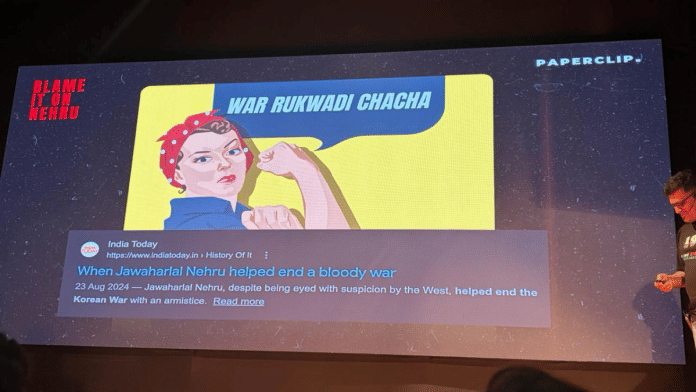
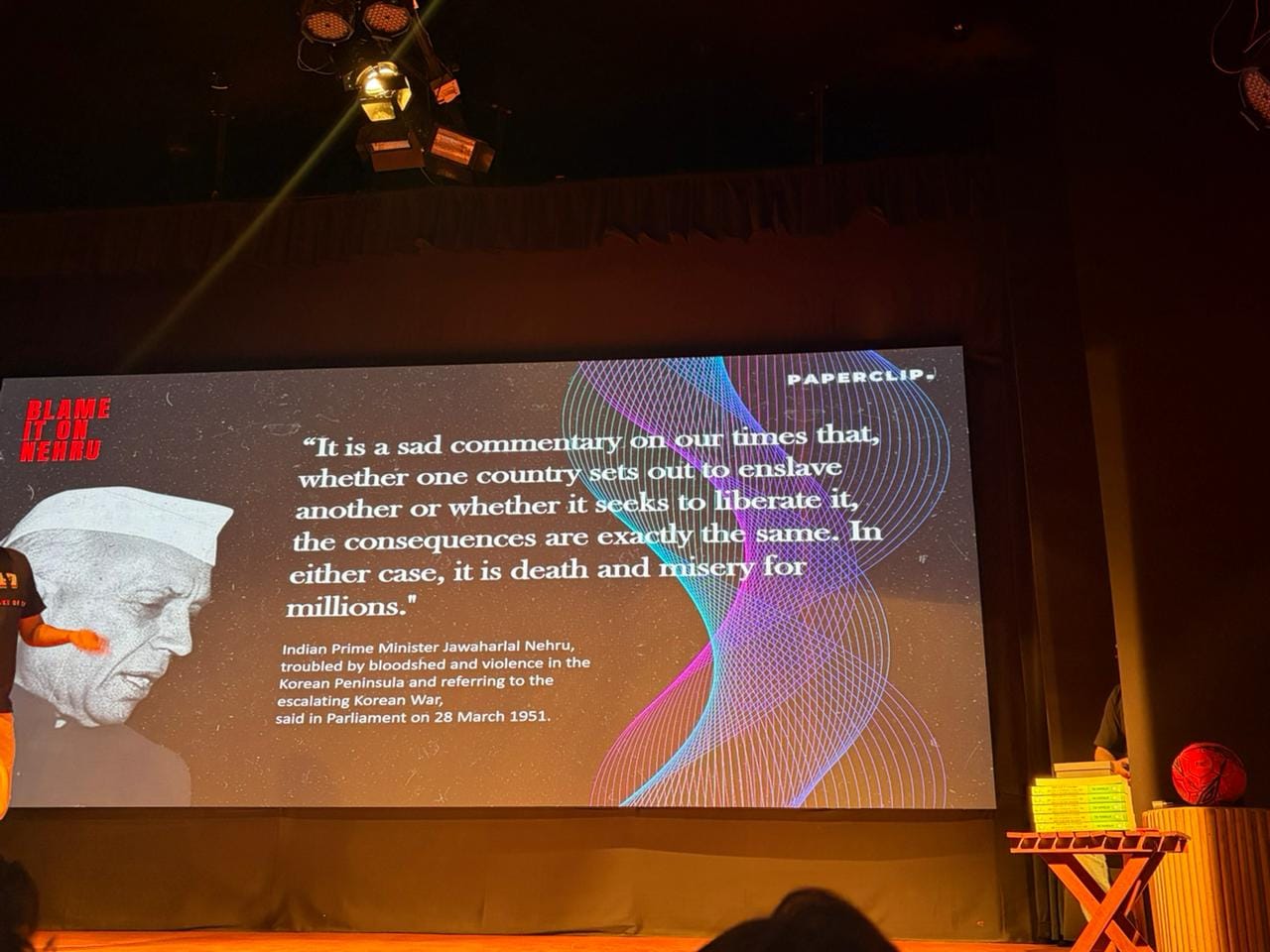
Through these episodes, the performance also humanises history in a way where, when the performers speak about Nehru’s role in ensuring an armistice during the Korean War with a cheeky meme that says “War rukwa di, Chacha” (You stopped the war, uncle), an audience member interjects to remind them of Rabindranath Tagore’s influence in Korea, too.
And when there is Nehru, there must be Pakistan but not in the usual ways. There was a reference to Aditya Dhar’s Dhurandhar (2025) which has an Indian connection, and to Brazilian and Argentinian football, which has a Pakistani connection, especially with Lyari—now the topic of the Indian film. Then there was Kargil, Tiger Hills and how an Indian soldier’s humane act led to his Pakistani counterpart winning a posthumous medal.
“An Indian army veteran who was part of the audience, walked up to me after the show and said, ‘Even I did not know so much about the Army’,” Mukherjee said.
Paperclip’s play does not shy away from difficult topics, but it avoids nationalism or simplification. It never gets offensive.
The debate then is, how does narrative shape modern memory that is contested and sometimes deliberately erased?
There are no easy answers, and the play offers none. It leaves audiences with a dense tapestry of interconnected stories, asking them to sit with its complexity, resist simplification, and, above all, continue the conversation.
As the lights come up, a small, telling moment captures the spirit of the evening: A child, walking out with his father, asks, “But why blame it all on Nehru?” The father pauses, then replies, “I’ll explain it on our way home.”
(Edited by Insha Jalil Waziri)