





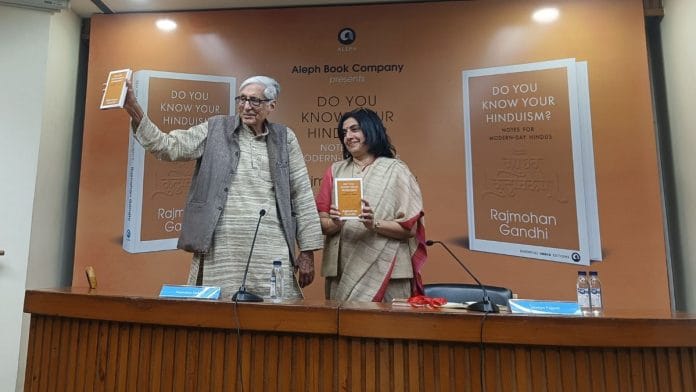



New Delhi: For scholar and professor Rajmohan Gandhi, Hinduism is more than a matter of birth.
“Hinduism has a set of beliefs and more than that, it has a set of values,” said Gandhi at the launch of his book Do You Know Your Hinduism? Notes for Modern-Day Hindus at Delhi’s India International Centre (IIC) on 10 March.
Gandhi’s book examines Hinduism as an evolving, non-monolithic, and intellectual tradition rather than just a set of rituals. It focuses on themes such as Vasudhaiva Kutumbkam (the world is one family).
Hinduism has so many wonderful expressions that we utter, listen to, and sing, but don’t reflect upon, said Gandhi. “I am inviting the Hindus and the non-Hindus of the world to reflect on these well-known phrases,” he said.
He referred to Ekam Sat Vipra Bahudha Vadanti (truth is one, the wise call it by many names), Raghupati Raghav Raja Ram (Lord Rama, king of the Raghu dynasty).
Gandhi said Hinduism has an emphasis on pluralism from the very start, it is evident with the Rigveda slogan: Ekam sat vipra bahudha vadanti (Truth is one, but the wise speak it as many)
Hindu a noun or adjective?
Scholar and writer Ananya Vajpeyi moderated the event, and among the audience were intellectuals such as Ashis Nandy.
Vajpeyi said Rajmohan Gandhi traversed the political and historical landscape around the term “Hinduism” without really addressing the religious core of the question he raised in the title. The book bypasses the religion aspect, and talks about the fundamental ideas of Hinduism, which, according to the author, should be practiced.
The author sees Hinduism as a set of values rather than merely religion, something that functions as an adjective before a verb—for example, Hindu actions. However, that’s not how the modern world sees it. “The widespread usage of Hindu is as a noun, not as an adjective,” he said, explaining that we speak of a Hindu community, Hindu temple, Hindu painting, Hindu song, Hindu rashtra.
Also read: ‘Batt Koch’ shows a Kashmiri Pandit’s journey home. Filmmaker was inspired by ‘Piku’
Gathering after Gandhi at Sevagram
Vajpeyi said Gandhi constructs a plausible lineage of exemplary Hindus in the book by mentioning personalities such as Vinoba Bhave. But after that, she said, he is unable to find a compelling spokesperson for Hinduism.
Gandhi praised Vajpeyi for mentioning Vinoba Bhave’s name and then narrated a story from 1948.
Rajmohan Gandhi recalled a gathering in March 1948, a few weeks after MK Gandhi’s assassination, at which several non-political and political Gandhians gathered.
Vinoba Bhave was among them and made some very important points, the author said.
“Democracy and democratic procedures are missing in the RSS, and they have made headway in Maharashtra. But we will not go anywhere by keeping all the blame on the RSS. There are people who think differently from the way we do, but there are some good, self-sacrificing people to be found among them, deserving of our respect,” Gandhi read Bhave’s words.
Gandhi’s book also mentions Rabindranath Tagore, MK Gandhi, Raja Ram Mohan Roy, but not BR Ambedkar.
Professor Mujibur Rehman asked Gandhi that, instead of Ananya Vajpeyi, if Ambedkar spoke to him about the subject, what kind of questions would he have confronted.
“Ambedkar’s intellectual contribution is so phenomenal. His objections were so unanswerable,” said Gandhi. The author also added that Ambedkar would have been concerned about the Buddhist nations of the world today. How they are not showing Insaniyat (humanity), whether it is Burma, China, or Sri Lanka.
(Edited by Ratan Priya)