





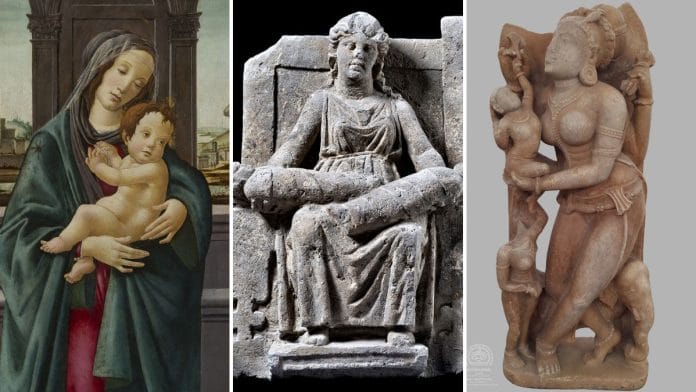

New Delhi: Italian Renaissance painter Sandro Botticelli’s Madonna of the Magnificat is popular for its depiction of a mother tenderly holding a child. What is less likely known, however, is that the depiction was not his creation, nor does it belong to the Church. By the time Botticelli painted it in the 15th century, the mother-child image had already been worshipped for 2,000 years under at least a dozen different names, across languages that had no word for Christianity.
This is the starting point of the One Mother, Many Mother Tongues exhibition, which will open on 22 June at the Humayun’s Tomb Museum in New Delhi. Professor Naman Ahuja, an art historian at JNU and the General Editor of Marg magazine, and Andrea Anastasio, the director of the Italian Embassy Cultural Centre in New Delhi, curated the event.
At a press conference, the curators explained that the exhibition would be compact, with 24 works in a single gallery, and spanning a period from Harappan terracottas of the Indus Valley to the European Renaissance. It draws from ten Indian institutions and three Italian museums, with the Botticelli painting anchoring its final wall.
One Mother, Many Mother Tongues will next travel to the National Gallery of Modern Art in Bengaluru.
Where the image comes from
The Italian contribution to the exhibition is, unexpectedly, its most revelatory section. Three museums—Museo Etrusco in Rome, Museo Provinciale Campano di Capua, and Museo Stibbert in Florence—will lend a range of images of the Mater Matuta, an Etruscan goddess whose cult predates Christianity by at least six centuries. Her name means “mother of the dawn.” She will be seen holding a baby, with a solar disc around her head. In the Etruscan imagination, birth and sunrise were the same event: something emerging from darkness into light.
Anastasio, who has spent decades studying Indian culture and philosophy, has traced what happened to her over time. The Mater Matuta became the model for the divine mother cult in the Roman Forum. Her image then merged with regional goddesses across the Rhineland and Gaul, and eventually flowed into early Byzantine Christian imagery. The Botticelli, which will be displayed at the end of the gallery, is not the origin of anything. It is the latest point in a very long line.
“The context can change, but the image can be totally the same,” said Ahuja, explaining the confluence of the exhibition’s different artworks centring motherhood.
The same process was happening, simultaneously, in India. The matricas, ancient mother goddesses invoked for protection during pregnancies and childbirth, appear in medical texts like the Sushruta Samhita, in the Mahabharata, and eventually develop into the saptamatrikas, the 64 yoginis, and the dasa-mahavidyas. The exhibition places them side by side and lets that fact sit.
Among the most striking objects in the show, from the Capua museum, will be the small mass-produced terracotta figures of a mother holding a child, domestic objects, made cheaply, kept in homes, dating to the third century BCE. They look, in form and function, almost identical to terracotta matricas found in provincial museum collections across India. The resemblance is not a coincidence or influence. It is the same human need, met with the same solution, in two places that had no contact with each other.
“It’s not like the Indians or the Italians were aping the Greek images,” Ahuja said. “Each one was using the same paradigm simultaneously, but interpreting their own regional, cultural specificity into that image.”
Also read: Stand-up comics versus Bollywood. What a post-mortem looked like
The Indian sculptures
The first half of the Indian section of the show will be anchored by Hariti, a figure who mirrors the Mater Matuta in several ways. In Buddhist mythology, Hariti began as a yakshini (a class of benevolent but occasionally mischievous female nature spirits) who stole and devoured children. The Buddha hid her most beloved son in his begging bowl, and her grief at losing one child made her understand what she had been doing to other mothers.
She reformed and became a protector of children, invoked especially against smallpox. In Hindi and dozens of regional languages, the word for smallpox is choti mata, or the little mother. The goddess who can kill your child is the same one you pray to for mercy.
“The mother is the one who can kill you, and she is the one who can protect you,” says Ahuja.
The largest object in the exhibition will be a monumental Hariti from Skarah Dheri in the Peshawar District, on loan from the Government Museum and Art Gallery in Chandigarh. It is among the few dated sculptures from Gandhara, making it important for art historians to establish chronologies for the region’s visual culture.
A Kushan-period Hariti from the Mathura Museum will be on display alongside one from Andhra Pradesh. The two objects separated by geography but sharing the same iconographic language are proof of how far the cult had spread by the second century AD.
A sixth-century masterpiece will be brought from the ancient temple to the Skandamatas at Thaneshwar near Udaipur, a site largely forgotten, with the temple now dismembered. Several objects in the show will come from provincial museums in Kolkata, Prayagraj, Surat, Baroda, and Udaipur, which most urban audiences have never visited.
Bringing them all to the exhibition required convincing institutions that were, in some cases, uncertain about what they held. One of the quieter arguments the exhibition makes is that this should concern us.
The other half of the Indian selection will be featuring mass-produced terracotta – small, domestic, repetitive. Placed beside the monumental sculptures, they look similar.
“When you look at it at first glance, you’ll just see mother and child,” said Ahuja. “But when you look carefully, you will start seeing subtle differences. And those subtle differences are telling us about the many mother tongues operating simultaneously in society.”
Also read: HYBE India’s Delhi event turned into a K-pop dance party. Hour-long queues weren’t a problem
What the exhibition asks
A small screening room at the end of the gallery will show archival footage to complement the gallery’s pieces. Throughout the space, the curators will paste a series of questions and answers for the audience to solve.
Is motherhood the only framework under which the feminine has historically been granted agency? Does society cast parenthood as exclusively a feminine role? Are there father figures in art? Are there daughters? Are there any cultures that celebrate the baby girl, or do artworks, across every tradition in this room, only ever show little boys?
That last question has an answer, and the exhibition provides it quietly. Somewhere among the 24 objects, there will be a small ivory figurine from West Bengal, roughly 2,000 years old. A mother holds a child. The child is a girl. In three decades of research into Indian mother-goddess iconography, Ahuja says it is the single image of this kind he has found. It is displayed not as a cause for celebration but as a measure of how rare it is.
“For five thousand years, the only model that has been mass-produced for society has been of a mother and male child,” Ahuja said.
(Edited by Saptak Datta)