





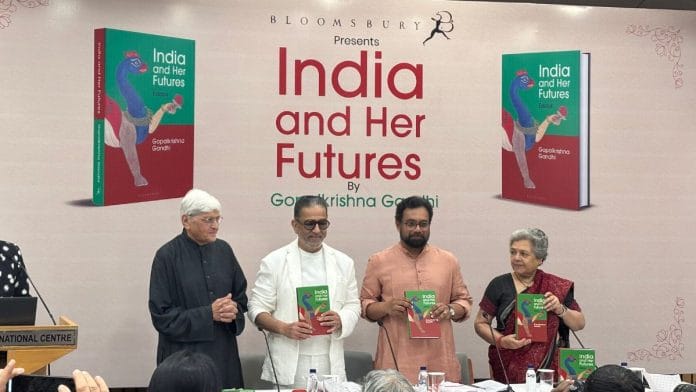



New Delhi: Even at his own book launch, Gopalkrishna Gandhi, grandson of MK Gandhi and C Rajagopalachari, pointed out the irony of writing a book about the future. As a packed hall listened, he described the present as an “unprecedented war” driven by the idea of “us and the other”.
“We have become a callous people in a callous time in a callous world,” he said.
The remarks came at the launch of India and Her Futures, a collection of essays by Gopalkrishna Gandhi, at the India International Centre on 14 March. Kamal Haasan and John Brittas, both Members of Parliament in Rajya Sabha, joined Gandhi in a conversation moderated by Mrinal Pande, author, journalist and former chairperson of Prasar Bharati.
At a time Haasan called “historically pivotal”, the discussion brought together voices from public life, politics and letters to reflect on the ideas shaping India’s present and the futures it must confront.
The evening opened with a seven-minute documentary, Lead on Gandhi, presented by Gandhi and Haasan, tracing the “biography of the bullet” that killed MK Gandhi. Framed through the triad of hate, fear and untruth, the film set a sombre tone. The packed auditorium, cutting across age groups, remained largely silent, with only brief moments of applause punctuating the exchanges. The themes of the film echoed through the discussion that followed.
Reflecting on the film, Pande said it brought buried memories to the surface. “It seems that in almost 75 years, we have not learnt anything… we have made the same mistake again and again,” she noted, describing history as layered and unpredictable rather than linear.
On the occasion, Gursharan Kaur, history professor and spouse of the late Manmohan Singh, was presented with the first copy of the book by Haasan, who described the former PM as a personal inspiration.
Calling the present moment a turning point, Haasan warned against what he termed “hatriotism,” a phrase he attributed to Gandhi.
“Patriotism, rooted in pride, can elevate the nation. Hatriotism is rooted in fear, exclusion and diminishes not only pride, but the nation itself,” he said.
He added that he hopes to take the book’s message across languages, describing it as “the most modern thriller I have read… each essay moving toward the next moment in history.”
Also read: ‘I feel very happy that my mother was not a good mother,’ says Subhashini Ali
What would Gandhi do?
Published by Bloomsbury, the book is a collection of essays by Gandhi, a former public servant, diplomat and scholar, that meditates on India’s place in the world, its foreign policy, and pressing domestic political and social issues. It brings together biographical homages, chronicles on the making and unmaking of India, reflections on figures who shaped the modern democratic republic, and appraisals of key public institutions.
For Gandhi, the plural in “futures” is central. “The history of India is its plurality, and so are her futures,” he said. “We do not know the people in whose name we speak, and they do not know us,” he added, calling it central to understanding India.
John Brittas said the book “enriches with every reading”.
For him, migration remains central to India’s evolution. “Migration is the essence of civilisation… there is nothing wrong with it,” he said, pointing to Kerala’s long history of movement across regions and borders.
The discussion that followed touched on Centre-state relations, migration and its role in shaping India’s history, environmental protections and bureaucratic loopholes, with Brittas and Gandhi engaging on the pressures shaping India’s political and institutional landscape.
Responding to the question of what MK Gandhi would do today, Gandhi added: “Let him rest now… we are expected to do what we should do, according to our intelligence… But there is very little time left.”
(Edited by Theres Sudeep)