





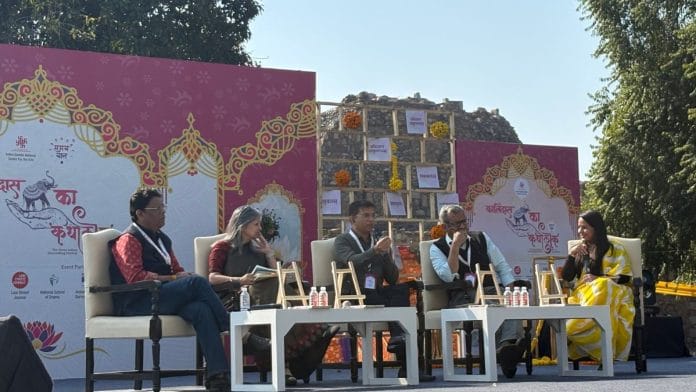



New Delhi: Goa DGP Alok Kumar has finally brought his poems together in a book, which was launched at Purana Qila during the cultural festival Kalidas ka Kathalok in New Delhi on 8 February 2026. It took him three decades.
“There is no explosion in the poet. Things are spreading slowly in it. And the things that are spreading, they are getting words slowly,” said Pawan Kumar at the launch of Kumar’s book Sanjhe Lamhon Ki Mehak, during a panel discussion moderated by Priyanka Sharma and featuring Kumar, Tanuja Thakur Khalkho, Joint Secretary & Financial Advisor, Ministry of Rural Development, and Pawan Kumar, IAS.
The event, held as part of the cultural festival Kalidas ka Katha Lok at Purana Qila, brought together voices from across the literary and art community, administration, and academic circles to celebrate the poet’s nuanced explorations of life. The gathering reflected on how poetry can emerge from the quietest experiences, shaping itself like a glacier.
The festival was inaugurated by Kapil Mishra, Minister of State for Language, Culture, and Tourism; Sachhidanand Joshi, Member Secretary of Indira Gandhi National Centre for the Arts (IGNCA); Retired Justice SN Dhingra, Founder of the cultural library Samay Yaan; Sandhya Purecha, Chairperson of Sangeet Natak Akademi; and Chittranjan Tripathi, Director of National School of Drama (NSD).
Ganga, mango blossoms & music
Akhilesh Jha, historian, filmmaker and the panellist who grew up with Alok, recounted how their hostel days in Patna by the Ganga shaped them. Jha is a 1996-batch Civil Servant and is currently posted in the Ministry of Rural Development.
“Every night, I heard the sweet music of your waves–chhap, chhap, chhap. Listening to it, I felt every note, like the birth of a distant star. As if, long ago, in a vast galaxy of open space, millions of years past, a quiet peace echoed to my ears from the deep,” Akhilesh read the poem from the book.
Pawan Kumar compared Alok Kumar’s poems to a glacier rather than a volcanic eruption. He noted that while the poems have emerged late, they have arrived at the perfect moment. He highlighted the vivid sensory imagery in Kumar’s work, centred on themes of arrival and presence, evoking the aroma of mango blossoms, the rise of spring, rain breaking long droughts, and the power of music.
Akhilesh read a poem from the book about love and separation. “Between love and people, a surprising pagdandi (trail or footpath) leads to the door on which your name is written. When the door opens, I find myself on both sides of the threshold.”
Also read: The hunt for Pataliputra—how the Mauryan capital connects Persia and Patna
Poets going digital
The discussion then shifted to contemporary trends in poetry. With social media increasingly shaping literary conversations, Tanuja Thakur Khalkho observed the new ways in which poets connect with readers.
“If you want to connect with readers, then you might have to be a part of social media. It’s a very new thing for me because I have recently started writing. But artists and poets are taking the help of social media,” she said.
Alok, however, reflected on the enduring nature of poetry that grows out of lived experience rather than trend-driven urgency. He emphasised that his work emerges organically, shaped by observation and reflection rather than the pressures of the digital marketplace.
He explained that his poems have never followed a fixed schedule or theme. Many are inspired by ordinary moments—a pair of new shoes on a jog, the sharp sound of a voice, or a fleeting observation. The essence of his poetry lies in dedication to conversation.
“Life itself, from birth to the day one returns to the ground, is a continuous dialogue. Even in silence, the universe speaks, and it is from this constant exchange that my poems arise,” he said.
(Edited by Ratan Priya)