





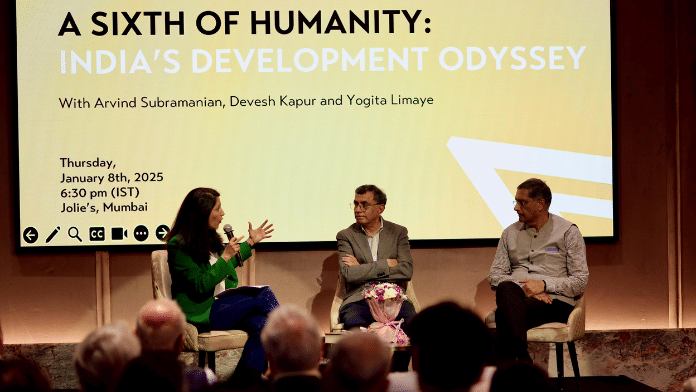



Mumbai: The Asia Society India Centre’s opening programme of 2026 offered a bracing counterpoint to India’s celebrated growth narrative. Drawing on decades of data and historical comparison, economists Arvind Subramanian and Devesh Kapur argued on Thursday, 8 January that beneath the headline numbers lies a development model marked by two enduring weaknesses: an economy that grew without generating enough jobs, and cities too institutionally weak to drive large-scale transformation.
The discussion, anchored in their book “A Sixth of Humanity: India’s Development Odyssey” published by HarperCollins India, traced India’s journey from a fragile postcolonial state to one of the world’s fastest-growing major economies. The achievement, they stressed, is real and rare. But so are the costs of what India failed to build along the way.
At its core, the authors’ argument is that India succeeded in preserving national order and macroeconomic stability yet fell short in creating the local institutions, especially cities and labour-intensive industries, needed to translate growth into broad-based prosperity. The result, they warned, is an economy with impressive aggregate outcomes but fragile foundations.
Subramanian, former chief economic advisor to the Government of India and Kapur, the Starr Foundation Professor of South Asian Studies at the Johns Hopkins University School of Advanced International Studies (SAIS), began by situating India in global history. In the mid-20th century, many newly independent nations collapsed into civil war or authoritarian rule. India did not. “India’s most under-appreciated achievement is not how much violence there has been, but how little,” Kapur said.

Subramanian added, “Historically, nation-building has been extraordinarily violent. In the United States Civil War, 2 per cent of the country’s population was killed. Applied to India, that would be 35 million people. China lost around 15 million people in the 1950s and 1960s. India avoided that scale of violence because it chose a distinctive path: democracy as the instrument of nation building, rather than a single language or religion.”
This democratic continuity, the authors argued, also delivered economic stability. “Unlike many developing countries, India avoided hyperinflation, preserving social stability. Democracy made inflation politically intolerable, forcing governments to prioritise macroeconomic order,” Subramanian said.
But the same political system that preserved order, Kapur added, failed to deliver the rule of law in everyday life. “Every decade since the 1950s, law commission reports have highlighted judicial delays. Nothing has changed. When a problem is repeatedly acknowledged but unresolved, one must ask why. It may suit sections of the political class to keep the rule of law weak, because weakness enables rent-seeking,” Subramanian claimed.
Also Read: India’s inflation figures tell a growth story, a cautiously optimistic one
Growth without transformation
The authors said that India’s growth story took off from the 1980s and accelerated after the 1991 economic reforms launched by Manmohan Singh, placing the country among the world’s fastest-growing economies for much of the past four decades. Yet, Subramanian argued that the path the country took was highly unusual and incomplete.
“You have the most successful development model, you start with agriculture, lots of people working there, then there’s an agricultural productivisition, which leads to the rise of manufacturing, especially formal manufacturing, and then you do a lot of labour-intensive manufacturing, from there you graduate into high-skilled services,” Subramanian explained.
He pointed out that that’s the model that Korea, Taiwan, Japan, and China, have adapted. “We entered a period of growth without structural transformation. The shiny roof without a foundation. India skipped manufacturing,” he said.
The consequences are clearest in employment. “Despite accounting for nearly 20 per cent of the global labour force, India holds only 3-4 per cent of global exports in low-skilled manufacturing such as textiles, apparel and footwear. That failure is fundamental,” Subramanian said. “In most developing economies, labour-intensive manufacturing has been the bridge between poverty and prosperity. In India, that bridge was never built at scale.”
“India grew very fast among the top five or six developing countries, but we had growth without structural transformation,” Kapur said.
“Even after liberalisation, India’s growth lacked structural transformation. Unlike East Asia, it failed to build labour-intensive manufacturing. The result was growth without jobs—and especially without jobs for women,” Subramanian added.
The gender impact of this omission has been particularly severe. “Labour-intensive manufacturing is female labour-intensive manufacturing,” Subramanian said, adding that by failing to expand these sectors, India missed a historic opportunity to absorb millions of women into the workforce, contributing to persistently low female labour-force participation even during periods of high GDP growth.
Also Read: Why India fell off the global middle-class map
Failing cities and states
If manufacturing is the missing engine in India’s development story, weak cities are the broken transmission. Kapur located this failure squarely in the structure of the Indian state. “India is centralised at the state level, not local,” he said, arguing that this design has systematically undermined urban capacity.
“If you look at the three largest countries in the world, the US, China, and India, the US and China have very different political regimes, but in a way, they are identical – public employment is the highest at the federal level, and very low at the state level. India is exactly the opposite,” Subramanian pointed out.
Unlike cities in many successful economies, Indian cities lack empowered mayors, predictable revenue streams and control over key public services. “This weakens cities and local public goods,” Kapur said, pointing to “chronic deficits in housing, transport, sanitation and urban infrastructure.”
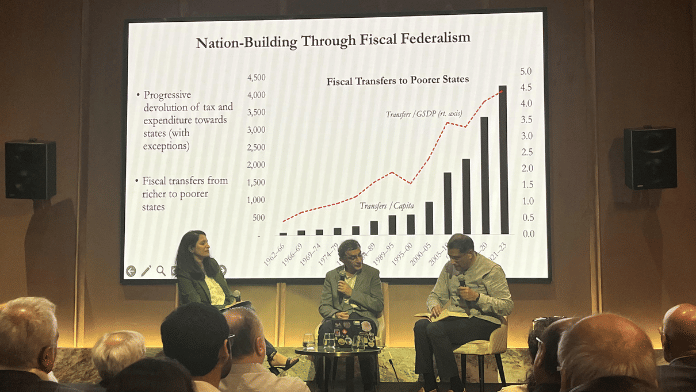
The contrast, the authors noted, is striking. India has managed macro-level order – democratic continuity, political stability and low inflation – while failing at the micro-level institutions that shape daily life. For businesses and workers, national stability does little to offset the everyday costs of dysfunctional urban governance.
Subramanian linked this directly back to the problem of jobless growth. Manufacturing clusters depend on efficient cities that can provide land, logistics, power and public services at scale. “Without strong urban governments, firms don’t scale, labour-intensive industries remain fragmented, and job creation stalls,” he said.
The book highlights an often-overlooked anomaly: in most large countries, public employment is concentrated at the federal and local levels. India is the opposite. “India is highly centralised at the state level,” Subramanian said. “Local governments are weak.”
That weakness shows up precisely where growth should be concentrated. “Cities are where development happens. Yet urban India struggles with water, sanitation, traffic management and schools – that’s exactly where India underperforms,” Subramanian said.
Kapur added: “It’s about centralisation in Delhi relative to the states. The real challenge is actually the centralisation within states of tier two. India is extremely centralised at tier two, which is why, of course, India’s cities are, let’s face it, terrible, right? And we know that cities are the engines of growth in this century.”
Also Read: India has a low inflation problem. What can it do?
Fragile foundations
Taken together, the arguments challenge a comforting assumption that high growth will eventually resolve India’s employment and urban crises. The authors are sceptical that without structural change in manufacturing and governance, growth alone may deepen existing distortions.
India’s services-led success, Subramanian noted, produced global IT champions and exported high-skilled talent abroad. But it did far less for the millions with lower or mid-level skills entering the workforce each year. The absence of labour-intensive manufacturing, combined with weak cities, has left India with what Kapur described as “impressive outcomes at the top, and persistent fragility at the base.”
The warning was not pessimistic but pointed. India’s democratic survival and macroeconomic stability are historic achievements. Yet, as the discussion at the Asia Society made clear, the harder phase of development – building jobs, cities and institutions that work at scale – remains unfinished.
As Kapur put it, “India has proven it can hold together. The question now is whether it can transform.”
(Edited by Insha Jalil Waziri)