



New Delhi: A centuries-old tree spreads its branches in every direction. At its base lie coconuts and flowers, diyas flicker nearby, and red threads tied by devotees hang from its branches. Before the tree, a man bows in reverence. Scenes of tree worship are hardly uncommon in India.
But how did this practice begin? Why did trees come to be regarded as sacred and worthy of worship? And has the way Indians worship trees remained unchanged over the centuries? Naman Ahuja, Professor of Indian Art and Architecture at Jawaharlal Nehru University (JNU), New Delhi, explores these questions by tracing the history and evolution of tree worship in India.
Ahuja recently delivered a talk titled ‘Rukha, Rakha, Yakha: Foundational Evidence for Tree Worship in Indian Art’ at the India International Centre (IIC). The event was part of the curtain-raiser for this year’s IIC Experience, themed ‘Prakriti, Ecology and Existence’. It examined humanity’s evolving relationship with the natural world through the history and visual representation of tree worship in Indian art.
Ahuja began his keynote address by explaining the meaning behind the talk’s title. The three terms-Rukha, Rakha and Yakha-originate in Pali. While Rukha refers to a tree, Rakha denotes protection, and Yakha refers to the protective spirit believed to reside within trees.
“Can we just assume that trees were always regarded as being sacred and with a divine spirit that was invoked for the sake of protection? Actually, not. Definitions changed over time, and not everyone saw them as benign beings. In fact, there were many who saw them as fearsome, frightening,” said Ahuja.
The human relationship with forests, he explained, evolved alongside changing social, cultural and religious attitudes. Ahuja also examined how far back tree worship dates, and whether it originated in the Vedic tradition or drew on older, non-Vedic practices.
To trace its origins, he turned to archaeological evidence from the Harappan civilisation. Some seals appear to depict figures worshipping trees. One shows a person bowing before a figure inside a tree, with seven others standing nearby. Another features distinctive leaves alongside mythical creatures.
Ahuja also drew a comparison between the Rigveda and the Atharvaveda, pointing to their differing approaches to nature. While the Rigveda focuses on the divine powers of nature, the Atharvaveda refers to specific plants and their uses in protection and healing.
From worship to artistic tradition
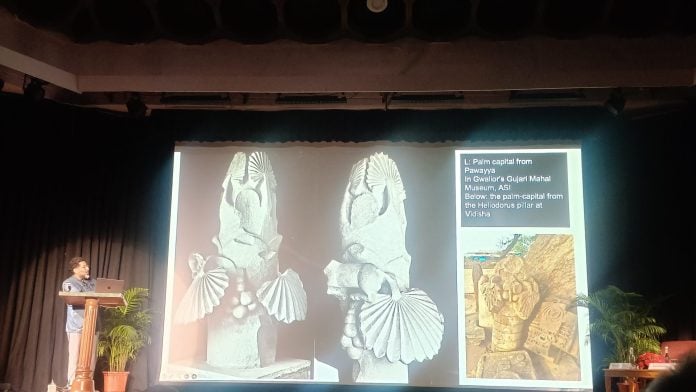
Moving beyond textual references and historical interpretations, Ahuja brought the subject to life through a collection of images depicting tree-worship sculptures, Yakshas, Yakshis and sacred tree shrines. Drawn from archaeological sites, museum collections and regions across the Indian subcontinent, the images offered a glimpse into how the practice found expression in art.
His visual presentation spanned Harappan seals and ancient reliefs at Bharhut and Sanchi, as well as sculptures from Gandhara, Bodh Gaya, Amaravati, Nagarjunakonda and other sites in the Deccan.
Ahuja also highlighted rare and lesser-known works, including unpublished sculptures and terracotta plaques, alongside photographs of living tree-worship traditions.
“It’s taken me some time to curate this set of pictures to be able to think about the images that are not just the most meaningful socially or culturally, but also images that are absolutely exquisite, where the quality of the sculpture itself is something worth beholding,” said Ahuja, as he presented sculptures of Shalabhanjika figures from Sanchi. These sculptures depict female tree spirits holding the branches of trees, reflecting the association between nature, fertility and divinity in early Buddhist art.
Ahuja explained that tree worship predated Buddhism and was gradually incorporated into different religious traditions. Ancient Vedic texts, the Mahabharata and later Puranas refer to trees as sacred beings worthy of worship.
Trees such as the Ashwattha and Udumbara were associated with fertility, prosperity and the blessing of children.
“So, this practice of tree-hugging, in which people seek the tree’s blessings and energy to conceive a child and ensure fertility, seems to have been canonised, at least in the Kalika Purana,” he added.
Tree worship also became an important part of early Buddhism through Yakshas and Yakshis, nature spirits believed to inhabit trees. Ahuja noted that Buddhism adopted these local beliefs and incorporated them into its traditions.
Over time, these spirits also became recurring figures in artistic traditions, finding expression in sculpture, architecture and poetry.
“It becomes an artistic and an aesthetic category, a system of aesthetics,” he said, describing how a nature spirit once associated with worship gradually evolved into a recognised artistic form.
A reminder of the continuity of a tradition
Ahuja then connected ancient practices of tree worship with those that survive in India today. He showed how people continue to worship old banyan and other sacred trees by offering flowers, lighting incense and tying colourful threads or chunris around their branches. The devotion has endured, even as the materials and forms of worship have changed.
Sharing a photograph of a banyan tree in southern India, he pointed out how natural flowers are increasingly being replaced by plastic ones, alongside other offerings placed at the tree.
“It is, in so many ways, a reminder of the continuity of a tradition, but now taking place in vivid plastic, rather than in big, natural flowers,” he added.
Ahuja also questioned why the active promotion of tree worship and the protection of sacred groves have become less visible today. He ended the talk by reflecting on the relevance of these ancient practices and the long-standing relationship between faith and nature.
“Such repeated celebration of trees and the casting of forests and parks as a special place, one that needed to be protected through sacralization, indicates that already 2200 years ago the society was concerned with matters of conservation and the protection of the natural environment.”
(Edited By Raunaq Lekhi)