





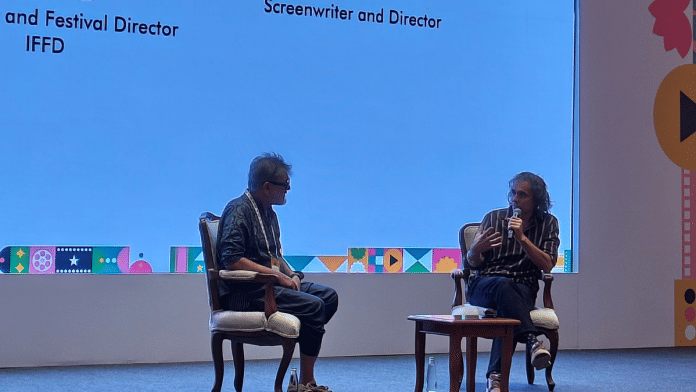



New Delhi: At the first International Film Festival Delhi, filmmaker Rakeysh Omprakash Mehra discussed the possibility of the city becoming an alternative space for cinema. Mehra, who is also the festival director, was in conversation with fellow filmmaker Imtiaz Ali.
“Delhi can become an alternate expression of cinema, not because it has the monuments, but because it is a mix of extremely serious and yet frivolous. It’s a place of extremes,” Mehra said.
Ali and Mehra were part of a panel titled “Delhi on Reel: Framing the Capital Cinema” on 31 March. The session unfolded like a conversation between long-lost friends, who finally had the chance to catch up with each other, even as a large gathering watched on.
The two stalwarts of Hindi cinema discussed their favourite songs, movies, and the integral role Delhi played in their films.
“Delhi’s biggest achievement when it comes to cinema is the way people speak here. So many characters can be drawn just because of the way they talk,” Ali remarked.
Delhi in cinema
The discussion started with Ali asking Mehra a series of questions about his films. He also asked Mehra about his legendary mysterious character of “Kala Bandar” in Delhi 6 (2009). The film, which starred Abhishek Bachchan and Sonam Kapoor, was set in Old Delhi, where Mehra was born and brought up.
“Kala bandar is the person you look at in the mirror every day. Roshan shows the mirror and tells the other characters in the film, ‘See, you’ll find your god and your Allah in here.’ At that time, we were not accepting of the fact,” he responded.
Mehra added that every morning, he looks into the mirror and has a five-minute conversation with himself, and that was how the scene was framed.
The Rang De Basanti (2006) director explained that the friend group in the film, featuring DJ (Aamir Khan ), Sonia (Soha Ali Khan), Sukhi (Sharman Joshi), Karan (Siddharth), and Aslam (Kunal Roy Kapoor) represent the different civilisations in Delhi over the centuries.
“They’re all linked in the way of a common passion and a feeling towards, a common feeling towards nationalism, which is as irrational as it was during Bhagat Singh’s time. There is an innocence and a power to that, which also signifies the innocence and power of Delhi,” said Mehra, reminiscing about the making of the movie.
When Ali asked him about the “rumour” that the Old Delhi-born Mehra would often take a flight to Delhi and spend some time getting back to Mumbai, Mehra replied in the affirmative. He talked about his favourite eating spots in Delhi, such as parathas at Moolchand, or Sardar Ka Falooda, or jalebi from Dariba Kalan.
He also shared an anecdote about often taking road trips along the Old Jaipur highway, next to the airport, at 4 am.
“At that time, the airport was not so security bound; there was just a barbed wire, and as the British Airways flight or Air India flight would be taking off, we’d run after it. That scene was used in Rang De Basanti,” Mehra added, as the audience broke into loud cheers and claps.
He shared the story of another iconic visual from the city that was used in his 2018 film Mere Pyare Prime Minister.
“I was pulling out of the film city after a late night shoot and turned towards Ram Manohar Lohia Hospital, and I saw women stand up, some pulling down their sarees, some pulling up their salwars. That formed the opening image of my film,” said Mehra.
Also Read: Money Heist fame Enrique Arce likes Indian movies—‘want to watch Zindagi Na Milegi Dobara’
From Screenplay to Music
The conversation between friends was soon opened up to the audience to make it more interactive. One audience member asked how a filmmaker can integrate a screenplay with a producer’s demands.
“You can only tell a story that is yours. No matter how much money Dhurandhar makes, if it is not your story, it will not work. The people of India will watch a movie if it is a good movie. Why you need a good screenplay is because people watch the screenplay in the form of the film,” said Ali, citing the example of Aditya Dhar’s new critically acclaimed film franchise.
The two directors also shared their views on how a director’s vision is translated on screen through the process.
“Films are written on the edit table. An editor is the closest to the director when they choose not the best shot, but one that conveys the story better.” Mehra said.
Ali’s take, however, was a different one, where he explained that the screenplay is both an organic and ongoing process that changes and evolves with each step, from filming, editing, to its final product shown in theatres.
The two also discussed some of the most popular tracks from Ali’s films, such as Rockstar (2011)
“Irshad Kamil, Mohit Chauhan, and I wrote the song ‘Phir Se Ud Chala’ together, to fit into the tune created by AR Rahman,” Ali shared. Mehra added that Rahman’s music could even create new subplots and scenes to fit the songs.
“There is no song called ‘Masakali’ or ‘Rehna Tu’ from Delhi 6 or ‘Luka Chuppi’ from Rang De Basanti. It’s AR Rahman who brings the light and makes the film look better,” Mehra said.
The session ended with an audience member asking the directors about their take on the latest discussion around “propaganda films.”
“You want filmmakers to have a political voice, but they have not earned it. They can easily say something with a loud mouth — call something propaganda or not, but they haven’t done their time in service of the people of this country to have the right to make a social comment,” Ali said.
Mehra also had a similar take on the question: “We should not misuse the soft power the people of this country have given us.”
(Edited by Insha Jalil Waziri)