








New Delhi: The topic of how history has been rewritten and the kind of approach toward it is not merely an academic complaint but a warning about the changing nature of narratives in public discourse, historians and professors said.
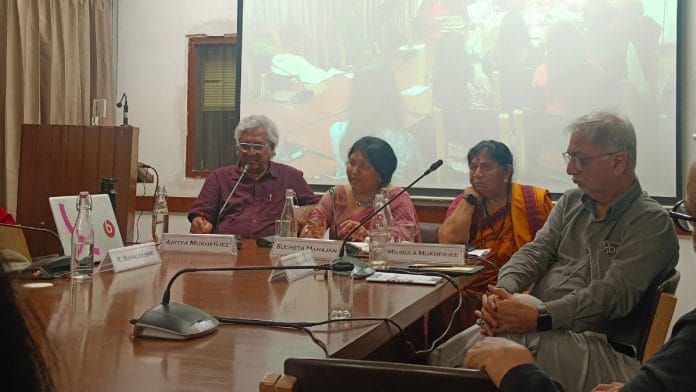
A discussion titled ‘Rewriting History: Recent Narratives of Our Past’ was held at the India International Centre on Wednesday, exploring the loopholes in the process of rewriting history. The discussion also highlighted a troubling trend—the growing influence of “non-academic history enthusiasts”, whose narratives, often driven by identity politics, are shaping public understanding.
“The vast body of what passes for history today is unrecognisable as the work of any professional historian,” said Sucheta Mahajan, the moderator of the event, and former professor of the Centre for Historical Studies, JNU.
The speakers at the event were R Mahalakshmi, professor at the Centre for Historical Studies, JNU (on the ancient period); Syed Ali Nadeem Rizavi, former secretary of the Indian History Congress and chairman and coordinator of the Centre for Advanced Studies in History at Aligarh Muslim University (on the Medieval period); and Mridula Mukherjee and Aditya Mukherjee, former Professors of JNU (on Modern History).
“None of us would argue against the idea of rewriting history—the point is, how is it being rewritten, and what is the intention behind it?” said Mahalakshmi.
Mahalakshmi’s central concern was the erosion of the distinction between facts and “factoids.” She explained that facts are “known or firmly believed to be real or true, attested by direct observation,” forming the foundation of historical inquiry. In contrast, factoids are “speculations or guesses that have been repeated so often that they are eventually taken as hard facts.”
Mahalakshmi added that the danger lies in their growing influence—not just in public discourse but also in shaping textbooks, policy, and even legal frameworks.
“Their pronouncements and so-called revisions have affected policymaking, legal judgments, school textbooks, and public perception,” she said, marking a profound shift from evidence-based history to belief-driven narratives.
Rewriting medieval history
Speaking about the medieval period, Rizavi offered a critical analysis of recent changes in history education, arguing that what is being presented as reform is, in reality, a systematic distortion.
Rizavi discussed developments since 2020, when historians began actively responding to curricular changes. At the core of his argument was the idea that these changes go far beyond simplification, with established knowledge being replaced by ideologically driven narratives.
“These changes constitute something more troubling—a pattern of erasure and insertion, the invoking of myth not mythology,” he said, adding that decades of rigorous scholarship based on archaeological evidence and nuanced understandings of medieval society are being quietly removed by the government.
He further said that the issue is not only what has been removed, but also why—highlighting how syllabi have become tools for shaping perception rather than fostering critical inquiry.
“When a syllabus becomes a site of distortion rather than education, we must ask not only what students are learning, but what they are being prevented from learning,” he said.
Through detailed examples, Rizavi showed how medieval history is being selectively rewritten—complex figures reduced to caricatures, cultural exchanges erased, and entire themes, such as social cooperation and intellectual achievements, being removed.
“All the removals, deletions, and additions add up to creating a narrative where children are fed only one version,” he added.
Also read: Satyajit Ray to Shah Rukh Khan, the art of movie posters. ‘Text has become a bully’
Political use of the past
The discussion by Aditya and Mridula focused on how modern Indian history is being used and misused for political purposes.
Aditya began by stressing the seriousness of the issue, calling it “a subject which is of critical importance for the survival of the nation itself.”
He added that history today is not just being debated but actively manipulated in dangerous ways for political use and benefits. He added that it has been used and manipulated to create conflicts between different religious groups.
“India is today witnessing the cynical use of history—it is being weaponised,” Aditya said.
Taking the discussion forward, Mridula focused on how state power has been used to reshape history. She provided examples of how this operates—through attempts to ban books, remove scholars, and exert control over institutions.
“You first put in your people, remove uncomfortable people, and then do the controlling,” said Mridula.
(Edited by Saptak Datta)