



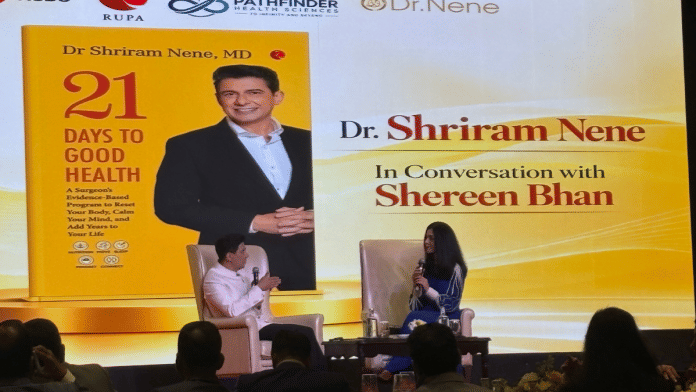
New Delhi: After nearly three decades of operating on patients and treating heart conditions, Dr Shriram Nene has turned to preventive healthcare. The cardiothoracic surgeon argued that medicine must focus on keeping people healthy long before they need an operating table.
“We would come in at the last minute with millimetres and milliseconds. We would bypass their coronaries, change their valves. And honestly, you couldn’t turn back 20, 30, 40 years of that living. We would save their lives. But I thought, what could I give my patients, who would be 40 years before they came to see me, with the idea that maybe I could just meet them over a chai instead of on the operating table?” Nene said.
That question is at the heart of Nene’s debut book, 21 Days to Good Health: A Surgeon’s Evidence-Based Program to Reset Your Body, Calm Your Mind, and Add Years to Your Life, which was launched in Delhi on 31 October. The book draws on five pillars of well-being–nutrition, movement, sleep, stress and mindset–and offers readers small daily steps towards better health.
In conversation with CNBC-TV18 managing editor Shereen Bhan, Nene spoke about preventive healthcare, the dangers of wellness fads, AI and the importance of everyday habits.
The audience included several doctors, as well as prominent figures from business, public service and the armed forces. Among those present were former NITI Aayog CEO Amitabh Kant; Admiral Dinesh K Tripathi, the 26th Chief of the Naval Staff; Dr Ambrish Mithal, chairman and head of endocrinology and diabetes at Max Healthcare; entrepreneur and angel investor Dr Ritesh Malik; and Kapish Mehra, managing director of Rupa Publications.
The basics of good health are hardly a secret, according to Nene. The challenge is finding the time and consistency to follow them. His book attempts to make that task manageable. But he, too, is careful not to promise an overnight transformation. The evening also offered a familiar picture of the struggle to practice what people already know.
As the discussion unfolded, guests mingled and chatted, while many looked forward to the dinner menu that Nene said he had personally curated to offer healthier choices.
No quick fixes
The 21-day habit rule is hardly new. Most people have heard some version of it—start small, be consistent and do not expect overnight results. Nene’s book builds on much the same premise, breaking healthy living into manageable daily tasks rather than prescribing a dramatic lifestyle overhaul.
“I tell people to move. And notice I say movement, not exercise. Why that’s important is even if you walk 15 minutes after you eat, and this is not a new thing. In 4,000 years, Shatapali is a common thing, right? You do that three times a day; it’s 45 minutes,” he said, referring to the ancient Indian tradition of walking after a meal to aid digestion.

The book discussion turned to the growing market for quick fixes, from fasting and supplements to intravenous vitamin drips and weight-loss medicines. Nene urged people to examine who was making a health claim, whether it was backed by peer-reviewed research in humans, and whether it was appropriate for them.
“Everyone’s looking for the magic bullet. The Diwali parties are coming. The weddings are coming. Everyone wants to get skinny. We’ll talk about GLPs at some point, but the bottom line is that, are they the answer? I think we need to preempt that and start the lifestyle equation first,” he said.
Nene acknowledged that GLP-1 medicines can help patients who meet the medical criteria for them, but argued that they should not replace the basics of a healthy lifestyle.
Also Read: From Nita Ambani to Sachin Tendulkar—Shriram Nene’s health book gets celebrity endorsements
Health and technology
For Nene, who is married to actor Madhuri Dixit, prevention also depends on whether people can access information, screening and medical care before their condition becomes serious.
He pointed to the uneven distribution of doctors in India, arguing that only 2.2 per cent of the country’s allopathic doctors serve rural areas. Lack of awareness and access, he said, often means that people do not recognise their risks or seek help in time.
This is where Nene sees a role for technology. Through his work in health technology, he is exploring the use of AI, electronic medical records and wearable devices to identify and assess patients at risk. But he cautioned against treating technology as a substitute for medical judgement.
“Some of the things we’re working on at Pathfinder use a combination of a cloud-based EMR with AI and wearables that identify and triage patients before they get into trouble. And in different socio-economic backgrounds we apply it in different ways, but the idea is to democratize healthcare by identifying who’s at risk when and building a path for them,” the doctor said.
AI can help identify patterns and support clinical decisions, but it cannot yet account for the full context of a patient’s life or replace the compassion involved in medical care.
Nene offered a similar caution about fitness trackers and smart rings. Their readings, he said, should be considered alongside a person’s overall health and long-term trends, rather than treated as definitive measurements.
He said that sleep needs to be treated as a priority. His advice included keeping a regular bedtime, dimming lights, switching off devices and giving the body time to wind down. He also urged people to put their phones away during meals and workouts, and to make exercise a social activity so that they are more likely to stick with it.
“But will the number of years we live be matched by the number of years we remain healthy? You don’t want to live to 100 only to spend the last 20 years bedridden and dependent on a feeding tube. To me, that is a fate worse than death. My vision was for health span to equal lifespan. And if we can achieve that, it will be a game changer,” Nene said.
(Edited by Insha Jalil Waziri)