





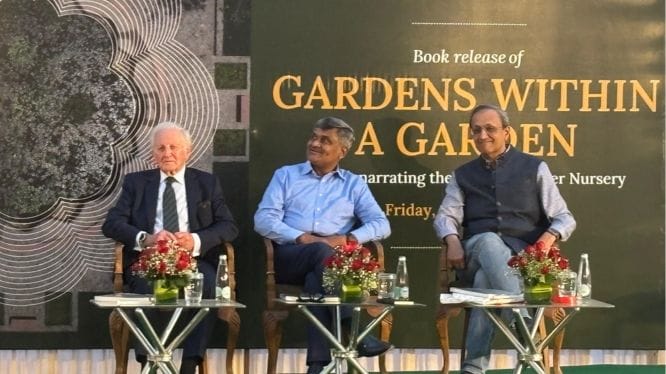


New Delhi: Early summer evenings in Delhi have a way of softening the city’s edges. At Sunder Nursery on 24 April, a slow walk along shaded pathways, the dusk chorus of birds, and cups of coffee set the mood for the launch of Gardens within a Garden — a book that traces the transformation of the historic landscape.
Organised by the Aga Khan Trust for Culture (AKTC), the event took place at the site of the proposed ‘Garden House’, a forthcoming space dedicated to tropical and desert flora, which is being developed with support from Havells India. The book, published by Mapin, was formally released by Srinivas Katikithala, Secretary, Ministry of Housing and Urban Affairs, in the presence of Anil Rai Gupta, Chairman and Managing Director of Havells India, and Luis Monreal, General Manager of AKTC.
Edited by Geeta Wahi Dua and Archana Saad Akhtar, the volume brings together multiple voices to document the restoration of Sunder Nursery’s Mughal-era ensemble of tombs, pavilions, and gardens. It also maps the site’s evolution into a public space that now draws over a million visitors annually.
Calling it a “monumental work”, Monreal emphasised the book’s role in documenting not just history but process, particularly the public-private partnerships between agencies such as the Archaeological Survey of India, the Central Public Works Department (CPWD), and municipal bodies that made the project possible.
“It traces the history of the place from very old times to the present,” he said, adding that it also serves as “a very good catalogue” of the site’s ecological diversity, appealing to those interested in heritage, ecology, and urban life alike.
Also read: A Shillong exhibition gets new funds to go big. All the art is about what they are losing
‘A great exception’
For Ratish Nanda, CEO of AKTC, the book is also intended as a guide for replication. “The idea is to share our efforts so that they can be replicated,” he said, pointing to the 15-year journey that turned Sunder Nursery into a model for urban conservation through sustained collaboration across institutions.
The book, he said, marks the conclusion of one project and the beginning of another.
Katikithala, meanwhile, described the publication as a rare and necessary exercise. “We are not very good at documentation… this is a great exception,” he said.
He congratulated the team for putting together what he called “one of those rare books” that capture both process and imagination. Reflecting on the idea of a “garden within a garden”, he added that such efforts are rooted in a deeper civilisational impulse.
“Gardens have always been at the core of our outlook. When we conceive of heaven, we imagine it as paradise, as a garden,” Katikithala said.
For Gupta, the project reflects a broader philosophy. “It’s a story not just of restoration, but of vision, collaboration and a reverence for elegance and nature,” he said, adding that initiatives like these show how “progress and preservation must move forward together.”
The evening also turned attention to what comes next. Architect Ashok B Lall spoke about the upcoming Garden House as an educational space designed around three distinct biomes. The intent, he said, is for architecture to “sit lightly” and allow flora to take centre stage, creating an immersive environment that draws visitors deeper into an understanding of nature.
Set within a garden that has itself become a benchmark for urban conservation, the launch felt less like a conclusion and more like a quiet continuation — of ideas, of landscapes, and of the many ways a city learns to renew itself.
(Edited by Aamaan Alam Khan)