





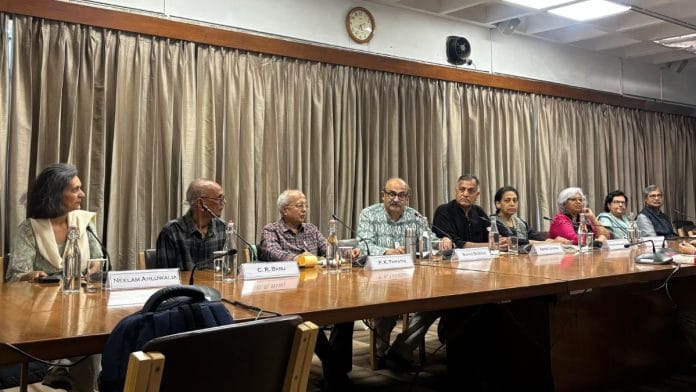


New Delhi: A mountain range older than the Himalayas, a “living defence system” for Delhi, and yet quietly, steadily eroding. That tension anchored a substantive discussion on the Aravallis at the India International Centre earlier this month, where a seminar marking 90 years of Lodhi Garden widened into a deeper reflection on the region’s ecological future.
Titled Aravalli—Sentinel of Delhi NCR Ecosystem, the evening brought together students, researchers and experts across disciplines of biology, geology, environmental policy and more for a thorough exploration of a landscape often spoken about, but rarely understood in its entirety.
Chairing the discussion, Suhas Borker, founder member of the Green Circle of Delhi, began with an anecdote tracing the origins of civic environmentalism in the capital. In 1992, he recalled, a seemingly minor decision to ban dogs from Lodhi Garden prompted a pushback that eventually led to the rule’s reversal and the formation of the Green Circle. “The trigger was very, very small,” he said, but it grew into a broader effort to adopt and conserve green areas across New Delhi as part of a heritage and ecological initiative. From there, he turned to the Aravallis, calling them “the last line,” a living defence system for the city.
Ashok Lavasa, former Union Secretary of Environment, pointed to the irony at the heart of the moment. “We are talking about the oldest mountain range being destroyed, while celebrating a flourishing garden.”
Reflecting on a lifetime spent living alongside the Aravallis, he flagged mining as one of the most exploitative pressures on the range and pointed to inconsistencies in governance. Courts that were once “staunch protectors” have gradually become “accommodative adjudicators”, signalling a broader shift in institutional response.
CP Rajendran, Professor at the National Institute of Advanced Studies, Bengaluru, followed virtually with a presentation, outlining the geological origins of the Aravalli system and the ecological services it continues to provide—from groundwater recharge to climate regulation.
That scientific framing was sharpened by Ghazala Shahabuddin, ecologist and visiting professor at Ashoka University, who described the current approach to the Aravallis as a symbol of apathy. “It’s not just about forest cover,” she said, critiquing a lingering colonial tendency to define forests narrowly. The Aravallis may not have dense canopy, but they sustain a high water table and support diverse native and rare species, many now struggling to regenerate as habitats shrink.
Also read: What are the Aravallis? The decades-long quest to define a 2-billion-year-old range
Listen to the people
CR Babu, Professor Emeritus at the Centre for Environmental Management of Degraded Ecosystems (CEMDE), University of Delhi, offered a counterpoint in possibility. Through before-and-after images of the Aravalli Biodiversity Park, he demonstrated what sustained restoration can achieve in just 20 years, transforming a degraded landscape into a thriving ecosystem. Bird species alone, he noted, have risen from around 30 to nearly 200, including some not recorded in the region for 50 to 100 years.
“Aravalli Biodiversity Park can be used as a model for restoration,” he said.
Yet, as Neelam Ahluwalia, founder member of People for Aravallis, pointed out, the view from the ground remains worrying. Drawing on her work with rural communities across the 700-kilometre range, she described the Aravallis as “extremely threatened”. The problem, she suggested, is not a lack of knowledge but a lack of listening.
“Nobody is listening to the people,” she said.
Former Chief Secretary of Delhi, PK Tripathi brought the discussion back to the question of responsibility. “We cannot sit alone thinking that the government or the courts will take care of the problem,” he said, emphasising the need for greater public awareness.
Drawing on personal experience, he recalled a time when communities were directly dependent on local ecosystems and, in turn, protected them through both necessity and cultural belief. That relationship, he argued, has since shifted. “The sacred part has gone, and the economic part has come in,” he said. While forests, he noted, can be regenerated, hills cannot, making the loss of the Aravallis irreversible.
Despite the depth of the discussion, the evening did not end in neat conclusions. Instead, it opened outwards. Questions from students, researchers and attendees carried the conversation forward, each probing a different facet of the crisis. The exchange was as engaged as it was restless, reflecting both the complexity of the issue and the urgency it demands.
(Edited by Theres Sudeep)