





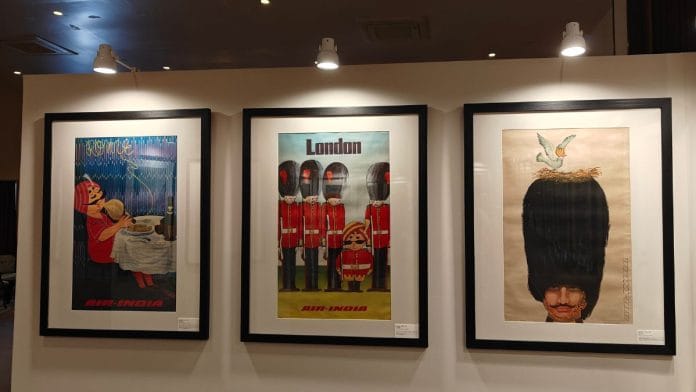



Gurugram: An Air India-commissioned poster from 1976 shows four King’s Guards looking at an impostor—the airlines’ mascot Maharaja. He is wearing a turban instead of the Buckingham Palace guards’ bearskin hats. A 1978 poster shows just the face and hat of a guard, looking up as the Maharaja flies onto a nest atop his hat, in the form of a dove. Both advertise Air India’s flights to London. Painted by VV Shetye, these are two of the 55 vintage posters on display at the Heritage Transport Museum located at Tauro, Gurugram.
On a sunny Sunday afternoon, journalists and art enthusiasts gathered for a glimpse of a collection of vintage transport posters. The exhibition marked 12 years of the museum, which was set up under a public-private collaboration by hotelier Tarun Thakral.
Titled ‘Posters That Moved India: Tourism, Travel & Transport, 1930s–1970s’, the special exhibition showcases original railway, aviation, maritime, and tourism posters collected by Thakral over a period of five years. It is on display until 28 February 2026.
“This collection offers a rare look at the visual culture that helped define India’s early travel landscape. It not only celebrates our heritage but also helps today’s audiences understand how mobility and identity evolved over the decades,” said Thakral.
Also read: The Sri Lanka story in 100 fridge magnets
Time capsules
Thakral’s passion for vintage cars led to the creation of the museum in 2013.
This collection started when he saw a poster titled ‘There is an air about Air India’, painted by SN Surti, at a Mumbai shop in 2019. The poster shows the Maharaja, atop a black elephant, surrounded by dancers and musicians. He sourced the rest of his collection from shops, auctions and even personal collections to curate the exhibition.
The aviation posters form the biggest segment of the collection. It showcases the marketing genius and creativity of Air India. While its posters promoting travel to India, shows elephants, the ones that promote travel to specific countries abroad, are a nod to their individual cultures.
One poster that promotes travel to Nairobi, has a hippopotamus with the caption, ‘Come down and see me sometime’ featuring the black animal against a bright yellow backdrop. Commissioned in 1966, the poster was painted by SN Surti. Another one from 1976 features two lions carrying a bound and tied Maharaja hanging from a pole.
Posters that show the wide network of Air India flights use a pineapple and the banana plant to showcase the Maharaja’s reach.
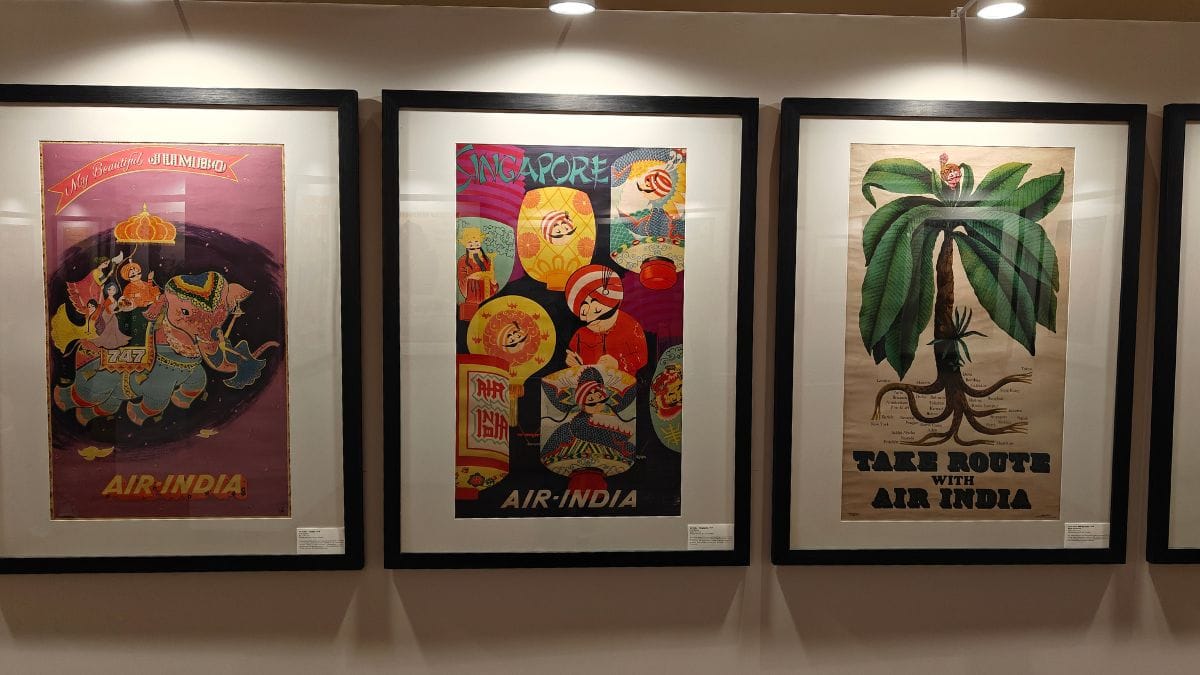
Most of the Air India posters were printed at the Prasad Process Private Limited, Madras.The 71-year-old company used to also produce movie posters, along with other printed materials.
“Every poster in this exhibition is a time capsule, inviting visitors to step back in time and experience an era that ignited the desire to travel,” said Thakral.
The posters by other airlines that were on display, be it Air France or Swiss Air, have a more minimalist approach to promote travel to India. A 1964 Swiss air poster shows the iconic 17th century monolithic Nandi on Chamundi hills in Mysore against a baby pink background. The Pan American World Airways is more elaborate and features a man from Rajasthan with his parted white beard against a green background, and a plane flying overhead. The green background has four embedded vignettes of a tiger hunt, the Taj Mahal, and glimpses of village life. The poster was printed in 1955.
Also read: Sculptor KR Nariman shrinks humans and lets the animals take over in Delhi exhibition
Travel within India
The railway posters promote diversity, as they focus on locations from Umananda Island in Guwahati to Kashmir. An ode to the many cultures, beliefs and traditions found in India, the railway posters urge people to travel the vibrant country, through its crisscrossing networks.
A 1928 poster for Great Indian Peninsula Railway by artist MV Dhurandhar shows a wedding procession, to indicate how trains were a major means of transport for massive groups traveling across cities and states for marriages.
A majority of the posters also focused on routes popular for pilgrimage, be it Chitrakoot in Madhya Pradesh or Nashik in Maharashtra. One detailed poster uses the Madurai gopuram as a map of the South Indian Railway Network, connecting temples from Tirupati to Rameshwaram.
The collection stands testimony to the new India beginning to spread its wings, travelling both within the country and abroad, with each poster an invitation to explore the world beyond their hometown.
“It’s an art that does not exist any more, because it was meant to be just put up and later torn. I wanted to build a collection to show the art form. Not everything needs to have a purpose, sometimes it’s just passion, which is validated when you see the visitor’s reactions,” said Thakral, with a smile.
(Edited by Theres Sudeep)