





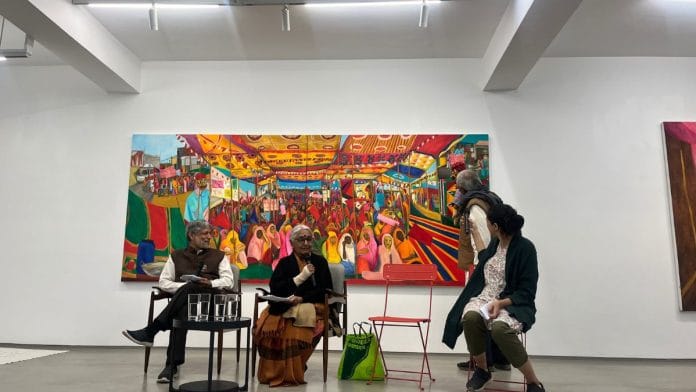



New Delhi: On a crisp Saturday morning, a vast canvas lay unfurled on the gallery floor, drawing people to sit around it as though it were a courtyard. Suspended on the wall above, a riot of orange—anger, defiance and courage leapt out in bold strokes.
Women in bright odhanis, musicians mid-stride, dust, colourful tripals, the swirl of a protest at a village fair: the painting seemed to pull viewers straight into a Rajasthani mela.The creator of the painting, titled Mazdoor Mela, a young artist called Aban Raza, looked on.
The painting shows a scene in Bhim, Rajasthan, where villagers—mostly women—gather during a Mazdoor Kisan Shakti Sangathan (MKSS) yatra to demand the Right to Information.
Activists, journalists, students, and weekend art-goers thronged the venue, Galerie Mirchandani + Steinruecke in Delhi’s Defence Colony, for the exhibition ‘Nothing Human is Alien to Me’ on 29 November. For a moment, the gallery felt like a small public square.
“We have seen very meaningful paintings in black and white that mostly show how there are no colours in a person’s life who is struggling,” a visitor commented on Raza’s artwork.
The artist had the perfect answer for her.
“When you enter a mela in Rajasthan, you are bombarded with colour. You cannot think in black and white,” she said. The colours, Raza added, had chosen her.
For the next few hours, the modest art gallery briefly turned into a classroom. Visitors also found themselves drawn into a conversation about the Right to Information Act and, inevitably, the state of the Indian democracy.
Also read: We live in a strange democracy where the world is led by undemocratic UNSC: former Lesotho PM
Mazdoor mela of dukh & sukh
Aruna Roy, Nikhil Dey and Shankar Singh, co-founders of MKSS and key figures in India’s RTI movement, had travelled from Rajasthan for the event.
Nikhil Dey opened the conversation with a reminder, saying the RTI movement was never grey. “It was a Mazdoor Mela of dukh and sukh—of defeats, yes, but also of winning,” he said.
Raza’s artwork throbbed with the energy of collective action of a crowd gathering to demand accountability. The one aspect many noticed was the number of women in the painting, overwhelmingly populating the canvas. Women, with veils, crowded the frame, but men were barely seen. Roy explained the reason: Men don’t sit.
“The men were present there, but it was difficult to make them sit. Men don’t sit — women are the ones who settle in, wait, listen, and hold the space,” Roy said.
She pointed out another painting where the women were waiting at the bus stop.
“If you look at that painting there… It’s a big bus stand and you see women waiting, I don’t know how many hours, to catch the bus. We have all waited on that bench. And the frustration of not getting on to the bus is a metaphor for how we have not got on to democracy,” she said. “That is democracy too, We are voters, but not much more. The RTI made the vote speak.”
One of the most unexpected delights at the gallery was a puppet called Mofat, which Shankar Singh often uses to say the unsayable. Pointing at the painting, he declared, half-amused and half-stunned: “I’m looking at myself.”
Later, the conversation turned to digital personal data protection. Nikhil Dey warned that the recent amendments introduced to the Act have “slaughtered” the careful balance between privacy and public interest that RTI once held.
“You cannot even ask for a name now,” Roy added. “There will be no journalism. No research. Everything public is being redefined as personal.”
The room shifted. A morning of art-viewing suddenly carried the tension of a civic briefing.
But Roy kept bringing the conversation back to the painting. She talked about her experience in Rajasthan.
“Rajasthan taught me that colours are not merely aesthetic. It is determination.” Women there wear bright colours even in grief. “We don’t give up colour,” she said. “It is strength.”
Shankar Singh added a touch of humour, invoking Mofat, his long-time puppet alter ego. He talked about the mela and what the painting represented.
“This is a fair of struggle — of sorrow, of happiness — and of the victories ordinary people have won,” he said, on a more serious note.
Before the event closed, Roy quoted German playwright Bertolt Brecht: “In the dark times, will there be singing?” Then she rewrote it gently for the room: “In the dark times, will there be painting? Yes. There will be paintings about the dark times.”
(Edited by Ratan Priya)