





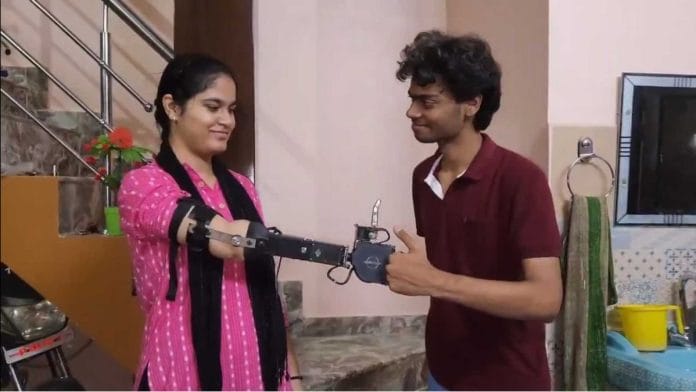



New Delhi: When Ansh Mishra was in school, he spent his birthday money not on gifts, but on building robots. Now 18, the Prayagraj–based engineering student has developed a brain–controlled robotic prosthetic hand that he says could cost a fraction of similar devices sold globally.
Mishra’s motivation traces back to Shaheen, his neighbour and friend, who lost her hand in an accident at the age of six. Fifteen years later, she still does not have a functional prosthetic.
“She did get a cosmetic hand from an NGO,” Mishra said. “But because it had no functionality, she wore it just once and never again.”
That experience stayed with him. Over a year ago, once he had both the technical skills and some savings from science competitions, he began building what he calls a more accessible alternative — a brain-controlled prosthetic hand that can respond to signals from the user’s residual limb.
The prosthetic
Robotic prosthetic hands are not new, but they remain extremely expensive and inaccessible, often ranging from Rs 5 lakh to Rs 30 lakh. Many also lack durability or sensory feedback, limiting their everyday use.
“With most prosthetics, reliability is a big issue. They break often and easily,” Mishra said. “And they don’t provide touch feedback, so it’s difficult to control them naturally.”
His prototype attempts to address these gaps. The device picks up signals from the user’s residual limb and translates them into movement. It also provides basic touch feedback and, according to Mishra, can lift up to 20 kilograms.
Crucially, it is significantly cheaper. Mishra says it costs him around Rs 40,000 to build one unit, and he expects the final product could retail for about Rs 90,000 — nearly 90 per cent less than many existing robotic prosthetics.
Much of the device is built using locally sourced materials. Steel components come from Lucknow, plastic parts are 3D-printed in-house, and the electronics and printed circuit boards are manufactured domestically. Some specialised components, such as motors, are imported.
Also read: US-based Anthropic PBC conducts the largest-ever AI study. This is what people told them
Solving the problem
A first-year BTech student at Allahabad State University, Mishra has been building machines since childhood. He traces his interest back to watching a cartoon at a friend’s house where a character’s father built robots.
“I started making things out of scrap,” he said. “Then I began asking my father for money instead of birthday gifts so I could buy components.”
Between Classes 10 and 12, he won 19 science exhibition awards, and used the prize money to fund his projects. He also received small grants and support from school alumni.
His work recently earned him the Samsung Solve for Tomorrow “Best Young Innovator” award, selected from over 20,000 applicants nationwide.
Mishra has named his venture ‘BRHM’ — derived from the Sanskrit word for ‘creator’, reflecting both his roots and ambitions. The prosthetic arm itself is called the ‘Divine Organ’.
He sees the project as part of a larger mission to close the gap in accessible technology for people with disabilities.
“If technology is only available to a few, then we are not really solving the problem,” he said. “There might be a wealthy person who can afford assistance, but someone who is the sole breadwinner cannot even do basic jobs without a functional hand.”
His long–term goal extends beyond prosthetics. Mishra hopes to build a robotics company, working first in the industry to gain experience before eventually developing advanced humanoid systems.
For now, his focus remains on refining the prosthetic hand and making it viable for real-world use — driven by the idea that technology should not be limited by affordability.
“I want to create something that brings abundance,” he said. “So that anyone who needs it can access it.”
(Edited by Aamaan Alam Khan)