



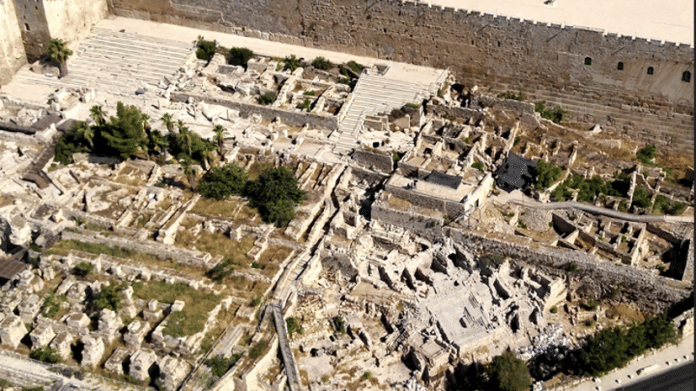
New Delhi: A monumental complex of ritual baths used by Jewish pilgrims visiting the Second Temple in Jerusalem has been uncovered at the foot of the Temple Mount, archaeologists said.
The complex, dating to the early first century CE, was unearthed near the Triple Gate, one of the principal entrances to the Temple Mount, by the Institute of Archaeology at the Hebrew University of Jerusalem. Archaeologists say its location and monumental scale indicate that it was built to accommodate the large numbers of Jewish pilgrims who came to Jerusalem and underwent ritual purification before visiting the Temple.
Professor Uzi Leibner and Prof Orit Peleg-Barkat of the Institute of Archaeology directed the excavations, which have been carried out over five seasons in the Ophel.
“A monumental ashlar structure devoted entirely to ritual purification, situated at the foot of the Temple Mount and near one of its gates, is a truly unparalleled phenomenon,” Leibner and Peleg-Barkat said.
The complex offers new insight into how the area immediately south of the Temple Mount was designed to accommodate pilgrims during the Second Temple period, and what activities and rituals took place near the Temple’s gates, the archaeologists said.
At the centre of the complex is a large plastered pool measuring approximately 12 by 9.5 metres, with steps descending into it from all four sides. Northwest of the pool is a finely built ashlar structure containing four rooms, three of which were identified as large public ritual baths, or mikva’ot.
The entire complex covers approximately 280 square metres.
What archaeologists found
The well-preserved complex includes three large ritual baths, a monumental plastered pool, a paved plaza and an extensive water system.
One of the ritual baths survives to its full height, including its vaulted stone ceiling. Archaeologists described it as a rare example in Jerusalem of a Second Temple-period structure preserved from floor to ceiling.
The baths and pool were connected to an extensive drainage system, with some channels preserved to more than two metres in height. The channels carried water from the complex towards the Kidron Valley.
Their size suggests that large volumes of water passed through the system and that the complex may have been supplied by a permanent source of running water, possibly a branch of the aqueduct that supplied the Temple during the Second Temple period.
The complex was in use until 70 CE, when Roman forces destroyed Jerusalem and the Second Temple. Dozens of coins dating to the First Jewish-Roman War were found on the floors of the complex and in the destruction debris, providing evidence of its use shortly before the destruction.
The excavations also revealed that this was not the first public purification facility built at the site.
Beneath the monumental complex, the Hebrew University team found remains of an earlier ashlar-built public complex that also included a large ritual bath. It probably dates to the first century BCE, suggesting that the area had been used for ritual purification for generations before the later complex was built.
The newly discovered baths were later covered by a Byzantine residential quarter. Archaeologists believe this helped preserve parts of the Second Temple-period complex, including the vaulted roof of one of the baths.
The excavation was conducted by the Institute of Archaeology at the Hebrew University of Jerusalem in cooperation with the Armstrong Institute of Biblical Archaeology. It was funded by the Israel Science Foundation, the Armstrong Institute and the Hertog Center for the Archaeological Study of Jerusalem.
The site is located within Jerusalem Walls National Park, which is managed by East Jerusalem Development Ltd.
(Edited by Prashant Dixit)